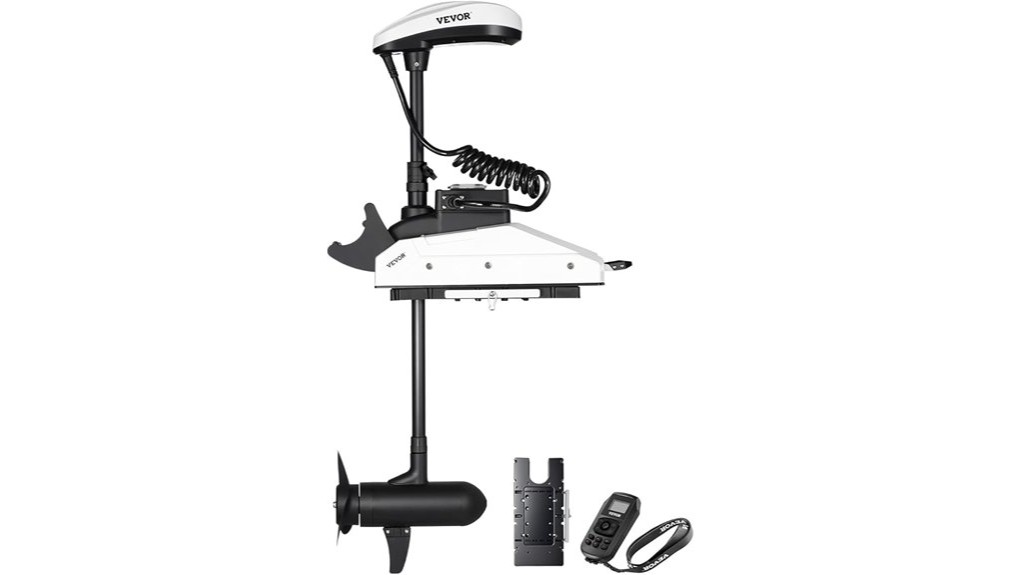
You’ll get a compact, GPS-equipped 55 lb-thrust trolling motor with a 36-inch aluminum shaft, 10 adjustable speeds, and 12/24V compatibility, suited for kayaks and small jon boats. Real-world tests show strong low-speed torque, GPS anchoring, cruise control, and reliable 2 m position accuracy; battery drain depends on speed and load so plan runtime from current vs speed curves. Installation uses a bow quick-release bracket; keep fasteners torqued and connections waterproofed for best results if you want more details.
Some Key Takeaways
- Offers up to 55 lb thrust with a 36-inch aluminum shaft, suitable for kayaks, jon boats, and light fishing craft.
- Ten adjustable speeds, cruise control, and heading-hold deliver precise speed and station-keeping performance.
- Built-in GPS (~2 m accuracy) shows tracks/waypoints, supports anchoring and remote PIN-pairing for wireless control.
- Real-world tests report good low-speed torque, GPS anchoring, and repeatable speed-vs-current behavior for planning.
- Limited by single-unit weight and 12/24V battery compatibility; consider 70–80 lb models for heavier boats.
Performance and Specs at a Glance: 55 Lb Thrust, 36 Shaft, 10 Speeds
Though compact, the VEVOR OMS150S delivers measurable performance: it generates 55 lb of thrust through a 36-inch aluminum shaft and offers 10 adjustable speed settings. You’ll evaluate thrust-to-weight ratio, shaft rigidity, and propeller design against specified 55 lb output. You can perform efficiency tuning via speed selection and battery voltage (12V or 24V) to optimize run time and torque. Use the LCD battery indicator and GPS-enabled cruise controls to quantify consumption and positioning. Conduct a noise comparison across speeds to document acoustic signature and detect cavitation or motor vibration. Data-driven checks confirm specification alignment and operational limits. Ideal setups often pair with kayak-friendly power pole accessories for improved anchoring and stability.
Real-World Speed, Torque, and Battery Life Tests on Kayaks and Small Boats
Begin testing by establishing consistent baseline conditions: use the same kayak or small boat hull, a fully charged specified battery (single 12 V or 24 V as applicable), calm water, and measured payload including operator weight and gear. You run timed trials across the 10 speeds, record GPS-verified velocity, and log current draw and voltage to compute real-time power. Measure acceleration and low-speed torque under load to evaluate thrust delivery and prop efficiency. Repeat until data shows repeatability; include long-duration discharge cycles to quantify battery degradation and usable capacity. Report speed vs current curves and time-to-empty for practical planning. Also consider testing with common accessories and gear configurations to reflect all-terrain kayak cart use and real-world launch scenarios.
GPS, Cruise Control, and Wireless Remote: How the Navigation Features Work
When you activate the OMS150S navigation suite, the built‑in GPS provides position fixes (approximately 2 m accuracy) that feed the LCD navigation display and the cruise/anchor functions, enabling route recording, auto-reset anchoring, and steady-speed holding. You’ll see recorded tracks and waypoints on the LCD; cruise control maintains selected speed by closed-loop RPM control, compensating for load changes. GPS anchoring locks position using continuous GPS fixes and heading hold; auto-reset corrects drift within programmed thresholds. The wireless remote uses secure remote pairing to link handset to motor, transmit commands, and display status; pairing follows a short PIN and confirmation routine. The system is well suited for kayak and small-boat users looking to integrate GPS speed trackers with their on-water gear.
Mounting, Installation, and Maintenance: Bow-Mount Setup and Quick-Release Tips
If you’re installing the OMS150S on your bow, plan the mount location, wiring route, and battery placement before you lift the motor into position to guarantee proper balance and clear control access. Position the quick-release bow mount so bracket alignment is parallel to the shaft, then torque fasteners to spec. Route cables away from moving parts, secure with UV-resistant ties, and waterproof connections to prevent bow corrosion in saltwater. Test remote and LCD battery indicator before finalizing. For maintenance, regularly inspect the quick-release mechanism, clean contact surfaces, apply corrosion inhibitor, and verify mounting torque and electrical continuity. Also consider using a stable anchor system to complement the motor for secure anchoring during extended stops.
Who Should Buy the OMS150S and What Alternatives to Consider
Although suited for anglers and small-boat operators who need reliable bow-mounted thrust, the OMS150S is best for users with kayaks, jon boats, or light fishing craft that require up to 55 lbs of thrust and a 36-inch shaft for shallow-to-moderate draft operation. You’ll appreciate its 10-speed range, strong low-speed torque, wireless remote and GPS anchoring if you prioritize precise station-keeping and simple installation. It’s attractive to budget buyers seeking saltwater suitability in a compact motor, but weight and single-battery voltage limit heavy-boat use. Alternatives include higher-thrust 70–80 lb models or lightweight transom electric motors depending on needs. Our store also offers compatible emergency power banks designed for paddlers to stay powered during extended trips.
Some Questions Answered
Is the Propeller Replaceable With Aftermarket Blades?
Yes. You can replace the propeller with aftermarket blades provided you verify blade compatibility with the OMS150S hub, shaft diameter, and rotation direction. For propeller customization, match pitch, diameter, and mounting spline or nut specifications to avoid cavitation or motor strain. Use corrosion-resistant materials for saltwater use and confirm balance and anti-tangling design. If unsure, consult VEVOR specs or a marine technician to make certain of safe, efficient operation and warranty compliance.
How Loud Is the Motor During Prolonged Use?
You’ll find the motor’s noise level is low to moderate during prolonged use; its acoustic signature is dominated by steady motor whine and propeller wash rather than sharp mechanical clicks. Expect consistent tonal output at cruising speeds with occasional pitch variation under load. Decibel readings depend on mounting, boat type, and battery voltage, but vibration damping and the three-blade prop reduce harsh harmonics, yielding a tolerable, continuous sound profile for fishing.
Does the Motor Include Corrosion-Resistant Coatings for Saltwater?
Yes — the motor includes saltwater proofing features. You’ll get an anodized housing on the aluminum shaft, stainless fasteners on exposed fittings, and a sacrificial anode to limit galvanic corrosion. These measures reduce electrochemical attack in salt environments, though regular rinsing and inspection are still required. You’ll want to verify anode condition periodically and replace it as needed to maintain peak corrosion protection.
Can the Remote Be Synced to Multiple Motors?
Yes — you can pair the remote to multiple motors, but pairing limits apply. You’ll need to follow each motor’s sync procedure to add the remote to its receiver. Keep setups staggered and test range, since signal interference between proximate remotes or motors can disrupt commands. Use distinct pairing sequences and maintain separation during pairing to reduce cross-pairing. Monitor the LCD indicators to confirm successful pairing and stable communication.
What Accessories Are Compatible With the Quick-Release Bracket?
You can fit common bow-mount accessories that match the quick-release bracket pattern, including quick release upgrades like reinforced plates, anti-vibration pads, and stainless-steel locking pins. Mounting adapters for fish-finders, transducer arms, rod holders, and camera mounts that use standard bolt spacing will work. Make certain adapters match the bracket’s hole pattern, thickness, and material strength. Always verify corrosion resistance for saltwater use and confirm weight ratings before installation.