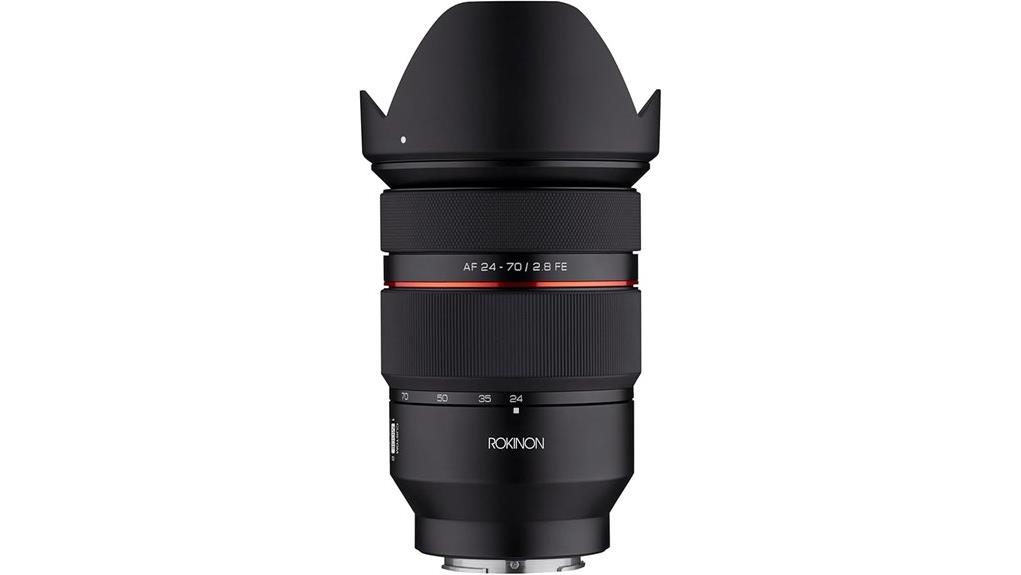
You’ll get a rugged, par‑focal 24–70mm f/2.8 that’s built for cinematic video and hybrid shooters: compact, well‑balanced, and sealed at key points with tightly damped zoom/focus rings and tactile controls. Optically it delivers strong center sharpness wide open, tightened edges by f/4–f/5.6, smooth nine‑blade bokeh, effective UMC coatings, and well‑controlled aberrations. LSM AF is fast and quiet with full manual override and optical IS for steady 4K handheld work—more technical details follow.
Some Key Takeaways
- Fast constant f/2.8 aperture with excellent center sharpness and strong micro-contrast for low-light and subject separation.
- Par-focal design, optical IS, and LSM AF suit video work with minimal zoom-focus shift and steady handheld 4K capture.
- Smooth nine-blade bokeh and well-controlled aberrations from ED/aspherical elements enhance portrait and cinematic imagery.
- Durable, balanced chassis with tactile controls, manual override, and seven-point sealing for reliable gimbal and travel use.
- Great value for Sony E/FE hybrid shooters seeking cinema-style features, though top-tier AF tracking and long-term warranty are limited.
Build and Handling: Physical Design, Weather Sealing, Controls, and Ergonomics
The Rokinon 24-70mm F2.8 feels purpose-built: its compact, durable chassis houses tightly damped zoom and focus rings that roll smoothly for both stills and cine work, and you’ll notice precise, low-friction travel that supports repeatable framing. You’ll find balanced weight distribution along the barrel, reducing front-heavy torque on gimbals and handheld rigs. Controls are logically placed: an LSM-driven AF switch, custom silent-aperture toggle, and a tactile zoom lock that prevents creep during transport or long exposures. The body is sealed at seven critical points for dust and light moisture resistance, and manual override remains immediate and predictable. Designed with traveling photographers in mind, it pairs well with rugged Pelican cases for secure transport and storage.
Optics and Image Quality: Sharpness, Bokeh, Flare Control, Coatings, and Low‑Light Performance
Having established how the lens handles and seals, let’s examine how its optical design performs across real-world shooting scenarios. You’ll find center sharpness is excellent wide open at f/2.8, with micro contrast yielding strong subject separation; edges tighten by f/4–f/5.6 though noticeable edge falloff remains at 24mm wide open. Bokeh is smooth thanks to nine blades and controlled spherical aberration, producing pleasing highlights. UMC coatings suppress flare and ghosting, improving color rendition under backlight. Chromatic aberration is well corrected by ED and aspherical elements, and low-light performance benefits from the constant f/2.8 aperture. This lens is a solid choice for photography enthusiasts seeking essential lens gear to expand their kit.
Autofocus, Stabilization, and Video Features: LSM AF Behavior, Manual Override, Par‑Focal Zoom, Optical IS, and 4K Capture Workflow
While you’re framing a moving subject or pulling focus during a take, the lens’ Linear Stepping Motor (LSM) drives fast, quiet AF with minimal hunting, and its full manual override lets you instantly fine-tune focus without switching modes. You’ll observe low LSM latency in short bursts and predictable tracking across focal range; par‑focal construction maintains focus during zooms, minimizing zoom ramping workarounds. Optical IS steadies handheld 4K capture, though you should monitor subtle focus breathing when racking. Watch for slight Aperture creep under gravity in shoulder‑up rigs; firmware updates via the Lens Station can refine LSM behavior and IS response. Our shop also recommends pairing the lens with a sturdy L‑bracket mount for optimal shooting stability.
Use Cases and Sample Results: Portraits, Landscape, Event, and Cinematic Setups
After evaluating LSM behavior, par-focal performance, and IS response, you can evaluate how the 24–70mm F2.8 performs across common shooting scenarios by focusing on measurable outcomes: edge-to-edge sharpness at key focal lengths, bokeh quality at f/2.8, stabilized handheld resolution in 4K, and autofocus repeatability under varying subject motion. For portraits and street portraits you’ll see tight mid-frame resolution at 70mm with smooth nine-blade defocus rendering; golden hour contrast holds with UMC coatings. Landscapes at 24–35mm deliver good corner detail stopped to f/8. Events and cinematic rigs benefit from par-focal stability and reliable AF tracking during sustained pans. This lens is ideal for photographers exploring wide-angle techniques and gear tailored to wide-angle lenses enthusiasts.
Buying Decision and Alternatives: Who Should Buy, Price/Value, Warranty, and Comparable 24–70mm Options
If you need a versatile, cinema-capable 24–70mm that keeps focus while zooming and delivers consistent f/2.8 performance, the Rokinon 24-70mm F2.8 AF is a strong value proposition for Sony E/FE users who prioritize video and hybrid shooting. You’ll get par-focal optics, robust ED/HR/aspherical elements, and optical stabilization at a price below flagship OEM zooms. Buy if you need cinematic functionality without flagship cost; skip if you require top-tier AF tracking for fast action. Consider budget alternatives from third-party offerings, factor the limited 1-year warranty, and verify long term support and firmware update paths. This lens is particularly well suited for enthusiasts focused on mirrorless camera systems who want cinema-style performance without flagship pricing.
Some Questions Answered
Does the Lens Support Third‑Party Lens Adapters for Non‑Sony Mounts?
Yes — you can use mount adapters to fit this Sony E/FE lens to non‑Sony bodies, but adapter compatibility varies. You’ll need high‑quality mount adapters that preserve flange focal distance and electronic contacts if you want AF and aperture control; passive mechanical adapters will allow only manual operation. Expect potential limitations in autofocus speed, stabilization, and firmware communication. Test specific camera‑adapter combinations and update lens firmware via the Rokinon Lens Station for best results.
Can Firmware Updates Add New Features or Improve AF Performance?
Yes — firmware updates can add firmware improvements and refine autofocus tuning. You’ll install updates via the optional Rokinon Lens Station, which can introduce new features, optimize the Linear Stepping Motor control, reduce hunting, and improve focus tracking and responsiveness. Updates can also adjust electronic aperture behavior and compatibility with camera bodies. You’ll need to follow Rokinon’s instructions, back up settings, and confirm firmware versions before and after updates.
Is the Lens Compatible With In‑Camera Stabilization on All Sony Bodies?
Yes — you’ll get in body stabilization support on Sony bodies with sensor compatibility for IBIS, because the lens relies on camera-side stabilization. You should confirm your camera’s IBIS implementation (2/3/5-axis) since compensation levels vary by model. The Rokinon doesn’t add lens-based stabilization, so cameras without IBIS won’t gain stabilization. Firmware updates may improve communication, but stabilization depends primarily on sensor compatibility and camera body capabilities.
What Is the Closest Focusing Distance for Macro‑Style Shots?
The closest focusing distance is 0.38 meters (38 cm) at the wide end, enabling close distance framing but not true 1:1 macro performance. You’ll get decent macro-style shots with moderate magnification suitable for crops and detail work, though not true macro reproduction. Optically, the lens balances resolving power and working distance; for higher magnification you’ll need extension tubes or a dedicated macro lens to achieve true macro performance.
Are There Recommended Cleaning Methods for the Umc-Coated Elements?
Yes — you should clean UMC-coated elements carefully. Start with a blower and microfiber brushing to remove loose dust. For smudges, use isopropyl wipes (70% IPA) or a lint-free wipe dampened sparingly, wiping in concentric motions from center outward. Avoid excessive pressure or circular scrubbing. Don’t use household cleaners or solvents. Let coatings dry fully, inspect under light, and repeat only if necessary to prevent coating damage.