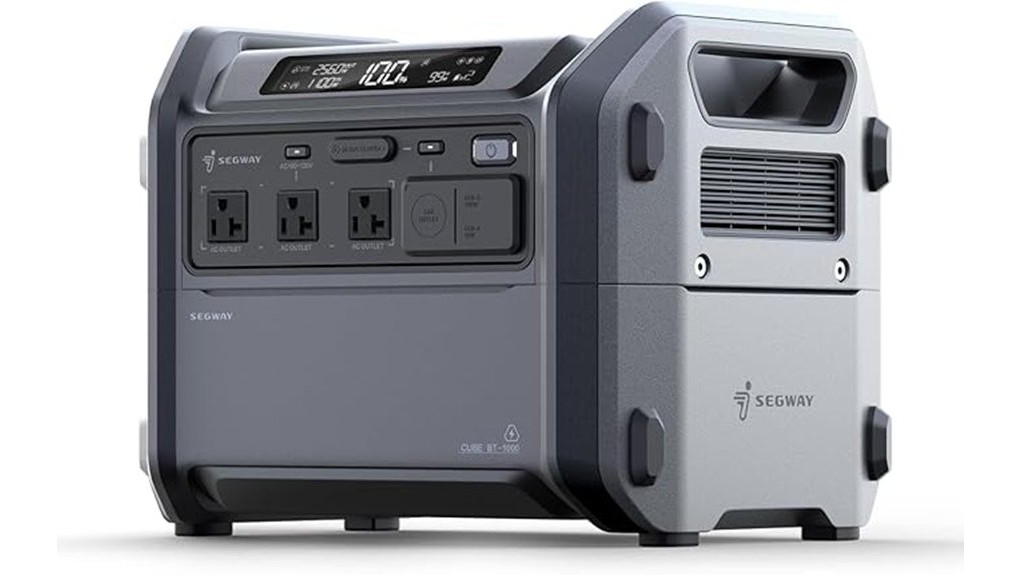
You’ll get a rugged, workhorse 1,024Wh LiFePO4 station that favors durability and expandability over ultralight portability. It puts out 2,200W continuous (4,400W bursts via R‑Drive), recharges fast in ideal sun or with R‑Drive, and should last 4,000+ cycles under sane use. Expect some AC inefficiency under partial loads and variable solar rates in real conditions. Ports and controls are practical though cramped. Keep it if reliability matters; more detail follows below.
Some Key Takeaways
- 1,024Wh LiFePO4 battery with 4,000+ cycle life and a five-year warranty suits long-term, frequent use rather than occasional outings.
- 2,200W continuous AC (4,400W R‑Drive burst) handles heavy appliances, but partial-load inefficiencies reduce real-world runtimes.
- Fast charging approaches advertised speeds in ideal sun or AC conditions; solar rates vary with angle and irradiance.
- Rugged magnesium-alloy chassis, IP56 sealing, and stackable expansion to 5 kWh make it durable and expandable for extended trips.
- Dual 100W USB‑C, multiple AC/DC outputs, and car-detect charging offer strong daily usability despite cramped port ergonomics.
Quick Verdict and Who the Cube 1000 Is Best For
While it delivers impressive power and durability, the Cube 1000 is best if you need a compact, workhorse-grade portable station rather than a lightweight weekend gadget. You’ll appreciate its compact portability, sturdy magnesium-alloy shell, and long-lived LiFePO4 cells if you prioritize reliable sustained output. Don’t expect featherweight convenience; it’s built for demanding tasks, long duty cycles, and expandable capacity. For emergency readiness it’s practical: high cycle life, IP56 protection, and multiple outputs mean you can depend on it during outages. You’ll value the five-year warranty too, but weigh size and weight against true portability needs. It’s a solid choice for campers who want to keep devices powered on extended trips.
Real-World Power and Charging Performance (AC, Solar, and R‑Drive)
You’ve seen why the Cube 1000 is built for heavy-duty use; now let’s test whether its real-world power and charging claims hold up. You’ll notice the 2200W AC (4,400W via R‑Drive) handles power-hungry tools but AC inefficiencies surface under partial loads and startup surges—expect slightly less runtime than spec sheets imply. Solar charging hits rated speeds only in peak sun; Solar variability and panel angle drop rates noticeably. R‑Drive delivers impressive peak capacity for short bursts, yet setup complexity and synchronization matter. Charging times approach the advertised rapid rates, but real conditions usually add overhead.
Battery Durability, Expandability, and Rugged Design Tested
Because the Cube 1000 pairs a LiFePO4 pack rated for over 4,000 cycles with a magnesium-alloy AM60B skeleton and IP56 sealing, you should expect long-lived performance in rough conditions—but real-world durability still demands scrutiny. You’ll appreciate stackable expandability to 5 kWh with BTX-1000 units, but inspect connector robustness and sealing after repeated swaps. Verify thermal management solutions under sustained draws; the enclosure looks sturdy but heat paths matter for long term cell health. Plan maintenance strategies: periodic visual checks, keeping vents clear, and avoiding extreme temperatures. Don’t assume toughness; validate it for your workload. Consider how battery banks perform on extended trips when planning capacity and redundancy.
Ports, Connectivity, and Daily Usability (USB‑C, Car Detect, Controls)
Durability and expandability matter only if the Cube 1000 actually fits into your daily workflow, and that’s where ports and controls either make or break the experience. You get dual 100W USB‑C ports that charge laptops fast, but USB C ergonomics feel cramped on the panel; cables compete for space. Multiple AC and DC outputs cover devices, and car battery detection smartly stabilizes recharging when you’re mobile. Buttons are tactile but small — control layout intuitiveness is mixed: power and mode are obvious, secondary functions require a manual. Overall, functionality’s solid, yet small ergonomic choices undermine day-to-day efficiency. Its focus on camping-ready high-capacity power banks aligns well with outdoor power needs.
Value, Warranty, and Final Buy Recommendation
Price-conscious buyers will want to weigh the Cube 1000’s mix of features against its cost: the 1024Wh LiFePO4 pack, 2200W output (expandable via R‑drive), rapid recharge, and stackable expansion potential push this toward premium territory, but the five-year warranty and 4,000+ cycle battery life materially lower long‑term ownership risk. You’ll get robust construction, IP56 resilience, and fast, efficient charging that justify a higher upfront price if you value reliability. Consider long term value: fewer replacements and a durable build. Extended support via five-year warranty reduces downside. Buy if durability and performance outweigh initial cost. Many campers pair power stations with solar charging gear to keep them topped up off-grid.
Some Questions Answered
Can the Cube 1000 Power a Whole-House Panel in an Outage?
No — you can’t reliably power a whole-house panel with the Cube 1000 alone. It’s great for critical loads, but its 1024Wh LiFePO4 pack and 2200W (4400W burst via R-drive) limit runtime and load capacity. You’d need a proper backup transfer arrangement or manual interlock, professional transfer switch work, and likely additional BTX-1000 expansion batteries to sustain larger circuits safely and legally. Be skeptical about DIY whole-house claims.
How Loud Is the Cube 1000 Under Heavy Load?
You’ll hear noticeable fan noise and a mild motor whine under heavy load, but it’s not deafening. Expect steady airflow whoosh around 50–55 dB at close range and a higher-pitched motor whine when the inverter ramps. You’ll find it intrusive in quiet indoor settings yet acceptable outdoors or in workshops. Don’t assume silence—plan placement away from living areas and test at typical loads before relying on it overnight.
Is the Unit Airline-Transportable Under Battery Rules?
No — you can’t take it on most flights. Airline restrictions limit transport of large LiFePO4 batteries; battery classification for the Cube 1000 (1024Wh) exceeds typical carry-on caps (usually 100–160Wh/allowed with airline approval). Even with conservative skepticism, you’ll find airlines reject or require special cargo handling and paperwork. Contact your carrier and check hazardous-goods rules; expect denial or costly special cargo arrangements rather than routine passenger transport.
Does It Support Pass-Through Charging While Powering Devices?
Yes — you can use it while charging, but don’t assume zero impact. You’ll get pass-through charging, yet continuous load during recharge can affect battery longevity through extra charge cycling and heat. Thermal management usually handles it, but prolonged simultaneous input/output may raise temperatures and trigger firmware updates or limits to protect cells. You should monitor temps and update firmware regularly to minimize accelerated wear and preserve long-term performance.
Are Expansion Batteries Hot-Swappable Without Shutdown?
Yes — you can hot swap expansion batteries without shutting the unit down, letting you maintain power while performing runtime extension. You’ll want to be cautious: follow manufacturer instructions, confirm secure mechanical and electrical connections, and avoid exposing contacts. Don’t assume every scenario is risk-free — transient spikes or connector wear can cause faults. Keep firmware updated and use only approved BTX-1000 batteries to minimize hazards and protect longevity.