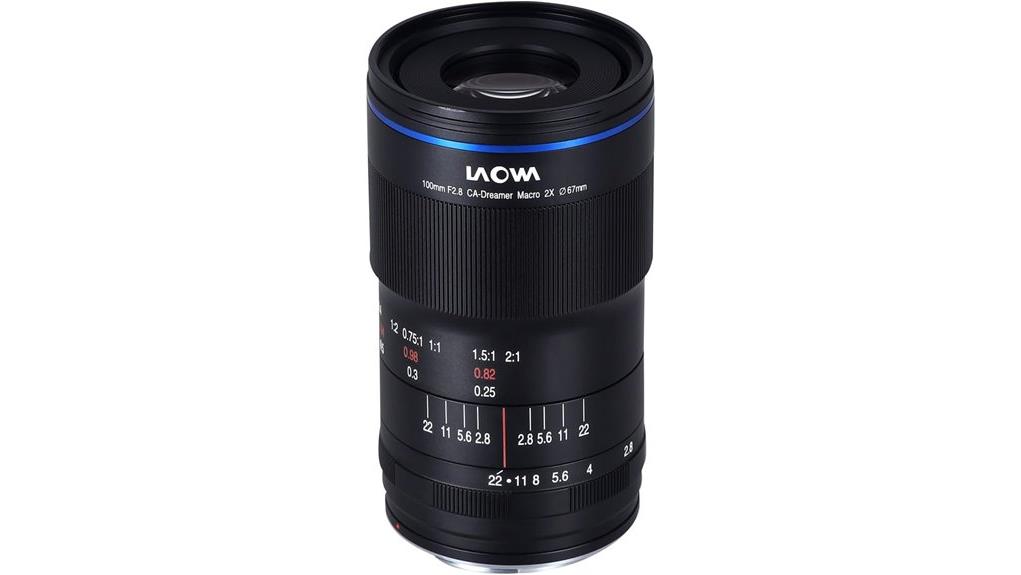
You’ll get a manual-focus 100mm macro that delivers true 2:1 reproduction with APO-corrected optics and high micro contrast for scientific and product work. It’s sharp center‑to‑edge when stopped down, suppresses chromatic aberration, and renders smooth bokeh via a 13‑blade diaphragm. Expect a long focus throw, tactile aperture control, and a ~9.7‑inch working distance suited for stacking; there’s no AF or full weather sealing. Keep going and you’ll find practical shooting and handling tips.
Some Key Takeaways
- True 2:1 reproduction macro lens delivering exceptional detail and high micro contrast for scientific and entomology work.
- APO-corrected 12-element design minimizes lateral and longitudinal chromatic aberration for accurate color fidelity.
- Excellent center sharpness wide open, with sustained edge resolution when stopped down; ideal for texture and fine structures.
- Manual focus and aperture with long focus throw suit precision stacking workflows; use a rail and tripod for best results.
- 100mm working distance (~9.72 in) is comfortable for lighting, but requires stacking and careful DOF management for usable depth.
What This Lens Is and Who Should Consider It
Meet a specialized tool: the Venus Laowa 100mm Ultra Macro is a manual-focus, 2:1 reproduction macro lens that gives you extreme close-up capability and APO-corrected optics for minimal chromatic aberration and outstanding sharpness. You’ll find it’s designed for specialty uses like entomology imaging, product detail work, and scientific documentation where magnification and color fidelity matter. Target users include macro photographers, lab technicians, and product shooters who need precise control and high-resolution capture at close distances. You’ll appreciate the manual focus and aperture control, durable yet lightweight build, and the comfortable working distance afforded by the 100mm focal length. Consider pairing this lens with extension tubes to further increase magnification for extreme macro applications.
Optical Performance: Sharpness, APO Chromatic Control, and Bokeh
Having outlined what the 100mm Ultra Macro is and who it’s for, let’s look at how it performs optically. You’ll notice excellent central resolution wide open and sustained edge sharpness stopped down slightly; the 12-element APO layout gives consistent detail across the frame. Chromatic suppression is effective—lateral and longitudinal color fringing are minimal even at high magnification—so colors remain true. Micro contrast is impressive, rendering texture and fine structures with clarity. The 13-blade diaphragm produces a pleasing bokeh rendition with smooth highlights and gradual shifts, aiding subject separation without distracting onion-ring artifacts or harsh edges. For photographers focused on close-up work, mastering macro lenses and technique can drastically improve image quality and composition mastering macro lenses.
Macro Capabilities and Working Distance: Real-World 2:1 Shooting Tips
Because the Laowa 100mm reaches a true 2:1 reproduction, you’ll need to plan for very shallow depth of field and limited working space when composing high-magnification shots. You’ll position the lens close—minimum focus ~9.72 inches—so ergonomic framing matters. Stop down and use focus stacking to extend usable DOF; automate precise rail increments and verify alignment. Control subject lighting tightly: directional, diffused light avoids hot spots and preserves contrast without blowing highlights. Use a tripod and remote release to minimize motion, and consider stacking-compatible apertures to balance diffraction versus sharpness. Anticipate tiny composition shifts; previsualize target planes for efficient capture. Choose sturdy support gear and a stable tripod head to maintain alignment when doing multi-shot stacks and precise adjustments like rail increments, since perfect tripods help ensure consistent results.
Handling, Controls, and Build for Field and Studio Use
After sorting out close-range composition and stacking strategies, you’ll appreciate how the Laowa 100mm’s physical controls and build support both careful studio workflows and mobile field use. You operate with manual focus and a manual aperture ring, which gives predictable, tactile adjustments for focus stacking and exposure ramps. The chassis is metal, lightweight at 1.4 lbs, and balances well on rails and handheld rigs. Mount tolerances are tight, and the focus throw is long enough for precise micro-adjustments. Note: there’s no full weather sealing, so you’ll protect the lens in damp field conditions despite its robust feel and reliable control layout. Consider storing the lens with custom camera foam to protect it during transport and when switching between studio and field work.
Verdict and Buying Alternatives for Macro and Portrait Shooters
While the Venus Laowa 100mm Ultra Macro impresses with its 2:1 reproduction, APO optics, and 13-blade diaphragm, you should weigh its manual-only operation and lack of weather sealing against your workflow needs; it delivers exceptional sharpness, minimal chromatic aberration, and a comfortable working distance for portraits and macro but requires deliberate technique for focus stacking and exposure control. If you prioritize ultimate detail and bokeh, it’s a strong choice. If you need autofocus, weather sealing, or faster handling, consider portrait comparisons such as native 100mm AF primes, or budget alternatives like 90–105mm third‑party macro AF lenses that trade maximum magnification for convenience. This review is aimed at readers who enjoy photography and are specifically interested in mastering zoom lenses and related techniques for better results mastering zoom lenses.
Some Questions Answered
Does This Lens Support Autofocus on Any Camera Bodies?
No — it doesn’t support autofocus; it’s manual focus only, so you’ll adjust focus by hand. You can, however, rely on focus confirmation on many camera bodies (microprism, focus peaking, or AF-confirmation dot) to verify accuracy. Because the lens offers precise manual aperture control and a long working distance, you’ll get reliable results with focus confirmation assistance. Expect to spend more time fine-tuning focus for critical macro and portrait shots.
Is Image Stabilization Built Into the Lens?
No — the lens doesn’t include optical stabilization or sensor shift. You rely on your camera body or shooting technique for stabilization. Given its manual-focus, 2:1 macro design and 100mm focal length, you’ll want a tripod, good support, or an in-body image stabilization (IBIS) camera to control shake. Its APO optics and 13-blade diaphragm optimize image quality, but stabilization must come from your camera or external gear for consistently sharp close-up results.
Can It Be Used With Extension Tubes or Teleconverters?
Yes — you can use extension tubes and teleconverters, but expect trade-offs in extension compatibility and teleconverter performance. Adding extension tubes increases magnification and reduces working distance; you’ll need to refocus and may lose light and sharpness at extreme extensions. Teleconverters can reduce effective aperture and may degrade contrast and edge sharpness despite APO optics. You’ll retain manual focus control, so test combinations to judge image quality and handling.
What Filter Thread Size Does the Front Element Have?
The front element uses a 72 mm filter thread, so you’ll screw in 72 mm filter accessories or use compatible front cap options. You’ll want slim, high-quality filters to avoid vignetting at close focus distances and 2:1 magnification. Because the lens is manual-focus with a large front element, consider using a protective front cap or a locking cap when transporting. Adapters or step-up rings can expand your filter choices without altering optical performance.
Is Weather Sealing Included for Outdoor Macro Work?
No, it isn’t fully weather sealed for outdoor macro work. You’ll find the lens is weather resistant in limited ways: it lacks a fully gasketed mount and thorough rubber protection, so you shouldn’t rely on it in heavy rain or dusty conditions. You can mitigate risk by using protective covers and careful handling; the element coating helps resist moisture and grime, but it’s not a substitute for true environmental sealing.