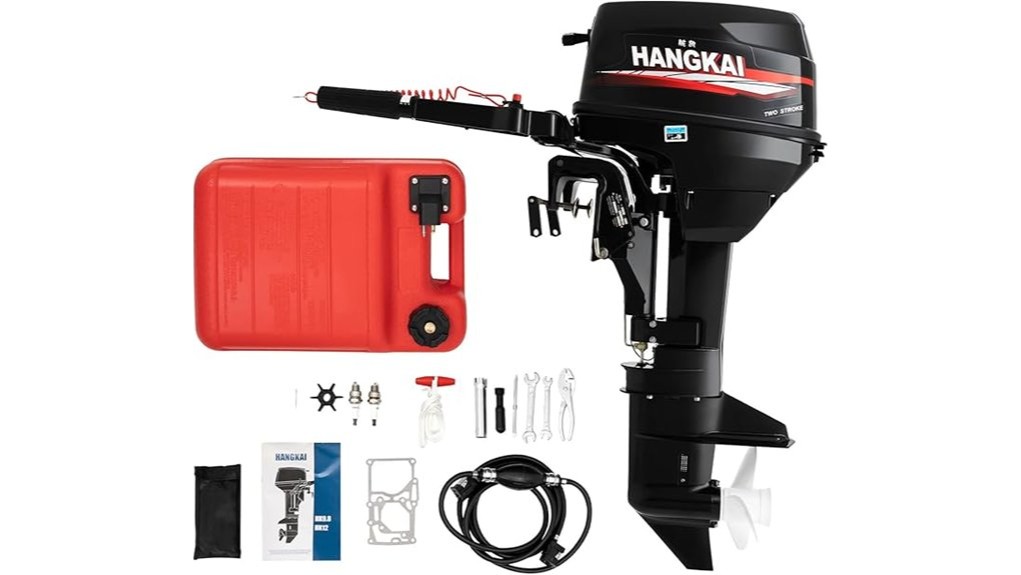
You’ll get a compact, high-thrust 12HP two-stroke outboard that’s ideal for small workboats and recreational craft up to about 19.7 ft and 661 lbs. It delivers peak power in the 4,500–5,500 RPM band, pushes light hulls near 18.6 MPH, and produces 661–1,763 lbs of thrust. It’s simple to mount with tool-free clamps, manual tilt, CDI start and a 24 L tank, but expect two-stroke emissions and moderate noise; more details follow. In addition to its user-friendly design, the VPABES 2stroke motor performance reviews highlight its impressive fuel efficiency, making it a cost-effective choice for long days on the water. Many users have reported exceptional reliability and low maintenance needs, which further enhances its appeal for both recreational and commercial use. Based on these reviews, this motor stands out as a top contender in the two-stroke outboard market. For those interested in outboard efficiency, the 4stroke hangkai outboard motor performance is commendable. It boasts lower emissions compared to traditional two-stroke models, aligning with eco-friendly practices. Additionally, its fuel efficiency ensures longer sessions on the water without frequent refueling, making it a great choice for extended trips.
Some Key Takeaways
- Compact 12HP 169cc two-stroke delivers strong thrust for small workboats and recreational craft up to ~19.7 ft and 661 lbs load.
- Peak power in the 4,500–5,500 RPM band, with top speeds near 18.6 MPH on light hulls and predictable throttle response.
- Tool-free clamping, manual tilt, and tiller controls make installation and use simple for budget-minded and beginner users.
- Water-cooling, corrosion-resistant alloys, and anti-swirl plate improve durability, cooling, and lower-unit protection.
- Trade-offs include two-stroke emissions, manual trim, limited transom compatibility, and moderate noise levels (≤78 dB).
What This 12HP 2‑Stroke Outboard Actually Is and Who It’s For
Think of this 12HP 2-stroke outboard as a compact, high-thrust propulsion package designed for small workboats and recreational craft up to about 19.7 ft and 661 lbs load. You get a 169cc two-stroke engine with simple tiller control, manual tilt and CDI ignition—straightforward systems that suit budget recreational users and beginner fishermen. Its tool-free clamping, transom mount limits, and recommended prop range make installation predictable. Cooling, silencer and anti-swirl features reduce maintenance and noise. Fuel premix and external 24 L tank demand basic handling skills, but the package emphasizes durability, ease of use and cost-effective operation. Perfect for anglers using kayaks and small boats who value reliable thrust and easy mounting, especially when paired with power pole accessories.
Real-World Performance: Power, Speed, Thrust and Fuel Use
Evaluate the 12HP two-stroke by matching its rated outputs to what you’ll actually get on the water: the 169cc engine delivers peak power in the 4,500–5,500 RPM band and produces thrust from about 661 to 1,763 lbs, which translates to top speeds near 18.6 MPH (30 km/h) on light hulls and more modest cruise speeds under load; expect real-world top speed and acceleration to vary with boat weight, prop selection (recommended 3–9 1/4 x 8”), and sea state. You’ll see good throttle response and predictable load handling; plan on about 4.5 L/hour fuel economy. Manual CDI start gives strong startup reliability; tune prop and trim for best efficiency. For paddlers and backcountry boaters who use tow systems, consider how a compact motor pairs with lightweight gear and tow lines when planning trips on lakes and coastal waters.
Mounting, Controls and Boat Compatibility Checklist
When you mount this 12HP outboard, confirm your transom meets the specified limits—height ≤44 cm (17.32 in) and thickness 2.5–4.5 cm (0.98–1.77 in)—and use the tool-free clamping system to set stern height precisely; the transom mount, manual tilt and tiller control (35 cm joystick, 15 cm handle) give you straightforward control, but you’ll want to verify clearance for the silencer cover (40 x 26 cm) and that the boat type (inflatable, iron, plastic, fiberglass, or wood) and max boat specs (≤19.7 ft, max load 661 lbs) match your application before final installation. the bitodd 12v outboard motor features an efficient design that enhances performance and fuel efficiency. Additionally, it includes a robust water cooling system that prevents overheating during extended use. With its lightweight construction, this motor is easy to transport and install, making it a top choice for boating enthusiasts.
Check transom compatibility, confirm clamp mechanism engagement and torque, position joystick placement for unobstructed reach and sightlines, and verify control ergonomics with intended operator stance. Safeguard steering arc and gear shift clearance, and test manual tilt travel without hull interference prior to first launch. Consider using a dedicated kayak cart to ease transporting the boat and engine between vehicle and launch site.
Durability, Noise, Cooling and Corrosion Resistance Tested
With the outboard properly mounted and control clearances checked, you can assess how it handles heat, noise, and harsh environments under real use. You’ll monitor cooling efficiency: water-cooling keeps operating temperature stable across 4,500–5,500 RPM and prevents hotspots that accelerate material fatigue. Noise stays ≤78 dB thanks to the silencer and reduced vibration transmission; you’ll still feel some chassis buzz at higher throttle. Inspect alloy surfaces for paint degradation and early signs of corrosion after salt exposure. Anti-swirl plate limits splash, slowing marine growth on lower unit. Rubber mounts reduce shock; routine flushing and coatings extend service life. Consider pairing your motor with reliable canisters for safe fuel storage on extended water adventures.
Bottom Line: Pros, Cons and Should You Buy This 12HP Outboard?
Although it’s compact and user-friendly, this 12HP 2-stroke outboard is best suited for small to mid-size boats where light weight, high thrust-to-weight and simple maintenance matter most. You’ll get responsive propulsion, low service complexity, and good top speed for its class; fuel consumption and manual start are trade-offs. Pros: high thrust-to-weight, corrosion-resistant alloy, anti-swirl plate, easy mounting, included tank and tool kit. Cons: two-stroke emissions, manual trim, limited transom compatibility, and moderate noise. Check warranty nuances before purchase and budget for accessory upgrades (prop, longer throttle, mounting hardware) to match your boat. Consider pairing this motor with portable power banks for longer outings and to keep electronics charged on the water.
Some Questions Answered
Is a Spare Propeller Included With the Purchase?
No, a spare propeller isn’t included. You’ll receive the standard 3-blade propeller with the outboard; spare availability isn’t listed among included accessories. You should verify prop compatibility before buying replacements: recommended range is 3–9 1/4 x 8” with rotation and gear ratio 2.08 (27:13). If you want a spare, order one separately from the manufacturer or a compatible aftermarket supplier ensuring correct diameter, pitch and hub fit.
Can This Engine Be Used in Freshwater Only, Not Saltwater?
Yes — you can use it in freshwater only. You’ll benefit from simpler corrosion prevention, but you should still follow freshwater maintenance: flush the cooling system after each use, drain fuel and fog cylinders for storage, inspect rubber parts, and keep fasteners lubricated. Even in freshwater, inspect the aluminum body regularly for pitting, replace sacrificial anodes if fitted, and follow the 25:1/50:1 premix and manufacturer maintenance schedule to guarantee longevity.
Are Replacement Parts Readily Available Locally?
Yes — you can usually source parts locally through dealer networks and aftermarket compatibility is decent. You’ll want to contact regional dealers for OEM items (prop, carb, CDI, gaskets) and check aftermarket suppliers for common wear parts. Keep the model and UPC handy to speed orders. Note some niche components may need shipping from the manufacturer, so plan lead times and confirm warranty support before purchasing.
What Tools Are in the Included Tool Kit?
The kit includes a spark plug wrench, flat screwdriver, combination wrench, pliers, spare spark plug, fuel line, small funnel, gasket set, and basic fasteners. You’ll also get a spark plug gap tool, Allen keys, ignition tools and a hose clamp. It’s aimed at routine maintenance and on-water fixes, so you won’t find specialty workshop gear but you’ll have the essentials to change plugs, adjust props and service the fuel line.
Does the Warranty Cover Commercial Use?
No, it generally won’t cover commercial use: the 2-year warranty targets consumer use and lists warranty exclusions that typically bar commercial coverage. You’ll want to check the full warranty text or contact the manufacturer to confirm specifics, because exclusions often include rental, professional, or commercial operation, excessive wear, misuse, and unauthorized repairs. If you plan commercial use, request written confirmation or a commercial-coverage addendum before operating.