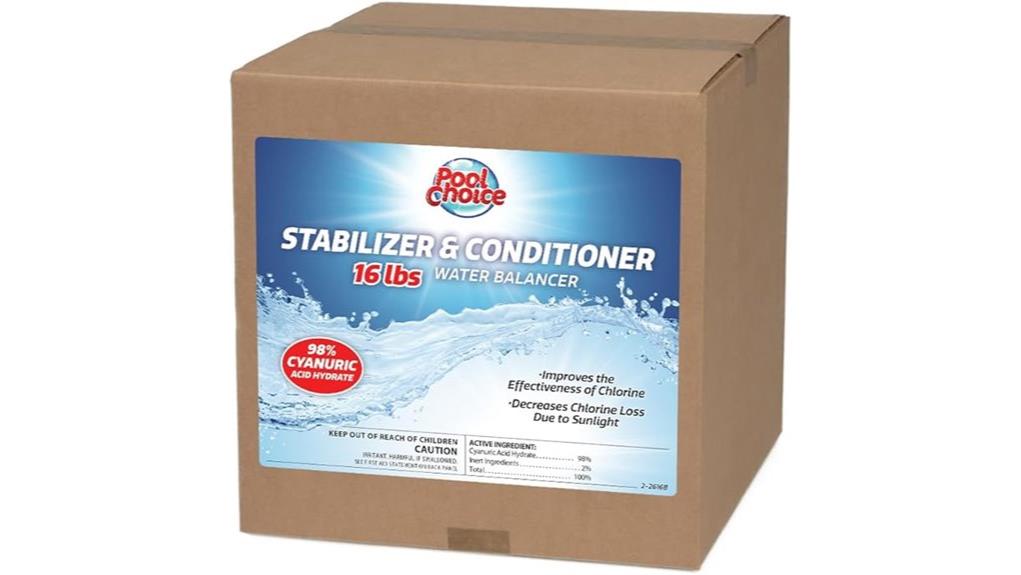
Spachoice 16-Pound Premium Pool Stabilizer is a concentrated cyanuric acid product that predictably raises CYA and slows UV-driven chlorine loss; you’ll get about a 10 ppm increase per 6 oz per 5,000 gallons when applied properly. It’s not a sanitizer substitute, so continue routine chlorine testing and dosing. Users note slow dissolution, occasional cloudiness, and surface contact concerns, so pre-dissolve or broadcast at a deep return. Keep CYA near 40–100 ppm for best results and learn more practical tips ahead.
Some Key Takeaways
- Concentrated cyanuric acid raises CYA predictably: 6 oz per 5,000 gallons ≈ +10 ppm.
- Effectively slows UV-driven chlorine loss, extending free chlorine persistence, especially in summer.
- Target CYA 40–100 ppm; start near 40 ppm and avoid exceeding 100 ppm to prevent overstabilization.
- Application can be slow to dissolve, cause temporary cloudiness, and risk localized surface contact—pre-dissolve or broadcast at deep return.
- Cost-effective per-ppm dosing with potential chlorine savings (~up to 25%), recommended for reliable CYA control.
What Spachoice Pool Stabilizer Is and Who It’s Best For
Understand Spachoice Pool Stabilizer as a concentrated cyanuric acid treatment formulated to reduce chlorine degradation from sunlight and improve sanitizer efficacy. You’ll use it when pool maintenance priorities include stabilizing free chlorine and minimizing UV-driven loss. The product supplies cyanuric acid in measured doses to raise CYA predictably, fitting target ranges typically recommended for outdoor pools. You’ll apply based on volume: precise dosing avoids over-stabilization. It’s best for owners managing outdoor, sun-exposed pools who want consistent sanitizer performance and sun protection without changing chlorination methods. It’s not a sanitizer substitute; you’ll continue routine testing and chlorine dosing.
How Spachoice Performs: Real-World Chlorine Retention and Cyanuric Acid Increase
When you apply SpaChoice as directed, its concentrated cyanuric acid reliably raises CYA levels and slows UV-driven chlorine decay, so free chlorine persists longer between doses. You’ll see in real world testing that measured CYA increases match expected increments for given volumes, producing consistent stabilization. Objective chlorine decay curves from outdoor pools show slower loss rates post-treatment, especially under high solar load. Seasonal variation alters baseline decay—summer shows larger absolute benefit—yet proportional reduction in photolysis remains consistent. You should monitor CYA to avoid exceeding target ranges, ensuring optimized chlorination efficiency without overstabilization.
Exactly How to Dose Spachoice (6 Oz → 10 Ppm per 5,000 Gal) and Safe Target Ranges
Because SpaChoice is concentrated cyanuric acid, dose calculations are straightforward: 6 ounces dissolved into a 5,000-gallon pool raises CYA by approximately 10 ppm, so scale doses proportionally to your pool volume and desired CYA increment. Use a dosage calculator or compute: (desired ppm increase ÷ 10) × (pool gallons ÷ 5,000) × 6 oz. Target CYA 40–100 ppm; start near 40 ppm and avoid exceeding 100 ppm. Follow safety precautions: wear gloves, dissolve slowly, add to circulating water. Plan application timing to avoid swimmers; include maintenance reminders in your routine testing schedule.
Pros, Cons, and Common Problems Users Report
Although SpaChoice delivers concentrated cyanuric acid that reliably raises CYA, you should weigh clear benefits against a few recurring user issues. You’ll benefit from reduced chlorine decay, predictable dosing (6 oz → 10 ppm per 5,000 gal), and stable target ranges (40–100 ppm). Downsides include slow dissolution time and potential over-stabilization if dosing isn’t tracked. Common problems users report are cloudiness after addition, particulate residue, and occasional leaching concerns when product contacts pool surfaces. Follow correct application technique: pre-dissolve or broadcast at deep return with pump running, measure CYA before and after, and avoid localized overdosing.
Is It Worth Buying? Price, Value Comparison, and Final Recommendation
Having weighed the performance characteristics and user-reported issues, you can evaluate whether SpaChoice 16‑Pound Premium Pool Stabilizer delivers acceptable value for your needs. You’ll find the unit price is competitive versus similar concentrated cyanuric acid products; a cost comparison shows lower per-ppm cost when treating typical residential volumes. Use dosing data (6 oz → 10 ppm per 5,000 gal) to model purchases precisely. If you maintain recommended 40–100 ppm, expect long term savings from reduced chlorine consumption (up to ~25%). Recommendation: buy if you need reliable cyanuric control and prefer predictable dosing economics; otherwise consider bulk alternatives.
Some Questions Answered
Can Spachoice Harm Vinyl or Fiberglass Pool Liners?
No, it shouldn’t harm vinyl or fiberglass liners when used correctly. You’ll avoid vinyl discoloration and preserve liner flexibility by dosing to target cyanuric acid levels (40–100 ppm) and following 6 oz per 5,000 gallons increments. Overdosing or uneven mixing can concentrate stabilizer locally, which might cause staining or stiffness. You should circulate thoroughly after addition, test levels regularly, and adjust to maintain recommended CYA to protect materials and chlorine efficacy.
Is It Safe to Use With Saltwater Chlorinators?
Yes — you can use it with saltwater chlorinators. You’ll maintain recommended cyanuric acid levels to stabilize chlorine, and the product itself doesn’t directly affect salt cell compatibility. However, you should monitor total dissolved solids and calcium to avoid scaling that can increase corrosion risk to cells and plumbing. Test cyanuric acid and cell performance regularly, follow manufacturer maintenance, and replace cells per service life to minimize corrosion risk.
How Long Does a Single Application Remain Effective?
A single application remains effective for several weeks to months, depending on sunlight, water turnover, and splash-out; this stabilizer longevity typically means you’ll need to recheck cyanuric acid monthly. You’ll monitor CYA to maintain the 40–100 ppm target and adjust dosage when levels drop. Application frequency is driven by measured CYA decline; if you lose more than ~10 ppm per month, you’ll increase how often you dose to preserve protection.
Can I Add It While the Pump Is Off?
You shouldn’t add directly while the pump is off; do not pour concentrated cyanuric acid into a static pool. Wait post circulation: run the pump and filter for at least several hours after dissolving the product in a bucket of pool water and broadcasting it slowly around return jets. This guarantees uniform distribution, prevents local high concentrations, and avoids liner or equipment damage. Follow label dosing and measure cyanuric acid after 24 hours to confirm levels.
Does It Affect Pool pH or Alkalinity Readings?
No, it won’t directly change pH or total alkalinity readings; cyanuric acid is not a pH adjuster. You’ll still monitor for pH drift because indirect buffer interaction can occur: CYA complexes with free chlorine and slightly alters carbonate system behavior, which may modestly affect apparent pH stability. Continue routine testing and adjust alkalinity/pH with appropriate chemicals if you observe drift; dosage calculations remain focused on achieving target CYA ppm.