You’ll find the Sony ILCE-7M3K/B a7 III delivers pro-grade 24.2MP image quality with about 15 stops of dynamic range, reliable 5-axis IBIS for handheld low-light work, and fast Hybrid AF with 693 phase-detection points covering ~93% of the frame. It shoots 4K with full pixel readout, 10 fps bursts with deep buffers, dual card slots, long battery life, and useful kit lenses—keep going and you’ll get detailed notes on performance, pros, cons, and buying advice.
Some Key Takeaways
- Sony a7 III delivers pro-grade 24.2MP image quality with ~15-stop dynamic range and excellent low-light performance to ISO 51200.
- Fast Hybrid AF with 693 phase-detect and 425 contrast points covers ~93% of the frame and excels at eye and subject tracking.
- Reliable 5-axis IBIS and 10 fps burst shooting enable handheld low-light work and sustained tracking for action sequences.
- 4K full-pixel readout gives crisp video with minimal rolling shutter, suitable for heavy color grading and professional workflows.
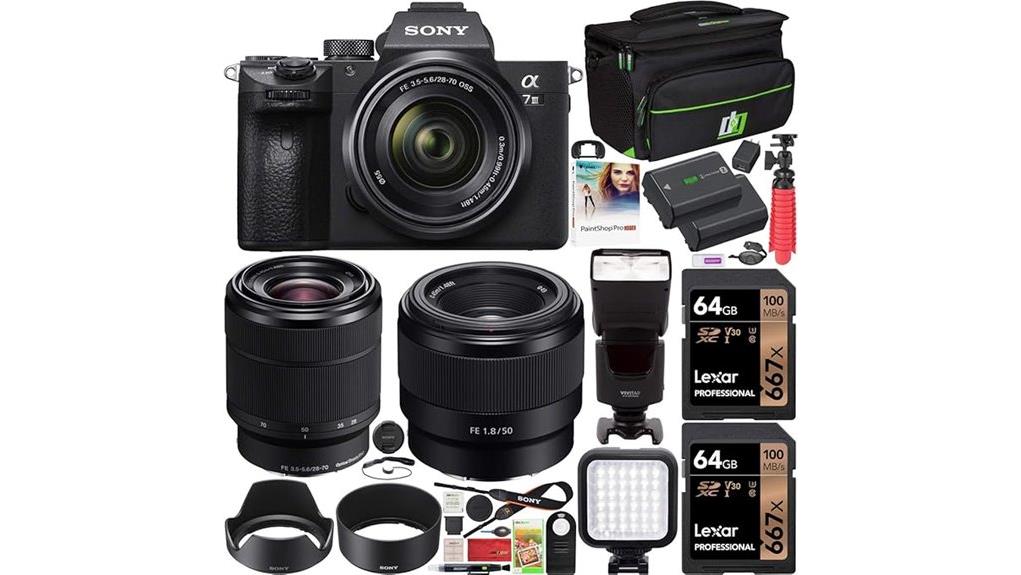
- ILCE-7M3K/B bundle adds a 50mm f/1.8, 28–70mm kit zoom, dual cards, extra battery, and accessories for immediate shooting readiness.
Quick Verdict: Who the a7 III Kit Is Best For
While the a7 III kit appeals broadly, it's especially well suited for enthusiast photographers and hybrid shooters who need pro-grade image quality, reliable AF, and versatile video in a compact package. You’ll find its high-resolution full-frame sensor, extensive AF coverage, and 5-axis IBIS especially productive for portrait photographers and wedding shooters who demand consistency across variable conditions. The dual card slots, long battery life, and robust autofocus tracking let you work confidently during long events. The bundled 50mm f/1.8 gives a fast portrait option, while the kit zoom adds walkaround flexibility—efficient, dependable, and workflow-oriented. If you shoot mirrorless often, consider stocking up on essential accessories for mirrorless systems like extra batteries and lens options to get the most from your setup.
Image, ISO and Video Performance in Real-World Use
Having covered who benefits most from the a7 III kit, let’s look at how its sensor, ISO handling, and video features perform in real shooting conditions. You’ll find the 24.2MP BSI sensor delivers clean files with about 15-stop dynamic range, preserving highlights and shadow detail for aggressive color grading. Native ISO is usable to 51200 in practice; low light shots retain texture with manageable noise and detail. 4K with full pixel readout yields crisp footage and minimal rolling shutter compared with competitors, though fast pans reveal some skew. Overall, images and video offer professional latitude for post-production work. For photographers serious about color accuracy, consider integrating color calibration into your workflow to ensure consistent results across devices.
Autofocus, Stabilization and Shooting Speed Tested
Test the a7 III's autofocus and stabilization and you'll find a system built for speed and reliability: the Fast Hybrid AF combines 693 phase-detection with 425 contrast-detection points to cover roughly 93% of the frame, delivering rapid subject acquisition and consistent tracking even at wide apertures or in mixed lighting. You’ll notice phase detection yields instant locks, eye tracking AF maintains focus on moving subjects, and AF/AE keeps exposure steady during sequences. The 5-axis IBIS shows strong stabilization effectiveness handheld, letting you shoot slower shutters. Burst performance reaches 10 fps with reliable tracking and deep buffer management for sustained shooting. For accessories that improve handling and stability, consider pairing it with a sturdy tripod head designed specifically for tripod heads to maximize support and versatility.
What’s in the ILCE-7M3K/B Bundle and Why It Matters
Plunge into the ILCE-7M3K/B bundle and you'll find a thoughtfully assembled kit that equips you for pro-level photo and video work straight out of the box. You get the a7 III body with full Sony USA warranty, SEL2870 kit zoom, SEL50F18F prime, NP-FZ100 battery plus replacement, dual Lexar 64GB UHS-3 cards, charger, cables, and dual media-slot support. Extras—tripod, LED light, Vivitar flash, remote, bag, protectors, cleaning tools, and software—extend functionality immediately. Evaluating bundle contents shows clear practical value: reduced initial spend, immediate workflow readiness, and accessory quality that complements the camera’s sensor, stabilization, and connectivity. Field monitors and other on-set tools can further enhance framing and exposure with the a7 III’s capabilities, making them essential for serious shooters targeting pro results with field monitor essentials.
Buy or Skip? Pricing, Alternatives and Final Buying Advice
Now that you know what the ILCE-7M3K/B bundle includes and why those components matter, let’s assess whether it represents a smart purchase for your needs. You’ll get a proven 24.2MP a7 III with solid IBIS, robust AF, dual slots and useful extras—good value if price aligns with your budget. Compare with budget alternatives like used a7 II bodies or APS-C mirrorless for lower cost. Factor warranty, included lenses, and strong resale value when upgrading. Buy if you need full-frame reliability, video capability, and accessories ready out of the box; skip if cost-constrained or favor newer specs. Consider protecting your gear in a dedicated Pelican case to keep the camera and accessories safe during travel.
Some Questions Answered
Does the Camera Include an International Warranty or Only Sony USA Coverage?
It only includes Sony USA coverage; it’s not an international warranty. You should expect warranty service through Sony USA, though Sony’s global service centers can sometimes provide paid repairs or assistance outside the U.S. You’ll want to confirm cross-border support and potential fees before travel. For warranty-covered repairs, you’ll need U.S.-authorized paperwork and proof of purchase; global service centers may help, but they won’t substitute for the Sony USA warranty terms.
How Long Does the NP-FZ100 Battery Typically Last per Charge?
You’ll get roughly 600–710 shots per charge in CIPA testing; real world runtime varies. With mixed use (stills, some 4K video, AF, IBIS) expect about 400–600 shots or 1.5–2.5 hours of active shooting. Battery life shortens with heavy video, flash or constant AF. Carry a spare NP-FZ100 for extended shoots; using power-saving settings, airplane mode and EVF over LCD will extend real world runtime.
Are the Included SD Cards UHS-II or UHS-I Compatible?
The included cards are Lexar Professional 667x 64GB UHS I cards; they’re UHS I cards, not native UHS II. You’ll get solid performance for most photo and 4K video tasks, but the camera’s dual slots are UHS-II compatible, so you can upgrade later to UHS II cards to exploit higher write/read speeds. If you need maximum burst buffering or fastest offload, choose true UHS II media for best results.
Can the SEL2870 Kit Lens Be Used for Video Without Noticeable Focus Breathing?
No — you’ll notice some focus breathing with the SEL2870 during video, especially when racking focus; it isn’t optimized to eliminate focal plane shift. You can minimize its impact by shooting wide, locking focus, or using manual focus and small aperture. Also watch for zoom creep on inclines or when pointing down; use a lens collar or rubber band to stabilize the zoom ring. For critical work, consider a cine or parfocal lens.
Is In-Body Stabilization Effective With Adapted Vintage Lenses?
Yes — you’ll get meaningful stabilization with adapted vintage lenses, but expect adaptation performance to vary. The a7III’s 5-axis IBIS compensates for pitch, yaw, roll and shift, reducing shake across focal lengths, yet stabilization limitations appear with very long focal lengths, heavy adapters, or lenses lacking accurate flange alignment. You should test each lens/adaptor combo for micro‑jitter and AF/AE behavior; use shorter exposures and mechanical support when needed.