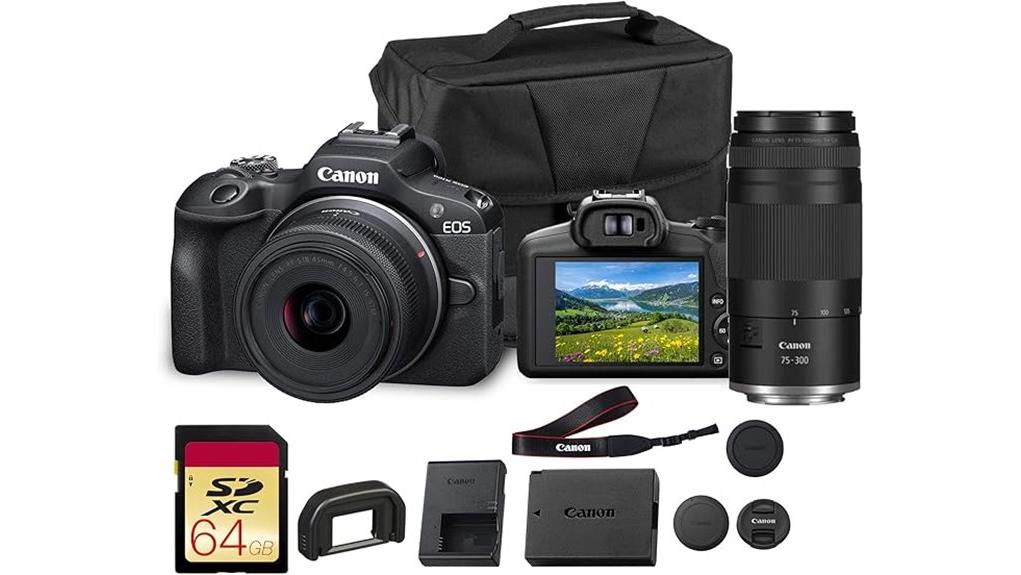
You’ll get a lightweight Canon EOS R100 kit with a 24.2MP APS‑C sensor, DIGIC 8 processor, Dual Pixel CMOS AF and 4K video with reliable low‑latency autofocus. The RF‑S 18–45mm covers everyday and vlogging with optical IS and good edge sharpness, while the RF 75‑300mm gives tele reach at the cost of slower apertures and some softness at long ends. Battery life limits long 4K sessions, but expandability via RF mount keeps upgrade paths open — more specifics follow.
Some Key Takeaways
- Lightweight R100 kit pairs a 24.2MP APS‑C body with RF‑S 18–45mm and RF 75–300mm lenses for versatile shooting.
- Strong Dual Pixel CMOS AF with 121 points and DIGIC 8 delivers reliable subject acquisition and smooth low‑latency 4K video autofocus.
- RF‑S 18–45mm offers edge‑to‑edge sharpness and optical IS for landscapes, vlogging, and everyday use.
- RF 75–300mm provides useful telephoto reach and subject isolation but shows slower apertures, softer resolving power, and chromatic aberration.
- Good value for beginners and travelers—compact, lens‑expandable system with limited low‑light performance and no weather sealing.
What the Canon EOS R100 Double‑Lens Kit Includes and Who It’s For
While compact and travel‑friendly, the Canon EOS R100 double‑lens kit gives you a complete starter system: the mirrorless R100 body, RF‑S 18–45mm f/4.5–6.3 IS STM for wide to standard shooting, RF 75–300mm f/4–5.6 for telephoto reach, LP‑E17 battery and charger, a 64 GB memory card, basic carry accessories (cover, strap, caps), and necessary cables and mounting compatibility for future RF lenses. You’ll get precise kit contents documentation and a lightweight form factor suited to entry‑level enthusiasts, travelers, vloggers and hobbyist wildlife shooters. Target users benefit from lens versatility, RF mount expandability and portable power management. This kit is ideal for those building an Essential Gear collection who want a straightforward, expandable mirrorless setup.
Real‑World Image and Video Performance: Sensor, Autofocus, and Low‑Light Tests
Because the R100 pairs a 24.2 MP APS‑C sensor with Canon's DIGIC 8 engine, you get detailed stills and clean high‑ISO performance that hold up in typical travel and enthusiast use. You’ll find usable dynamic range for highlights and midtones, with limited recovery in deep shadows at high ISOs. Dual Pixel CMOS AF delivers reliable subject acquisition; Hybrid AF and 121 points enable fast, low-latency motion tracking for people and vehicles in both stills and 4K video. Low‑light shooting to around ISO 3200 remains practical; noise reduction preserves detail but softens fine texture beyond that threshold. Keeping your gear clean with a rocket blower helps maintain sensor performance and avoids dust spots in images.
Lens Breakdown: 18–45mm Vs 75–300mm - Sharpness, Stabilization, and Use Cases
When you compare the RF‑S 18–45mm and RF 75–300mm lenses, you’ll notice they address distinct needs: the 18–45mm emphasizes edge‑to‑edge sharpness and stabilized wide‑angle versatility for travel and everyday shooting, while the 75–300mm prioritizes reach and subject isolation at the expense of aperture speed and some resolving power at long focal lengths. You’ll rely on the 18–45mm’s optical IS and better center-to-edge resolution for landscapes and vlogging gear pairing, while the 75–300mm suits wildlife and sports where focus tracking and compression matter. Expect more visible chromatic aberration and softer bokeh comparison at long telephoto ends. Mastering lens mount adapters can expand compatibility and creative options when pairing these lenses with different camera bodies, especially for adapting legacy glass and extending focal utility with mount adapters.
Handling, Controls, Battery Life, and Connectivity for Travel and Vlogging
Although compact and lightweight, the EOS R100 puts its controls and connectivity where travel shooters and vloggers can use them without fuss. You’ll find logical button placement: mode dial, record button, and quick menu reachable with one hand for run‑and‑gun shooting. The LP‑E17 is battery swappable in the field; spare cells and the supplied charger keep uptime high, though capacity limits long 4K sessions. Wi‑Fi setup is straightforward for transferring clips and remote control via smartphone. The fixed 3‑inch screen and standard tripod compatibility via a 1/4‑20 mount make mounting and monitoring simple for travel rigs. For extended outings, consider carrying spare LP‑E17 batteries and an external charger to maintain battery uptime.
Is It Worth Buying? Value, Limitations, and Who Should Choose This Kit
If you value a lightweight, easy‑to‑operate mirrorless kit for travel and casual video work, the EOS R100 offers strong practical value: it pairs a 24.2 MP APS‑C sensor and Dual Pixel AF with two versatile lenses that cover wide to telephoto needs, 4K recording, and Wi‑Fi connectivity while keeping size and cost down. You’ll get reliable autofocus, acceptable low‑light performance, and lens flexibility for most hobbies. Limitations include modest low‑light aperture, no weather sealing, and basic ergonomics. It’s a sensible buy for beginners, travelers, and vloggers; pros may prefer higher‑end bodies or budget alternatives. Resale value is fair. This kit is a good match for those building out essential gear for DSLR enthusiasts and photographers, especially when prioritizing lens flexibility.
Some Questions Answered
Does It Support In‑Camera Vertical Video Recording?
Yes — you can record vertical video in‑camera by rotating the camera to portrait orientation and using the 4K/MP4 movie mode; the EOS R100 supports vertical recording workflows. You’ll frame, focus, and record normally with Dual Pixel AF and Eye Detection active. Note the fixed 3‑inch LCD lacks a vari‑angle hinge, so composing in portrait may be less convenient; consider an external monitor or post‑rotate footage if needed.
Can I Use Third‑Party Batteries or Chargers Safely?
You can use third‑party batteries and chargers, but you shouldn’t assume full battery compatibility or charger safety. Third‑party LP‑E17 replacements often work, yet may lack firmware reporting, capacity accuracy, or protective circuits. Use reputable brands with overcharge, short‑circuit, and thermal protection, verify voltage and polarity match Canon specs, and avoid cheap no‑name units. Test cautiously and keep original Canon LP‑E17 and charger as preferred, safer defaults.
Is There Any Lens Weather Sealing or Rain Protection?
No, the kit lenses and camera body don’t offer dedicated lens sealing or rain protection. You’ll need to avoid heavy moisture and shield gear with weatherproof covers or rain sleeves for shooting in wet conditions. Use sealed third‑party housings or fully weather‑sealed RF lenses if you require persistent protection. Also keep spare silica packs, dry bags, and promptly dry contacts and mounts to reduce corrosion and electronic failure risk.
Does the Camera Accept Usb‑C Charging and Tethering?
Yes — the R100 uses a USB‑C port for power and data, but it doesn’t support in‑body USB‑C charging from all power banks or chargers; you’ll need a compatible LP‑E17 charging/USB‑C power delivery setup or the external charger. For Tethered shooting, USB‑C tethering is supported for image transfer and remote control via Canon software, though functionality can be limited compared with higher‑end models and depends on driver/software versions and cable quality.
Are Firmware Updates User‑Installable via Wi‑Fi or USB?
Yes — you can install firmware updates, but not both ways. You’ll perform wireless firmware updates via the camera’s Wi‑Fi using Canon’s app or service when supported. For usb updates, you’ll need to download firmware to a computer and transfer it to the camera’s memory card via USB or card reader; the camera itself doesn’t accept direct USB‑C firmware flashing. Follow Canon’s instructions to verify versions and complete the install.