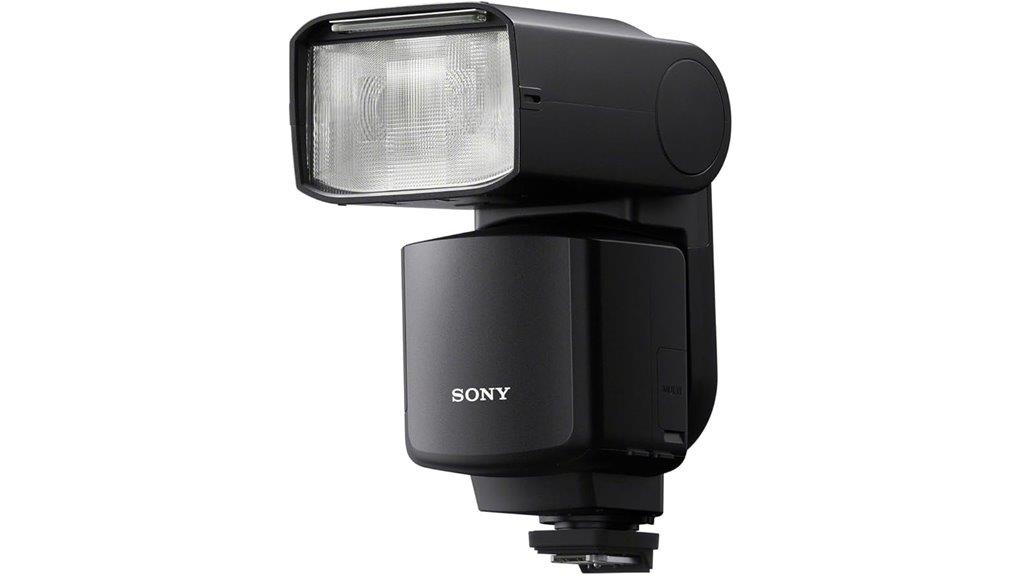
The Sony GN60 (HVL‑F60RM2) gives you GN60 output, reliable P‑TTL, and tight radio control for Alpha mirrorless bodies, plus 1/400s sync for better ambient balance. It scales output with focal length and links face detection to prioritize subjects, so exposures stay consistent. AA power keeps it travel‑friendly but brings slower recycling and thermal throttling under heavy bursts. Build and controls suit pros, and accessories cover basics — keep reading to see detailed tests and alternatives.
Some Key Takeaways
- GN60 (HVL‑F60RM2) delivers GN60 output, reliable P‑TTL, and focal‑length‑aware light for even coverage across 14–200mm.
- Built‑in Sony radio offers robust off‑camera control, master/remote roles, and negligible latency for multi‑flash setups.
- Sync up to 1/400s and usable support for camera burst rates (practical to ~10 FPS) aid ambient balance and motion control.
- Runs on AA cells with decent event endurance but slower recycling and thermal throttling during sustained high‑speed bursts.
- Solid build and intuitive controls suit pros and enthusiasts; consider Godox V1 or Profoto A1X for beam shape or battery advantages.
Quick Verdict: Is the Sony GN60 Worth Buying for Mirrorless Shooters?
While compact, the Sony GN60 (HVL‑F60RM2) delivers the power and smart control many mirrorless shooters need, and it's worth buying if you want high output, reliable radio wireless control, and tight integration with Alpha cameras. You’ll appreciate the clear value proposition: GN60 output, P‑TTL adaptability, and focal‑length optimization give flexible lighting without bulky gear. Build quality feels solid for field use, with intuitive controls and accessories that add versatility. It isn’t waterproof and uses AA cells, so plan accordingly. Overall, you get a high‑performing, well‑integrated flash that suits serious mirrorless shooters seeking consistent, controlled results. For those building a dedicated flash kit, mastering speedlight gear will help you get the most from the GN60 in a variety of shooting situations.
How the GN60 Performs: Power, Sync Speed, and Shooting Speed Testing
Test the GN60 and you’ll immediately notice its punch: the GN60 delivers strong, consistent output that handles typical portrait and event situations without maxing out on most APS-C and full‑frame mirrorless bodies. You’ll find the GN60’s GN60 rating translates to reliable exposures across 14–200mm. Flash sync at 1/400s lets you balance ambient light and flash for motion control. High speed testing shows usable burst support to the camera’s 10 FPS, though recycling slows with heavy use. Expect thermal throttling after sustained bursts on AA power; recovery times vary. Overall, power and sync are competitive for demanding shoots. Our store also offers a selection of compatible wireless flash triggers that pair well with units like the GN60.
Real-World Use: TTL Reliability, Face-Detection Communication, and Focal-Length Output
Having established the GN60's robust power, sync and burst behavior, let's look at how its TTL, face-detection linkage, and focal-length-aware output perform in real shooting. You’ll find TTL consistency strong: P-TTL adapts per-frame to shifting light without hunting. Face tracking integration is practical — the flash communicates with Alpha bodies to prioritize subjects, reducing misfires in mixed-group scenes. Focal range-aware output smartly scales light from wide panels to longer zooms, maintaining even falloff. Exposure optimization works across rapid sequences and portrait work, giving predictable fills and preserving highlights while minimizing manual tweaks. The softbox options available on the site help shape and soften the GN60’s light for flattering portrait results with controlled falloff and reduced specular highlights when used properly with softboxes.
Wireless Control, Battery Life, and Accessory Notes You Need to Know
Because Sony uses radio control, you'll get reliable off-camera triggering up to typical manual ranges without line-of-sight hassles, and the GN60 stays solid as a master or remote in multi-flash setups. You can expect consistent radio range performance across indoor shoots and short outdoor runs; latency is negligible and pairing is straightforward. Battery life with four AA cells is adequate for event work but varies by alkaline versus NiMH—bring spares for long days. Useful charge indicators on the camera and flash warn when power drops, though there's no detailed runtime readout. Included pouch, stand, and filters cover basic needs. Mastering flash trigger basics like radio triggers will help you get the most from this unit.
Who Should Buy the HVL-F60RM2 and Which Alternatives to Consider
Now that you know how the radio control and AA power affect real-world use, consider who’ll get the most from the HVL-F60RM2. You should buy it if you shoot mirrorless Sony bodies and need GN60 output, fast 1/400s sync, reliable radio triggers, and portrait lighting that benefits from focal-length-optimized output and face-detection-linked metering. Pros who travel light will like AA convenience; hobbyists will value TTL and 10 FPS support. For Backup options—or if you want more power/TTL consistency—compare Godox V1 for round-beam quality, Profoto A1X for build and battery, or Sony's prior F60RM for cost savings. Many enthusiasts also pair such flashes with flash sync cables when working in studio setups to ensure consistent triggering and backup connectivity.
Some Questions Answered
Does the GN60 Support High-Speed Sync (HSS) Beyond 1/400s?
No, it won’t support HSS beyond 1/400s; the flash’s high speed limitations cap sync at 1/400 sec. You’ll need sync workarounds for faster shutter speeds: use rear-curtain or electronic front curtain shutter modes if your camera offers them, drop to manual flash with reduced output, or employ neutral density filters to control ambient exposure. Evaluate trade-offs—these workarounds can preserve exposure but may limit flash power and recycling speed.
Can It Act as an Optical Master for Non-Radio Flashes?
No — it won’t function as an optical master for non-radio flashes. You’ll get radio wireless control and optical triggering only as a receiver in legacy setups, so legacy compatibility is limited. Use it primarily as a radio commander with Sony-compatible radio slaves. If you need an optical master to trigger older non-radio units reliably, you’ll want a dedicated optical master or a flash that explicitly supports optical master mode for full legacy compatibility.
Is There Built-In Memory for Custom Flash Profiles?
No — it doesn’t offer user-accessible internal storage for custom profiles. You can adjust exposure, zoom, and mode settings on the unit and those settings persist while batteries remain, but there’s no dedicated internal storage labeled for saved custom profiles. If you need recallable custom profiles, you’ll rely on camera-linked settings or external controllers. That makes the flash flexible in use, but limited for storing multiple bespoke custom profiles on the unit itself.
Does It Charge via USB or Support Rechargeable AAS Internally?
No — it doesn’t offer USB charging; you’ll rely on AA compatibility. The HVL‑F60RM2 requires four AA cells and doesn’t include an internal rechargeable battery or USB power-in. You can use rechargeable AA NiMH cells for better runtime and lower running cost, but you’ll need an external charger. That tradeoff keeps weight down and simple replacement possible, yet it means no on‑flash USB charging convenience or passthrough power.
Are Firmware Updates User-Installable Through the Flash Unit?
No — you can't perform firmware installation directly via the flash unit’s user interface. You’ll need to update the HVL-F60RM2 by connecting it to a compatible Sony camera or using Sony’s desktop updater where the camera mediates the transfer. This means you’ll prepare firmware files on your computer, use the camera’s user interface to apply updates to the flash, and follow Sony’s step-by-step instructions to avoid interruptions.