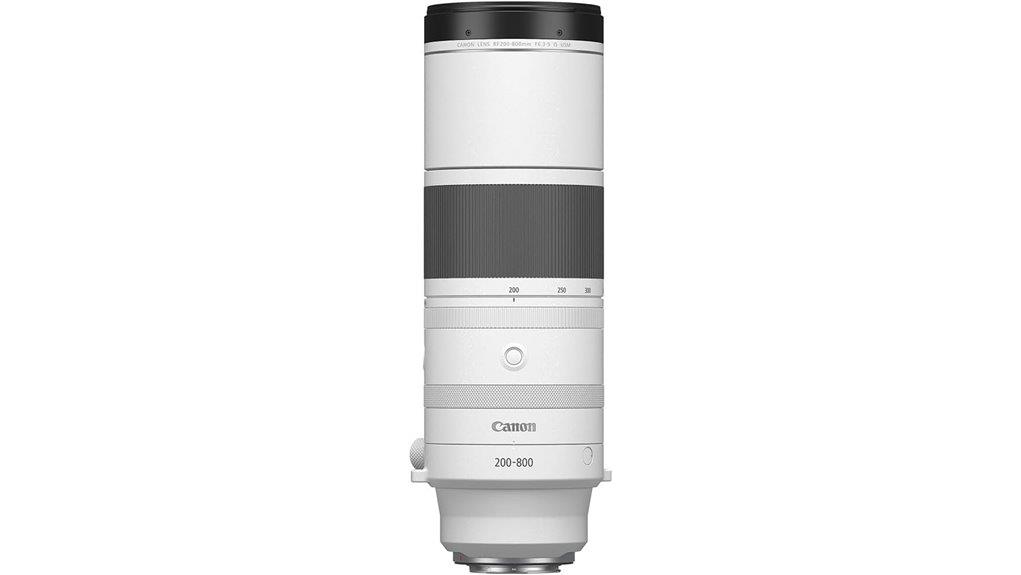
You’ll find the Canon RF200‑800mm F6.3‑9 USM a uniquely portable long‑reach zoom for wildlife, birding, and outdoor sports when you can’t haul super‑telephoto primes. It’s compact, weather‑sealed, and maintains solid center sharpness through 600mm with manageable edge softness at 800mm. AF is reliable with RF 1.4x/2x extender support across the range. You’ll trade low‑light speed and ultimate edge resolution for mobility and reach, and the full review explains practical handling, image performance, and alternatives.
Some Key Takeaways
- Exceptional 200–800mm reach in a compact, lightweight package ideal for handheld wildlife and travel shooting.
- Native RF1.4x and RF2x extender compatibility preserves AF and exposure across the zoom range.
- Center sharpness strong from 200–600mm, with noticeable edge softness and slight fringing near 800mm.
- USM autofocus is reliable for subject acquisition and tracking, though it can hunt in low-contrast scenes.
- Best value when prioritizing reach and portability over low-light speed and ultimate edge-to-edge sharpness.
Real-World Overview: Who This RF200‑800mm Is For and When to Choose It
When you need extreme reach without hauling a tripod and battery-gripping super-tele lens, the Canon RF200–800mm F6.3–9 USM answers by combining a true 800mm telephoto end with a compact, lightweight RF-mount design; it's aimed at wildlife, birding, and outdoor sports shooters who prioritize mobility and focal flexibility over the absolute speed and light-gathering of prime super-telephotos. You’ll choose it if you’re an enthusiast photographer or budget traveler needing handheld reach, long focal coverage, and reliable AF. It’s ideal for distant subjects, travel constraints, and situations where weight, versatility, and cost trade favorably against ultimate low-light performance. It complements other essential DSLR gear by offering a lightweight telephoto option for photographers focused on mobility and versatility, especially those assembling a practical lens kit.
What You Get: Key Specs, Build, Controls, and Extender Compatibility
Although it's built for reach, the RF200–800mm F6.3–9 USM keeps the essentials focused and accessible: you get a 200–800mm 4× zoom with an RF-optimized optical design, USM-driven AF, and full compatibility with Canon’s RF1.4x and RF2x extenders across the entire range, all packaged in a surprisingly compact, lightweight housing that supports comfortable handheld use. You’ll note balanced weight distribution for stable handheld framing, a robust control layout with zoom, focus, and customizable switches on the barrel, and practical lens weatherproofing seals. Extender compatibility is native, preserving AF and exposure communication without mechanical adapters. It’s an excellent choice for telephoto wildlife and sports shooters seeking reach without excessive bulk.
Image Quality and Autofocus Performance Across 200–800mm
With the handling and extender support established, let’s examine how the RF200–800mm performs optically and in autofocus across its full range. You’ll see consistent center sharpness at 200–600mm with measurable edge softening toward 800mm; sharpness variance is modest but noticeable when stopped down. Chromatic aberration is controlled by coatings and in-camera corrections, though slight fringing appears at high-contrast edges at long focal lengths. USM-driven AF delivers reliable subject acquisition and steady focus tracking on moving subjects, with occasional hunting in low contrast or dense backgrounds. Subject isolation improves with focal length and background compression, aiding separation despite the variable aperture. For photographers shooting demanding wildlife or action, pairing this lens with high-performance CFexpress cards ensures fast buffer clearing and uninterrupted burst shooting.
Handling, Weight, and Usability for Handheld Wildlife and Sports Shooting
Because Canon engineered the RF200–800mm to be unusually compact for its class, you'll find handheld shooting feasible for longer periods than with typical super-telephoto zooms. You benefit from lightweight handling that reduces shoulder and wrist fatigue during extended wildlife or outdoor sports sessions. Balance on mirrorless bodies is neutral, aiding handheld stability when tracking fast subjects. Control layout and zoom throw are predictable, letting you make quick focal changes without losing the subject. Autofocus responsiveness complements your tracking technique, though you’ll still rely on steady posture and controlled breathing to maximize sharp frames at the long end. Perfect Tripods recommends considering a compact support option like a monopod for added stability during long shoots, especially when working at the extreme telephoto range and needing portable support.
Value Judgment: Pros, Cons, Alternatives, and Final Buy Recommendation
While the RF200–800mm F6.3–9 USM targets photographers who need extreme reach without the bulk of traditional super-telephoto zooms, it delivers a clear trade-off between portability and absolute optical speed; you’ll appreciate the remarkable weight savings and usable handheld balance, yet you should expect modest low-light performance and somewhat variable sharpness at the extreme long end compared with prime super-telephotos. Pros: unmatched reach in a compact package, solid AF, extender compatibility. Cons: slow maximum aperture, edge softness at 800mm, limited low-light headroom. Alternatives: prime super-telephotos or the heavier RF100-500mm. Consider price comparison and long term durability when buying. For those shooting wildlife or action in remote locations, pairing this lens with a heavy-duty tripod can greatly improve stability and sharpness.
Some Questions Answered
Does It Have Weather Sealing for Dusty or Rainy Conditions?
Yes — it features weather sealing, so you can use it in dusty or rainy conditions with confidence. You’ll find seals at the mount and key joints; build materials durability focuses on a robust composite and metal mix that resists ingress and wear while keeping weight down. You’ll still want caution in heavy downpours or immersed environments, and regular maintenance will preserve long-term sealing performance and optical reliability.
Can It Be Used Effectively for Astrophotography?
Yes — you can use it for astrophotography, but expect limits due to its slow aperture which affects low light performance. You’ll get good reach for lunar, planetary and some deep-sky targets with extenders, but exposure times and ISO will rise. Use star trailing techniques deliberately (long exposures on a fixed mount) or a star tracker to avoid trails. Stabilize with a sturdy tripod, manual focus to infinity, and test exposures for best results.
What Minimum Focus Distance and Maximum Magnification Are Achievable?
The minimum focus distance is 0.6 m, yielding a maximum reproduction ratio of about 0.25x magnification. You’ll exploit Close up techniques to frame subjects tightly at shorter focal lengths, and you can use Focus stacking for greater depth of field when working near that 0.6 m limit. Be methodical with focus increments and stabilization, since shallow depth and optical compression at higher focal lengths demand precise control for peak sharpness.
Does It Accept Filters Directly and What Filter Size Is Required?
Yes — you can use filters, but not directly on the front element. The lens requires a specific filter adapter that mounts to the front element to accept drop-in or screw-in filters depending on the adapter type. You’ll attach the filter adapter to the lens’ front element, then install compatible filters or holder systems. This maintains optical performance while allowing polarizers, ND, or protective filters without vignetting at long focal lengths.
Is There Image Stabilization in the Lens or Reliance on Camera IBIS?
No — the lens lacks optical stabilization, so you’ll rely on camera IBIS or electronic stabilization in-body or in-camera for shake reduction. The RF200-800mm F6.3-9 USM depends on the camera’s stabilization systems; pairing with a body that offers strong IBIS or electronic stabilization is recommended for handheld work at long focal lengths. You’ll still benefit from fast AF and lightweight handling, but stabilization strategy matters critically for sharp results.