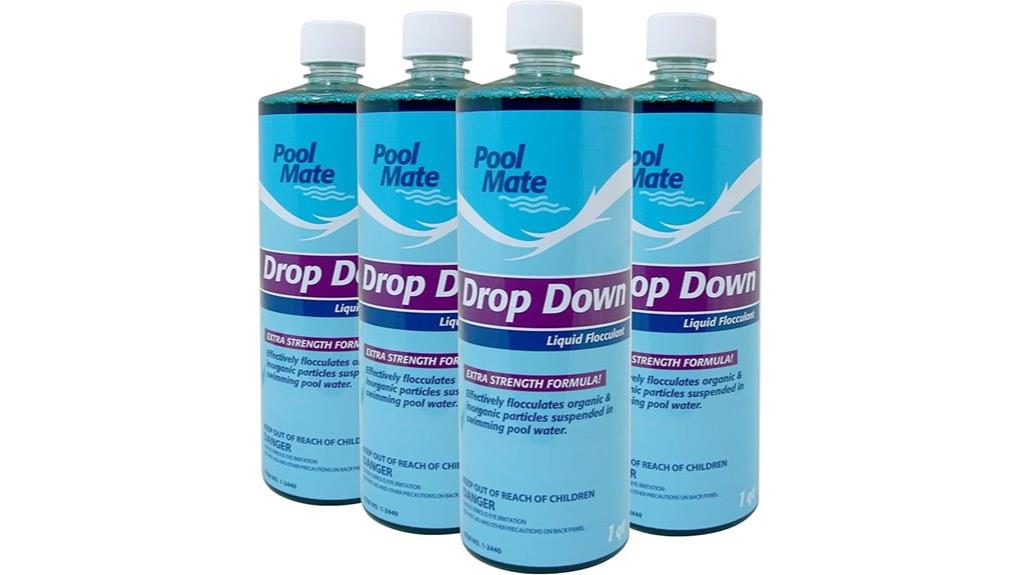
You’ll get four 1‑quart bottles of Pool Mate concentrated liquid flocculant, made in the USA and shrink‑wrapped for transit, suited for homeowners and pros tackling cloudy pools after storms or algae. It neutralizes charges and bridges particles into settleable clumps; maintenance dose is 1 oz/5,000 gal, heavy dose ~4 oz/5,000 gal with pH ≥7.2. Vacuum‑to‑waste is required and cartridge filters need element removal; keep it stored safely and learn more about cleanup and value.
Some Key Takeaways
- Four 1‑quart bottles (128 fl. oz. total) provide cost‑effective, multiple treatments for homeowners and pool pros.
- Concentrated liquid flocculant bonds colloids via charge neutralization and bridging, turning microscale debris into vacuumable floc.
- Typical effectiveness: clears mild–moderate cloudiness within 24–72 hours; heavy turbidity may require repeated dosing and vacuuming to waste.
- Dosage: maintenance 1 oz/5,000 gal; heavy 4 oz/5,000 gal; pH ≥7.2 and pump running during dispersal recommended.
- Requires vacuum‑to‑waste and filtration precautions (remove cartridge elements or bypass, monitor pressure) to avoid filter overload.
What This 4‑Pack Contains and Who It’s Best For
This 4‑pack includes four 1‑quart bottles (128 fl oz total) of Pool Mate Premium Drop Down Liquid Flocculant—each bottle labeled Model 1-2440-04/MPN 1-2440-04 (UPC 034261244040, ASIN B00IXRYO9K)—and it’s made in the USA. You get concentrated clarifier for multiple treatments, suitable for routine maintenance or clearing heavy turbidity. You’ll use vacuum attachments to remove settled sediment after treatment; cartridge, sand, or D.E. systems require specific vacuum-to-waste procedures. The pack suits homeowners, pool service pros, and seasonal storage prep before winterizing. Follow dosage and filter guidance, monitor pressure, and store sealed bottles in a cool, labeled location.
How Pool Mate Flocculant Works and When to Use It
Think of Pool Mate Liquid Flocculant as a targeted cleanup tool that grabs tiny organic and inorganic particles floating in your pool and bonds them into heavier clumps that quickly settle to the floor for vacuuming. You’ll rely on particle chemistry—charge neutralization and bridging—to aggregate colloids that resist standard filtration. The formulation alters settling dynamics so microscale debris becomes macroscale floc, reducing turbidity visibly. Use it when water is cloudy after storms, heavy bather load, or following algae treatment, and as a periodic preventative when clarity lags. It’s a focused corrective, not a substitute for routine chemical balance or filtration maintenance.
Dosage, Step‑by‑Step Application, and Filtration Cleanup
After you’ve used Pool Mate to aggregate suspended particles, follow precise dosing and cleanup steps to remove the settled floc without overloading your filter. For maintenance, dose 1 oz per 5,000 gallons; for heavy turbidity, use ~4 oz per 5,000 gallons, dispersing evenly with pump running. Test and adjust pH to ≥7.2 to avoid adverse chemical interactions. Brush surfaces, wait 24–72 hours for settling, then vacuum to waste. Cartridge filters require element removal or bypass; sand/DE systems vacuum slowly and backwash as needed. Consider seasonal timing for heavier applications during warm months and monitor filter pressure continuously.
Performance, Pros, and Cons From Real‑World Use
When you use Pool Mate Liquid Flocculant on mildly to moderately cloudy pools, it reliably gathers fine organic and inorganic particles into heavier flocs that settle within 24–72 hours, making vacuum-to-waste removal straightforward. In practice, you’ll see clear improvement after one treatment; follow-up vacuuming removes the bulk. Pros: predictable results, easy dosing, compatible with routine maintenance, and noted seasonal effectiveness when algae blooms spike. Cons: requires vacuum-to-waste capability and temporary downtime; cartridge filters need element removal for heavy jobs. Long term durability of treatment results depends on ongoing chemistry control and filtration upkeep rather than single applications.
Value, Packaging, Safety Notes, and Buying Verdict
If the flocculant’s performance fits your needs, the 4-pack offers strong value for routine maintenance and seasonally heavy use — you get four 1‑quart bottles (128 fl. oz. total) at a per‑ounce price that undercuts many single‑bottle options. Packaging is compact, clearly labeled with dosage and safety icons, and shrink‑wrapped for transit. For price comparison, factor in per‑ounce cost, shipping, and occasional returns. Safety notes: avoid contact with skin/eyes, store upright in a cool, dry, locked area away from children and pets, and follow pH guidance before application. Verdict: cost‑effective, reliable, and easy to stock.
Some Questions Answered
Is It Safe to Use With Vinyl Liners and Pool Covers?
Yes — it’s generally safe with vinyl liners and pool covers when you follow directions. You’ll get safe compatibility if you test and adjust pH to 7.2+ before use, avoid prolonged contact with concentrated product, and rinse any cover or liner spots promptly. For added caution, perform material testing on a small, inconspicuous area first. Monitor filtration and vacuum-to-waste procedures to prevent trapped sediment against liners or covers.
Can It Be Used in Hot Tubs or Spas?
No — you shouldn’t use it in hot tubs or spas. It’s formulated for pools and may exceed safe compatibility and temperature limits for spa equipment and liners. Hot tubs have smaller volume, higher temperatures, and sensitive filters; dosages and vacuum-to-waste procedures don’t translate. If you need clarification in a spa, use a product labeled for spas or contact the manufacturer for explicit temperature limits and compatibility guidance to avoid damage or filtration issues.
Does It Affect Chlorine or Other Sanitizer Levels?
No, it won’t markedly lower chlorine; the flocculant binds particles without chemically consuming sanitizer, so chlorine interaction is minimal. You should still test and maintain sanitizer levels after treatment because trapped organic load can temporarily demand more sanitizer. Monitor sanitizer stability and free chlorine over 24–72 hours, shock if needed, and follow pH guidance. Maintain normal filtration and vacuum-to-waste to remove sediments and reduce chlorine demand.
How Long Is the Shelf Life Once Opened?
Once opened, you should use the product within about 12–18 months for best activity. Store at a moderate storage temperature (cool, dry, 50–77°F/10–25°C) away from direct sun. Always practice proper container resealing after each use to minimize contamination and evaporation. Keep the label on hand for lot info, and if the liquid changes color, clarity, or odor, discard it and replace to make certain reliable flocculation performance.
Are Reusable Dosing Tools Included in the Pack?
No — reusable droppers or dosing syringes aren’t included in the 4-pack. You’ll get four 1-quart bottles only, so plan to provide your own reusable droppers or dosing syringes for precise measurements. Use a calibrated syringe or measuring cup to apply maintenance (1 oz/5,000 gal) or heavy doses (≈4 oz/5,000 gal). Follow pH guidance and filtration cleanup steps, and monitor filter pressure during and after use.