You’ll get class-leading 36.3MP full-frame detail from an OLPF-less sensor that preserves microcontrast and tonality, paired with EXPEED 4 for faster processing and wide dynamic range. Native ISO 64–12,800 delivers clean base-ISO performance and predictable high‑ISO noise, while a 51-point AF and 3D Color Matrix III meter give reliable focus and exposure decisions. RAW Small speeds workflow without killing critical resolution, and the handling suits pros — continue for specific tests and comparisons.
Some Key Takeaways
- 36.3MP full-frame sensor without OLPF delivers exceptional resolution, microcontrast, and tonal gradation for high-detail stills.
- EXPEED 4 processing improves speed and buffer performance, enabling faster write times and responsive high-resolution shooting.
- Native ISO 64–12,800 yields excellent low-ISO noise control and usable high-ISO performance with predictable noise rise.
- 51-point AF with 3D Color Matrix Metering III provides reliable focus tracking and accurate exposure across varied scenes.
- Best for advanced enthusiasts and pros prioritizing image fidelity; trade-offs include slower AF speed and no mirrorless EVF conveniences.
Image Quality and Dynamic Range: Why the 36.3MP FX Sensor Matters
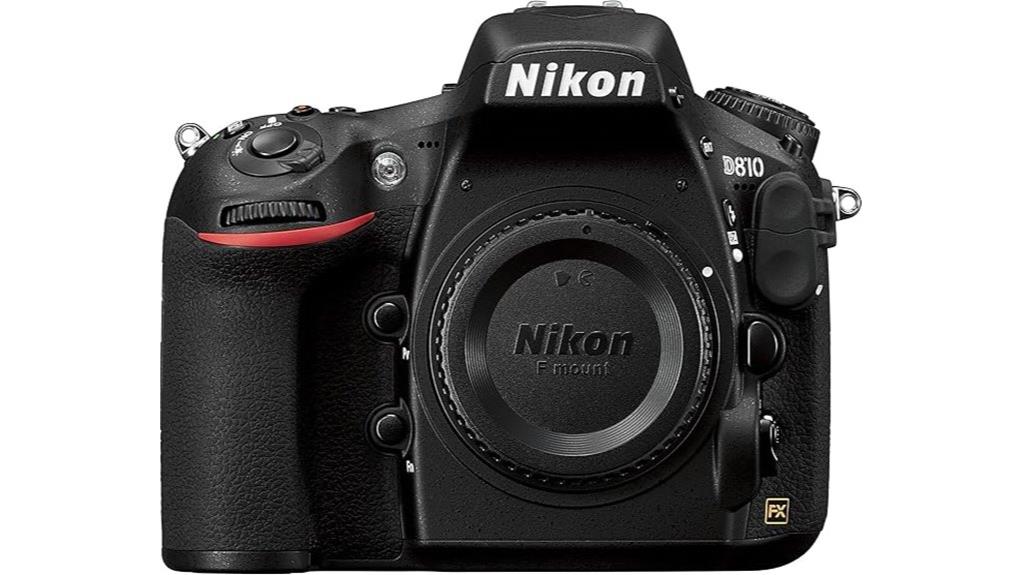
Resolution matters: the D810’s 36.3MP FX-format CMOS sensor delivers exceptionally high pixel density on a full-frame imaging area, letting you resolve fine detail, crop more aggressively, and extract larger prints without interpolation. You’ll benefit from an OLPF-less design that preserves microcontrast, enabling high resolution detail across the frame. The sensor’s native performance, paired with EXPEED-driven processing, yields an expanded tonal_range with smooth gradations and low noise at base sensitivities. RAW small-size offers workflow flexibility without sacrificing critical resolution for many uses. Metering and optics still determine final results, so you’ll need precise exposure and quality lenses. This makes choosing the right essential gear for mirrorless camera enthusiasts an important consideration.
Low-Light Performance and ISO Behavior: Native ISO 64–12,800 Tested
Although the D810’s full-frame sensor shines in daylight, its real-world low-light behavior hinges on how EXPEED 4 manages noise and tone at the native ISO range of 64–12,800 (expandable to 51,200). You’ll find excellent noise performance at base and low ISOs: fine grain, strong midtone retention, and preserved detail from the 36.3MP sensor. At high iso settings, chroma and luminance noise rise predictably but remain usable with moderate NR; shadow recovery shows limited penalty. For long exposures you must account for thermal noise and apply long-exposure NR when necessary. Overall control is measured and technically robust. Consider using a dedicated memory card reader to speed workflow when transferring large RAW files.
Autofocus, Metering, and Handling: 51-Point AF + 3D Color Matrix in Real Shoots
Having covered how the D810 manages noise and tone at varying ISOs, we now look at how its autofocus and metering keep that detail usable in real shooting. You’ll rely on the 51-point AF to lock and maintain sharpness; its cross-type sensors improve lateral and vertical detection, and focus tracking performs reliably across the frame, even with complex subject motion. Metering uses 3D Color Matrix Metering III with a 91,000-pixel RGB sensor to analyze scene color and distance, minimizing exposure bias in mixed lighting. Controls and ergonomics let you fine-tune AF modes and exposure bias quickly during sequences. For those mounting the camera on a tripod for precise composition, choosing the right head—such as a robust ball or pan-tilt tripod head—improves stability and handling.
Speed, Shutter, and File Workflow: EXPEED 4, Shutter Range, and New RAW Small Option
Because the EXPEED 4 engine accelerates image processing by roughly 30%, you’ll notice faster write times, more responsive buffer clearing, and smoother in-camera operations when shooting high-resolution bursts or switching between playback and live view. You can exploit the 1/8000–30s shutter range for precise motion control and long exposures while EXPEED 4 sustains continuous shooting without prolonged buffering. The new RAW Small option yields 16MP files that reduce storage requirements and speed postprocessing; guarantee file compatibility with your RAW converter and integrate storage management and workflow automation to move, back up, and batch-process files efficiently for consistent throughput. Gear Guide caters to enthusiasts with curated camera gear and accessories, helping photographers find the right tools for their needs and interests, including detailed reviews and recommendations for digital cameras.
Who Should Buy the D810 and How It Compares for Photo/Video Pros
When you need a high-resolution stills workhorse that also offers robust video tools, the D810 is aimed at advanced enthusiasts and professionals who prioritize image fidelity, dynamic range, and dependable exposure control over the latest mirrorless conveniences. You’ll benefit from the 36.3 MP sensor, no OLPF, EXPEED 4 processing, and native ISO 64–12,800 for critical stills. For hybrid shooters, its professional video and audio capabilities pair well with considered video ergonomics, though you’ll trade autofocus speed and mirrorless EVF conveniences. Choose lenses deliberately: lens selection affects resolving power and microcontrast, so favor sharp FX glass for portraits, landscapes, and studio work. For those building out their kit, pairing the D810 with essential DSLR accessories like quality tripods and protective bags helps maximize the camera’s performance and longevity—consider essential gear early in your planning.
Some Questions Answered
Does the D810 Have Built-In Wi‑Fi or Bluetooth for Image Transfer?
No, the D810 doesn’t have built‑in Wi‑Fi or Bluetooth for image transfer. You’ll rely on Nikon wireless adapters (like the WU‑1a or third‑party options) or tethered USB/FTP solutions to move files. You’ll use Nikon transfer apps or compatible third‑party transfer apps to control transfers and preview images; these apps work via the adapter’s Wi‑Fi hotspot or a wired connection. This setup gives full technical control but adds hardware complexity.
What Is the Camera’s Battery Life in Continuous Shooting Modes?
You get about 1,200 shots per CIPA cycle for standard shooting, and in continuous shooting modes your battery endurance drops depending on frame rate and use of Live View or flash; expect roughly 40–50 minutes of continuous burst longevity at 5 fps before battery depletion, less if you push 6–7 fps with grip or use Live View/video. Carry spares for extended sessions and enable power-saving settings to maximize runtime.
Is the Rear LCD Touchscreen or Tilting for Live View Use?
No — the rear non‑touchscreen is a fixed LCD, so you won’t get touchscreen or tilting functionality for live view. You’ll compose and navigate menus using physical buttons and the multi-selector; live view framing stays on the rigid 3.2-inch panel. That design favors durability and stability over flexible articulating or touch controls, which means you’ll rely on optical viewfinder operation or the fixed-screen live view for critical focus and exposure confirmation.
What Memory Card Types and How Many Slots Does It Support?
It has dual card slots: one accepts SD UHS II cards and the other accepts CompactFlash Type B cards, letting you use both media simultaneously. You’ll configure recording to save RAW to CF and JPEG to SD, or mirror files for backup. The CF slot supports fast UDMA transfers; the SD slot supports UHS-II speeds for high write throughput. You’ll manage recording and overflow through the camera’s media menu settings.
Does the D810 Offer In‑Camera Focus Stacking or HDR Modes?
No — the D810 doesn’t provide in‑camera focus stacking or automated hdr exposure bracketing fusion. You can, however, capture bracketed exposures or focus-shift sequences manually: the camera supports exposure bracketing and a built-in focus shift (focus‑shift shooting) mode that records multiple frames at different focus steps. You’ll need to merge stacks or HDR exposures later in postprocessing with dedicated software to produce final focus‑stacked or HDR images.