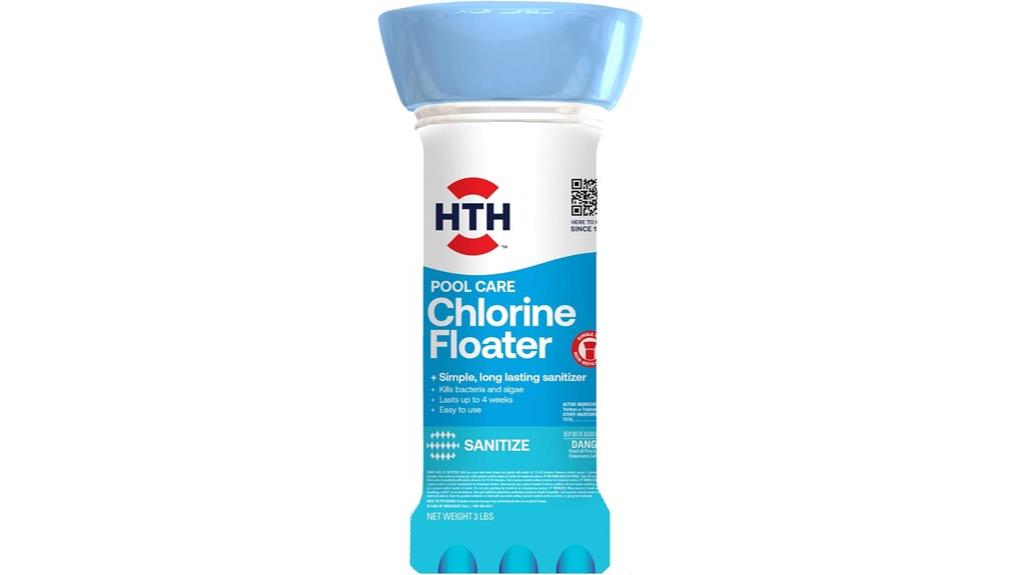
You’ll get a pre-filled, non-refillable floater that meters chlorine to maintain about 1–4 ppm for up to four weeks in pools up to 20,000 gallons. It’s compatible with vinyl and salt systems and reduces routine dosing, but you’ll lose some precise control and create more waste versus refillable units. Expect shorter life with heavy sun or bather load and monitor pH and vent clogging. Keep going to see setup, maintenance, and alternatives.
Some Key Takeaways
- Pre-filled, non-refillable floater delivers steady chlorination for up to four weeks per unit in pools up to 20,000 gallons.
- Maintains target free chlorine of about 1–4 ppm under normal conditions but can drift with heavy use or sunlight.
- Compatible with vinyl-lined and saltwater pools; prevents frequent manual dosing.
- Common issues include uneven tablet consumption, vent clogging, and pH drift requiring manual correction.
- Trade-offs: convenient low-maintenance dosing but higher waste and less precise control than refillable or inline systems.
Product Snapshot: What the HTH 42057 Chlorine Floater Is and Who It’s For
What does the HTH 42057 Chlorine Floater do for you? You get a pre-filled, non-refillable tablet floater that delivers consistent chlorination for up to 4 weeks, simplifying pool ownership and reducing daily dosing. You’ll use it to kill bacteria and algae, maintain 1–4 ppm chlorine, and keep water clear across common pool setups. It treats up to 20,000 gallons and supports beginner swimmers by maintaining sanitary conditions with minimal oversight. You should still test and balance water twice weekly. Manufacturer support and warranty are available; returns follow standard Amazon policies. Technical, reliable, low-maintenance sanitization.
How It Performs: Coverage, Lifespan, and Compatibility With Pool Types
When you need steady, hands-off chlorination, the HTH 42057 floater covers up to 20,000 gallons and maintains a target free chlorine level of 1–4 ppm for up to four weeks per unit. You’ll get predictable coverage consistency across the service interval; the pre-filled, non-refillable design meters tablet dissolution to sustain sanitizer residual without frequent adjustment. Lifespan aligns with stated up-to-four-week performance under normal conditions, though heavy bather load or sunlight can shorten it. The formulation and housing demonstrate broad material compatibility—safe for vinyl-lined pools and operational in saltwater systems—making it a versatile, low-maintenance sanitizer.
Real-World Use: Setup, Maintenance Routine, and Testing Tips (Target 1–4 Ppm)
Usually, you’ll set the HTH 42057 floater in the shallow end and let it meter chlorine automatically, but you should position it away from return jets and steps to promote even dispersion and prevent localized over-chlorination. For placement strategy, center it in a circulation path without blocking skimmers. Use the pre-filled, non-refillable unit until depleted — expect up to four weeks — and plan a refill schedule accordingly. Test water twice weekly with HTH 6-Way strips, target 1–4 ppm free chlorine, and adjust placement or add shock if levels fall. Inspect floater integrity weekly and store unused units dry.
Pros, Cons, and Common Issues to Watch For
Because the HTH 42057 floater automates dosing, you’ll get reliable baseline sanitization with minimal hands-on time, but you should still monitor for a few predictable limitations and failure modes. You’ll appreciate consistent chlorine delivery, broad compatibility (including salt and vinyl), and four-week service life per unit. Downsides: fixed dosing limits precise ppm control, and the non-refillable design raises ongoing cost and waste. Watch for uneven tablet consumption, clogging of vents, and drifting pH that requires manual correction. Be mindful of chemical interactions with shock, algaecides, and stabilizers, and consider environmental impact when disposing of used floaters.
Buying Decisions: When to Choose This Floater and Alternatives to Consider
After noting the floater’s automated dosing, fixed output, and disposal trade-offs, you can decide if this unit matches your pool management goals. Choose the HTH 42057 if you want a low-attention, pre-filled solution for up to 20,000 gallons that lasts ~4 weeks and is compatible with vinyl and salt systems. Prioritize it when staffing, time, or simplicity matter and when target chlorine 1–4 ppm is acceptable without manual dosing flexibility. Factor budget considerations against refillable floaters or inline feeders. If you need precise control or alternate sanitizer strategies, evaluate chemical alternatives like liquid bleach, salt chlorinators, or bromine systems.
Some Questions Answered
Is the Floater Safe Around Pool Pets and Wildlife?
Yes. You should exercise caution: pets safety depends on keeping animals from direct contact with the floater and concentrated tablets. Wildlife exposure is minimized by placing the pre-filled, non-refillable floater centrally so tablets dissolve dispersed in treated water. Maintain target chlorine 1–4 ppm and test twice weekly. If pets drink pool water or swim frequently, rinse them after exposure and consult a vet for sensitive animals or unusual reactions.
Can the Floater Be Used With Automatic Chlorinators?
Yes — you can use the floater with automatic chlorinators, but you shouldn’t operate both as independent dosing sources. For automation compatibility, synchronize dosing: disable one device or set the chlorinator to account for the floater’s continuous output. Monitor free chlorine and adjust setpoints to avoid over-chlorination. Test twice weekly and maintain 1–4 ppm. This prevents conflicting dosing, guarantees stable sanitation, and protects your pool equipment and surfaces.
Are Replacement Floaters Recyclable or Considered Hazardous Waste?
No — replacement floaters with tablets aren’t recyclable and are treated as potentially hazardous due to residual chlorine; you should follow local disposal regulations. Empty, inert plastic floaters might be recyclable if cleaned thoroughly, but contaminated units require hazardous-waste handling. Check municipal recycling options and hazardous-waste collection programs, and consult your local waste authority or EPA guidance for proper recycling options and disposal regulations to make sure compliant, safe disposal.
Will the Floater Bleach Pool Toys or Fabric if Stored Nearby?
Yes — if you store pool toys or fabrics near the floater, chlorine off gassing can cause fabric discoloration and bleaching. You should keep items away from direct contact and confined spaces where chlorinated vapors can concentrate. Store the pre-filled floater in a ventilated area, away from textiles and plastics, to prevent fading and material degradation. Regularly inspect nearby items for early signs of discoloration and relocate them promptly.
Does the Floater Affect Pool pH or Alkalinity Over Time?
Yes — the floater can cause pH drift over time because stabilized chlorine releases acidic byproducts. You’ll need to monitor pH and alkalinity buffering regularly; if total alkalinity’s low, pH will fluctuate more. Test twice weekly, target alkalinity 80–120 ppm and chlorine 1–4 ppm. Adjust alkalinity with bicarbonate first, then use pH increaser/decreaser as needed to maintain stable sanitization and prevent corrosion or scaling.