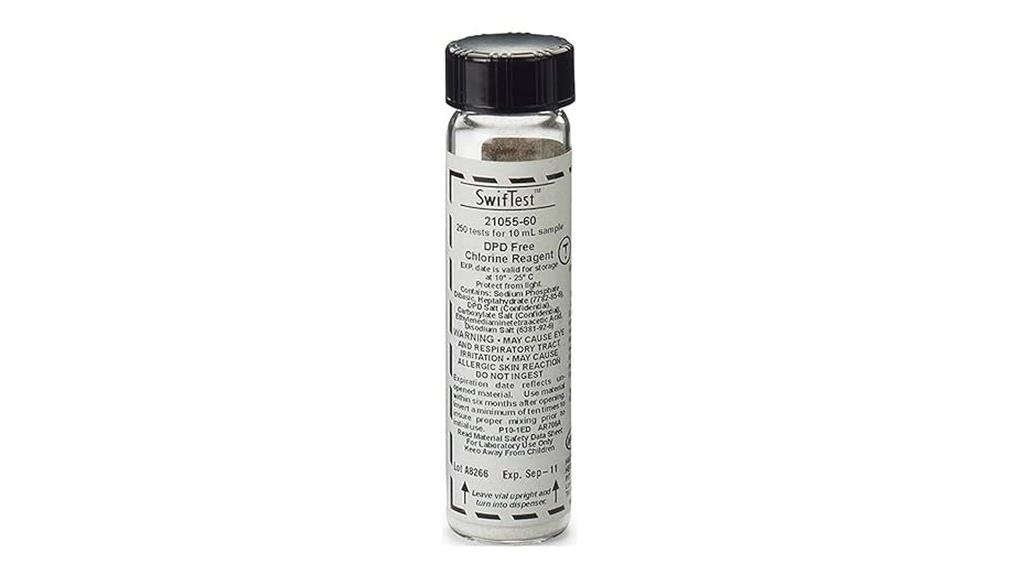
You’ll find the Hach DPD free chlorine refill vial ideal if you run many 10 mL DPD tests and need EPA‑approved accuracy. Its squeeze‑to‑dispense nozzle delivers a metered powder dose for one‑handed, repeatable actuation, cutting transfer steps and contamination risk. It reliably measures 0.02–2.00 mg/L free chlorine with linear, reproducible absorbance and 250 tests per vial to lower per‑test cost. Keep it dry and match dispensers; more details on performance and compliance follow.
Some Key Takeaways
- Squeeze-to-dispense vial delivers metered DPD powder doses for consistent, one-handed reagent dosing and faster testing workflows.
- Accurate for 10 mL samples across 0.02–2.00 mg/L free chlorine, with detection limits near 0.02 mg/L under controlled conditions.
- Conforms to Hach Method 8021 and carries USEPA approval for regulatory drinking-water chlorine testing and reporting.
- Each vial provides ~250 tests, lowering per-test reagent cost and reducing packaging waste for high-volume users.
- Requires dry storage and compatible dispensers; opened-vial life depends on field conditions and proper handling.
Quick Verdict: Who This Hach DPD Free Chlorine Refill Is Best For
Typically, you’ll find the Hach DPD Free Chlorine Refill best for labs and field teams that run high-volume, regulatory drinking-water testing and need rapid, precise reagent delivery without opening containers. You’ll rely on it when you process many 10 mL samples, need USEPA-approved Hach Method 8021 compliance, and require the 0.02–2.00 mg/L free chlorine range. Water utilities will appreciate the 250-test capacity per vial and reduced packaging waste; pool operators gain speed and consistency for routine checks. The squeeze-to-dispense design minimizes contamination risk and streamlines workflow, boosting throughput and ensuring repeatable, regulatory-quality results.
How the Squeeze-to-Dispense Vial Works and Why It’s Faster
By squeezing the refill vial you force a metered dose of powdered DPD reagent through a calibrated nozzle directly into the 10 mL sample, eliminating cap removal and transfer steps. You engage a simple squeeze mechanism that compresses the flexible reservoir, generating predictable internal pressure. The nozzle and internal metering geometry deliver a repeatable mass per actuation, so you get consistent reagent mass without weighing or scooping. Reduced handling shortens cycle time and minimizes particle loss. Faster dispense speed comes from direct delivery and one-handed operation, cutting per-test prep time and increasing throughput for field and lab workflows.
Accuracy and Range: Testing Performance (0.02–2.00 Mg/L, 10 mL Samples)
Although compact, the Hach DPD refill delivers the precision needed to resolve free chlorine between 0.02 and 2.00 mg/L in 10 mL samples, meeting the sensitivity requirements for regulatory and routine monitoring. You’ll obtain linear, reproducible absorbance changes across the stated range using the powder chemistry and controlled dispense volume. Detection limits approach the lower bound when you control matrix interferences and instrument noise; consider sample dilution only when concentrations exceed 2.00 mg/L to remain within the linear range. Repeatability across 250 tests per vial is high, enabling consistent field and lab workflows without frequent recalibration.
Regulatory Fit and Lab Use: USEPA Approval and Hach Method 8021 Explained
Because the vial follows Hach Method 8021 and carries USEPA approval, you can rely on its results for regulatory reporting and compliance monitoring of drinking water. You’ll implement Method 8021 procedures—10 mL sample volume, DPD powder chemistry, defined reaction and timing—to produce quantifiable free chlorine in the 0.02–2.00 mg/L range. EPA approval documents acceptance criteria for accuracy, precision, blanks, and calibration; you’ll retain records and run quality controls per regulatory protocols. In lab or field workflows, the refill vial supports validated analyses, traceable data, and audit readiness, simplifying method adherence while meeting EPA approval expectations.
Cost, Capacity, and Practical Pros/Cons for Field and High-Volume Testing
When you’re running frequent field rounds or high-throughput lab shifts, the Hach DPD refill vial’s per-test cost and 250-test capacity reduce consumable turnover and lower unit reagent expense compared with single-use sachets; its squeeze-to-dispense design also cuts handling time and waste, improving operator efficiency and logistics. You’ll see clear cost savings in sustained operations: bulk vial pricing plus reduced packaging reduces per-sample expense. At 10 mL samples and 250 tests, sample throughput stays high without frequent resupply. Trade-offs: powdered reagent requires dry storage, vial life once opened depends on field conditions, and dispenser compatibility is mandatory for accurate dosing.
Some Questions Answered
Are These Refill Vials Compatible With Older Swiftest Dispenser Models?
Yes — you can use these refill vials with many older Swiftest dispenser models, but you should perform Compatibility checks first. Most legacy dispensers accept the squeeze-to-dispense vials directly; if your model has a nonstandard neck or retention feature, check Adapter availability from Hach or authorized suppliers. You’ll maintain accurate 10 mL delivery, EPA-compliant performance, and the 0.02–2.00 mg/L range when proper fit and dispensing function are verified.
Do the Powder Reagents Have a Specific Shelf Life After Opening?
Yes — you should treat opened powder reagents as having limited opened stability. You’ll store vials tightly sealed, in a cool, dry place because the powder is moisture sensitive and will degrade if humid. Under recommended conditions you can expect stable performance for a limited period (follow manufacturer guidance), but don’t rely on indefinite use; monitor for caking, color change, or test drift and replace to guarantee accurate results.
Can the Vials Be Transported Safely on Commercial Flights?
Yes — you can usually transport these vials on commercial flights, but you’ll need to comply with airline regulations and any hazardous-material rules. Declare reagents if requested, pack leakproof in original squeeze-to-dispense vials inside sealed secondary containment, and follow carry-on or checked-bag policies. Note battery restrictions if you’re also carrying instruments with batteries; separate or protect batteries per airline guidance. Check specific carrier and national rules before travel.
Are There Temperature Storage Limits Affecting Reagent Performance?
Yes — you should store the vial within specified storage temperature limits to avoid performance degradation. Keep reagents away from extreme heat or freezing; temperature excursions can alter powder chemistry and reduce assay accuracy. Follow manufacturer storage temperature ranges on the label or datasheet, rotate stock by expiration, and avoid prolonged exposure to sunlight or humidity. Doing so preserves reagent stability and maintains reliable free chlorine measurement performance.
Is a Calibration Adjustment Needed When Switching Reagent Lots?
Yes. You should verify and, if needed, apply a calibration adjustment when switching reagent lots. Lot to lot variability and potential instrument drift can produce small bias; run standards or check samples after changing vials to confirm agreement. If results deviate beyond acceptable limits, adjust your instrument calibration per SOP or document a lot-specific correction factor. Record lot numbers, verification data, and any calibration changes for traceability and regulatory compliance.