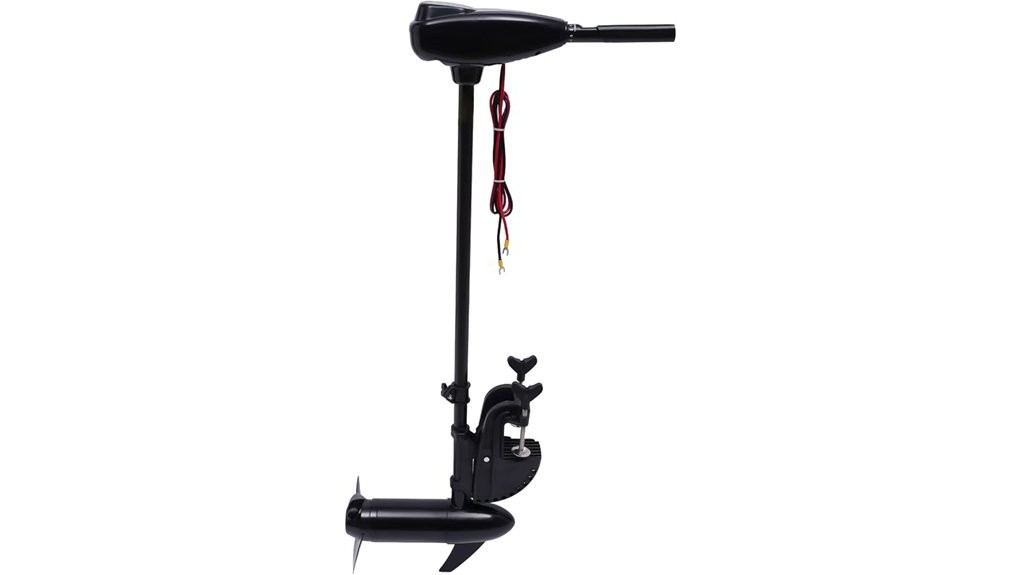
You’ll get a compact 1.2HP (626 W) 12V outboard delivering 55 lb thrust, ideal for kayaks, inflatables and small boats up to ~4 m. It uses a pure-copper motor, anti-winding 3-blade prop, adjustable transom bracket and retractable handle for easier mounting and control. Expect variable speed with battery-dependent runtime, some noise at full throttle, and regular fastener and seal checks for corrosion. Keep going to see performance, fitment and maintenance details.
Some Key Takeaways
- 55 lb thrust, 626 W (1.2 HP) 12V motor suits small boats, kayaks, and inflatables up to ~4 m.
- Anti-winding 3-blade prop reduces entanglement and provides predictable thrust for shallow-water use.
- Real-world speed and runtime depend on hull, load, battery state, and wind/current; test under representative conditions.
- Adjustable transom bracket, 91 cm shaft, and retractable handle ease mounting, but verify clamp gap and shaft reach.
- Lightweight (9.2 kg) and corrosion-resistant materials, but battery excluded and noise may increase at full throttle.
Quick Verdict : Who This 1.2HP 12V Trolling Motor Is Best For
If you need a lightweight, transom-mounted electric motor for small craft, this 1.2HP 12V trolling motor fits boats up to ~4 m (13 ft) and excels for kayaks, plastic or inflatable boats, and shallow-water use where compact, quiet propulsion matters. You’ll find it ideal if you’re a lightweight angler or one of the budget commuters needing reliable, low-maintenance propulsion. The 55 lb thrust, 626 W pure-copper motor, and anti-winding propeller give predictable thrust for modest loads. Mounting, adjustable bracket, and retractable handle simplify installation and ergonomics, while 12 V compatibility keeps battery requirements straightforward. It’s also well suited for paddlers and racers who outfit kayaks and small boats for water adventures and racing.
Real-World Performance: Speed, Thrust, Noise, and Battery Needs
While the manufacturer rates this 1.2HP motor at 55 lb (25 kg) thrust and a top speed of 16 km/h on a 2.3 m boat with a 90 kg load in calm water, real-world performance depends on boat hull, total load, battery state, and current/wind conditions. You’ll see lower top speeds on heavier hulls or with headwind. Conduct thrust testing at multiple gears to map effective push versus rpm. Implement strict battery management to avoid voltage sag; expect run-time tradeoffs between speed and duration. Perform noise profiling to identify prop cavitation and motor vibration. Document speed endurance under representative loads. Also carry essential safety and convenience gear like an electric bilge pump and life jackets to ensure safe kayak adventures.
Fitment, Installation, and Adjustable Bracket Tips for Kayaks and Small Boats
Get the mounting right before you power up: measure your transom thickness, clamp gap, and shaft reach to guarantee the outboard sits square and at the correct depth for your kayak or small boat. Use the adjustable transom bracket to set shaft immersion: too deep wastes energy, too shallow ventilates the prop. Torque clamp bolts to specified mounting torque to prevent slippage; check after first run. Position the retractable control handle for prime throttle ergonomics so you don’t overreach. Protect fasteners and hinge points against bracket corrosion with marine-grade grease or corrosion inhibitor. Verify clearance for steering and launch. Secure tie-downs and straps for transport to prevent movement and protect your kayak during travel, following best practices for kayak tie-downs.
Durability and Safety: Materials, Anti-Winding Prop, and Collision Protection
Because durability and safety hinge on material choice and protective design, you should expect the Electric Outboard Motor’s aluminum-alloy shaft, high-strength nylon composite bracket, ABS components, and pure-copper motor to resist common marine stresses while keeping weight low. You’ll get corrosion resistance from powder-coated aluminum and nylon composites; pure-copper windings reduce electrical heating and extend service life. The 3-blade anti-winding prop minimizes entanglement, lowering torque spikes that accelerate material fatigue. Bracket anti-collision devices absorb impact energy and isolate the shaft from shock loads. Inspect fasteners and seals regularly; replace compromised components to maintain rated thrust and safe operation. These features make the motor well-suited for use with kayaks and drift chutes during water-based adventures.
Final Pros/Cons, Alternatives, and What to Check Before You Buy
When you evaluate this 1.2HP, 12V electric outboard, focus on its electric outboard specifications—55 lbs thrust, 626 W motor, and a 91 cm shaft—so you can match it to your boat’s dimensions, payload, and battery capacity rather than relying on marketing claims. Pros: lightweight 9.2 kg, anti-winding prop, adjustable bracket, multigear control, saltwater-ready materials. Cons: battery excluded, limited to small boats, possible noise at full throttle, clamp gap may not fit all transoms. Alternatives: higher-thrust 24–30 kg models or electric hybrid options for pedal/electric systems. Before buying, verify warranty coverage, required battery specs, and needed installation tools. Consider pairing the motor with a suitable emergency power bank for extended outings on the water.
Some Questions Answered
Does This Motor Come With a Battery or Charger Included?
No, battery included? No — the motor requires a separate 12 V battery. Charger availability? Not included either; you’ll need to supply a compatible charger. You’ll want a deep-cycle marine battery sized to deliver 626 W continuous and sufficient amp-hours for your run time. Verify terminal types and install proper fuse/cable gauges. If you need recommendations for battery capacity or charger specs, ask and I’ll provide sizing and connection details.
Can It Be Used in Freshwater and Saltwater Without Extra Corrosion Protection?
Yes. You can use it in freshwater and saltwater, but you’ll need freshwater maintenance to limit saltwater corrosion. Rinse the motor with fresh water after each saltwater use, dry thoroughly, and inspect seals, bolts, and electrical connections for corrosion. Apply corrosion inhibitor to exposed metal, grease moving parts, and use sacrificial anodes if boating frequently in salt. Follow periodic checks per manual to preserve performance and warranty.
Is There a Warranty Longer Than the Seller’s 30-Day Return Window?
No — the listing only references the seller’s voluntary 30-day return window; there’s no explicit manufacturer warranty disclosed. You should contact the manufacturer (HiBaiYUS/HAOREBAIYU) to request written manufacturer warranty terms and inquire about extended protection or third-party plans. If you want longer coverage, get confirmation in writing, compare extended protection options from the platform, and confirm any battery or water-damage exclusions are clearly documented before purchase.
How Much Noise Does It Make in Decibels at Full Throttle?
There’s no manufacturer decibel spec, so you’ll expect roughly 70–85 dB at full throttle based on similar 626 W trolling motors; the noise level depends on mounting, hull resonance and water conditions. You’ll hear a broadband sound signature dominated by motor whine and propeller cavitation tones. You should measure with a handheld dB meter at 1 m from the motor and at operator position to get precise, repeatable readings for your setup.
Are Spare Propellers or Replacement Parts Available From the Manufacturer?
Yes — you can obtain spare propellers and replacement parts directly from the manufacturer or authorized sellers. Check for propeller options and maintenance kits listed under part number OT-MLPQ-4409 or ASIN B0C8J2JC2G. You’ll want to confirm compatibility (3-blade, 20 cm) and order mounting hardware if needed. Contact HiBaiYUS/HAOREBAIYU support for availability, lead times, and warranty-covered replacements. Keep proof of purchase for claims.