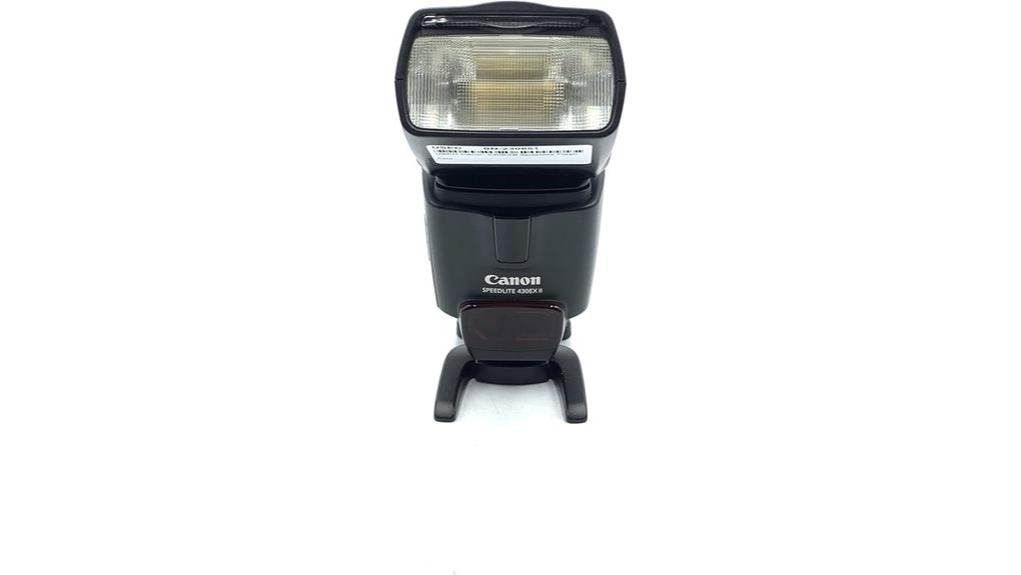
You’ll get a compact, reliably built on‑camera flash that suits casual shooters and budget buyers who want faster, quieter recycling without pro power or advanced wireless features. The hardened metal foot and tight tolerances mean secure mounting and everyday robustness, though there’s no weather sealing. Recycling is about 20% quicker than the predecessor and near‑silent, but peak performance falls as batteries drain and TTL can be iffy in mixed light — keep going to see full performance and tradeoffs.
Some Key Takeaways
- Compact, reliable on‑camera flash suited for casual shooters and budget-minded buyers.
- Hardened metal foot and tight tolerances improve durability for frequent mounting.
- 24–105mm zoom head covers most standard lenses for general-purpose use.
- About 20% faster, near‑silent recycling improves consecutive shooting speed.
- Not for pros needing high power, advanced wireless, weather sealing, or extreme range.
Hands-On Verdict: Who Should Buy the 430EX II and Why
If you need a compact, reliable on-camera flash that won’t hold you back, the 430EX II is a solid choice: it offers a hardened metal foot and superior build for frequent use, a 24–105mm zoom head for most standard lenses, and faster, quieter recycling that speeds shooting without drawing attention. You’ll appreciate its predictable exposure and straightforward controls if you’re a casual shooter or a budget buyer wanting dependable performance. It won’t replace pro-level power or advanced wireless features, so don’t expect flagship flexibility. Choose it for consistent, efficient on-camera fill and everyday reliability. For photographers who also shoot video or need continuous lighting options, consider pairing it with on-camera LED lights like those offered by specialty retailers for improved versatility and constant light on-camera LED lights.
Build and Durability: Metal Foot, Construction, and Real-World Robustness
Because Canon reinforced the 430EX II with a metal foot and tightened tolerances throughout the housing, you get a noticeably tougher unit that stands up to daily mounting, transport, and field use. The cast foot resists slot wear and maintains secure camera contact; the chassis shows minimal flex under torque. Seams and joints are precise, but Canon didn’t add seals—expect weatherproofing concerns in wet conditions. Controls feel durable yet modestly plasticky. For regular prosumers this balance is sensible; if you demand weather sealing, look elsewhere. The solid build supports long term resale value, provided you avoid moisture damage. Many photographers store and transport gear in Pelican cases to protect equipment from impact and environmental risks.
Performance and Speed: Recycling Time, Noise, and Flash Consistency
When you need rapid consecutive shots, the 430EX II delivers noticeably quicker recycling—about 20% faster than its predecessor—so you spend less time waiting between pops. You’ll appreciate the near-silent operation; noise is virtually absent, reducing distraction during events. Recycling gains, however, hinge on battery longevity—expect shorter peak performance with depleted cells. Flash-to-flash output is consistent across mid-to-low power, though full-power cycles show slight variance that warrants bracketed testing for critical work. Color stability remains reliable within typical TTL adjustments, but extreme zoom or bounce combos introduce minor shifts. Overall, performance is improved but not flawless. For maintaining consistent results and prolonging equipment life, proper care such as regular lens cleaning and storage is recommended.
Handling and Mounting: 1-Touch Quick‑Lock, Ergonomics, and Day-to-Day Use
Although compact, the 430EX II feels solid in hand and its 1-Touch Quick‑Lock lets you mount and release the flash with a single, decisive motion. You’ll appreciate the metal foot’s rigidity and the positive lock action; twisting the wheel secures it without wobble. Ergonomics favor one-handed operation, though controls are small and require deliberate presses. Day-to-day handling is predictable: the unit balances well on smaller bodies but can feel top‑heavy on pro rigs. Note limited strap compatibility for carrying solutions and be aware that third‑party mounting adapters vary in fit and may introduce play or contact issues. Many photographers who use speedlights also invest in additional mounting adapters and modifiers to expand creative options.
Compatibility and Coverage: EOS Control, Zoom Range (24–105mm), and When It Fits Your Kit
If you pair the 430EX II with a compatible EOS DSLR, you get full flash control through the camera menu—so you can set exposure, metering, and high‑speed sync without leaving the viewfinder. You’ll appreciate the 24–105mm zoom head for general-purpose coverage on full‑frame bodies; it matches standard zooms and limits spill. Note battery compatibility: using NiMH reduces recycle time versus alkalines and affects burst performance. Be aware of TTL limitations — metering can be inconsistent in mixed lighting and with wide lenses near 24mm. It fits kits for event and travel shooters, not specialists needing extreme range or precision. This flash is a good match for photographers who frequently use tripods and heads designed for stability with lighting accessories, especially when paired with tripod heads suited to flash-mounted setups.
Some Questions Answered
Does It Support High-Speed Sync (HSS) With All EOS Cameras?
No — HSS compatibility isn’t universal across all EOS bodies. You’ll get high-speed sync with many recent Canon cameras, but Camera limitations mean older or entry-level EOS models may not support HSS with the Speedlite. Check your camera’s compatibility list and firmware. Expect full flash control via compatible EOS DSLRs, but verify shutter-sync modes and menu options on your specific body before relying on HSS for fast-shutter work.
Can It Function as a Master Unit in Wireless Setups?
No — it can’t function as a master unit in wireless setups. You’ll rely on optical triggering from a master-capable camera or Speedlite; the 430EX II only acts as a slave. You can use manual grouping to assign output levels and groups when triggered optically, but you won’t get TTL master control or advanced remote features. That limits on-flash control and flexibility for complex multi-flash arrangements.
What Is the Battery Life Under Continuous TTL Use?
Under continuous TTL use you’ll see moderate battery drain: expect roughly 200–300 full pops from fresh alkalines in performance testing, fewer with recycled rapid bursts. Rechargeable NiMH cells extend usable shots and tighten recycle consistency; high-speed sequences push drain faster and heat may throttle output. You’ll want spare batteries for intensive shoots. Monitor recycle lag and swap cells once output or speed degrades to maintain reliable performance.
Is There Any Weather Sealing for Outdoor Shooting?
No, it doesn’t offer dedicated weather resistance or gasket seals, so you shouldn’t rely on it in wet conditions. You’ll get a robust metal foot and good overall build, but the 430EX II lacks explicit sealing around joints and controls. For outdoor shooting in rain or heavy moisture, you should use protective covers or choose a flash with certified weather sealing to avoid corrosion or malfunction from water ingress.
Does It Offer Rear-Curtain Sync and Custom Flash Modes?
Yes — you get rear curtain sync and basic custom modes, but don’t expect advanced programmability. You’ll be able to use rear curtain for motion trails timed to the shutter and switch between a few custom modes for function tweaks. The implementation is minimalistic: it’s practical and reliable, yet lacks deep customization found on higher-tier units. You’ll appreciate straightforward control, though power users may find it limiting.