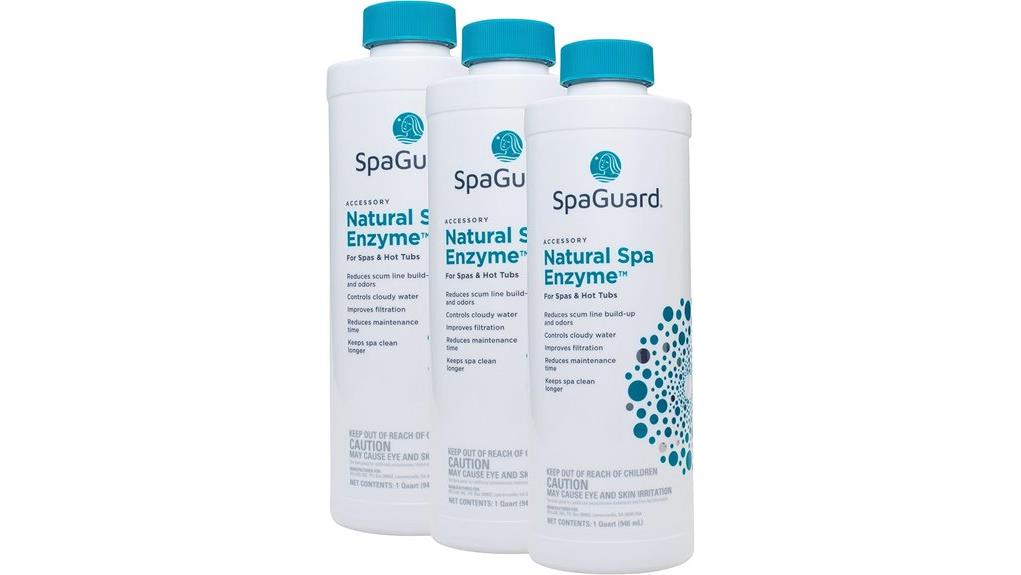
You’ll find SpaGuard Natural Spa Enzyme is an enzyme-based maintenance product that hydrolyzes oils, lotions, and grease to soluble fragments, reducing scum, turbidity, and odor. You’ll dose it weekly or boost after heavy use, adding directly to circulating water for consistent dispersion. It targets common spa organics without interacting with sanitizers or equipment, lowering filter loading and sanitizer demand while improving clarity. Continue for practical dosing, performance metrics, and buyer-fit guidance.
Some Key Takeaways
- Enzyme formula hydrolyzes oils, lotions, and grease to reduce scum lines and surface residues.
- Weekly dosing improves clarity by lowering turbidity and particulate counts from organic buildup.
- Regular use reduces filter loading, extends cartridge life, and decreases backwash/cleaning frequency.
- Fewer organics competing for oxidizers helps stabilize sanitizer residuals and can lower chlorine/bromine use.
- Sold in 3-packs for medium/large spas and commercial users, offering predictable dosing and lower per-unit cost.
What SpaGuard Natural Spa Enzyme Is and How It Works
Although it’s labeled “natural,” SpaGuard Natural Spa Enzyme is a targeted, enzyme-based maintenance product designed to break down organic contaminants in spas and hot tubs. You’ll apply a concentrated formulation that employs a defined enzyme mechanism to hydrolyze oils, lotions, and grease into soluble fragments. You’ll observe reduced filter fouling because enzymatic action minimizes particulate accumulation and maintains flow rates. The product demonstrates substrate specificity toward common spa organics, limiting unintended interactions with sanitizers or equipment materials. Dosing is routine and quantitative, so you can model enzyme turnover and residual activity to optimize service intervals and sanitizer load.
Does It Really Reduce Scum, Cloudy Water, and Odors?
When you use SpaGuard Natural Spa Enzyme as directed, its targeted enzymes actively hydrolyze the oils, lotions, and greases that form the scum line, and that enzymatic breakdown measurably reduces filter loading, turbidity, and odor-causing organics. You’ll observe lower particulate counts and improved clarity via quantitative turbidity reduction and reduced backwash frequency. Scum detection is simplified because residues disperse into biodegradable components rather than adhering to surfaces. Odor profiling shows decreased volatile organic compounds associated with body oils and detergents, so you’ll detect fewer sulfurous or musty notes. Results depend on dosing consistency and baseline contamination levels.
How to Use SpaGuard Natural Spa Enzyme for Routine Maintenance
Regularly add SpaGuard Natural Spa Enzyme as part of your maintenance routine to keep oils and organic residues from accumulating in the water and filters. You’ll dose weekly dosing at the manufacturer’s recommended rate based on spa volume—measure gallons precisely, then add enzyme directly to circulating water with pumps running for enhanced dispersion. For new fills or heavy use, apply a one-time boost following label guidance. Application tips: avoid adding other chemicals within 15 minutes, store upright in original container, and log doses. Monitor pH and sanitizer; enzymes work adjunctively, not as sanitizer replacements.
Real-World Effects on Filters, Sanitizer Load, and Water Clarity
After you’ve established a weekly enzyme routine, you’ll notice measurable effects on filters, sanitizer consumption, and water clarity within a few cycles. You’ll observe reduced organic load on cartridges as enzymes hydrolyze oils and lotions, improving filter longevity by maintaining flow rates and reducing cleaning frequency. Sanitizer conservation follows: with fewer organics competing for oxidizers, free sanitizer residuals remain more stable, so you’ll use less chlorine/bromine to maintain target ppm. Water clarity improves quantitatively—lower turbidity and faster particulate removal—so visual and instrument readings align. Monitor pressure differentials and sanitizer demand to validate performance gains.
Who Should Buy This 3-Pack and Where It Fits Among Spa Enzyme Options
Although you might only need a single bottle for light, occasional use, the 3-pack is best suited to owners of medium-to-large spas, multi-spa facilities, or anyone who prefers bulk purchasing to reduce replenishment frequency; it gives predictable dosing over months and lowers per-unit cost. You’ll find this pack ideal if you manage higher bather loads, want steady enzyme input to relieve sanitizer demand, or need consistent filter maintenance. It’s a pragmatic choice for commercial installers specifying routine programs and for budget buyers seeking lower lifecycle cost. Compared to single bottles, the 3-pack reduces service interruptions and simplifies inventory control.
Some Questions Answered
Is This Enzyme Safe for All Hot Tub Materials and Equipment?
Yes — you can use it on typical hot tub surfaces and components; the all-natural enzyme formula promotes surface compatibility while avoiding harsh chemicals that etch acrylic, vinyl, or metal finishes. You’ll want to follow dosing instructions to prevent residue buildup and periodically inspect seals, plumbing, and filters. Proper use digests organics, aiding equipment longevity by reducing sanitizer load and filter clogging, but always confirm with your manufacturer’s material-specific recommendations.
Can Spaguard Enzymes Be Used With Saltwater Systems?
Yes — you can use SpaGuard enzymes with saltwater systems. You’ll get saltwater compatibility because the enzyme formula targets oils and organics without reacting with dissolved salt. Monitor sanitizer levels since chlorine interaction still matters: enzymes reduce organic load and help maintain sanitizer efficacy, but they don’t replace chlorine or bromine. Test and adjust sanitizer residuals regularly, and follow recommended dosing to avoid under- or over-treatment.
How Long Does One Quart Last With Regular Spa Use?
About 4–6 weeks. With weekly maintenance you’ll dose per manufacturer guidelines (typically a few ounces per application), so one quart usually covers 4–6 weekly treatments for an average-sized spa. Track consumption via dosage tracking—measure each dose, log dates and ounces—to refine estimates for your bather load and contamination levels. If you use the spa heavily or have heavy scum-line, expect faster depletion and adjust ordering cadence accordingly.
Are There Any Fragrance or Dye Additives in the Formula?
Yes — you’ll find a fragrance free formulation and dye absence in this enzyme product. You’ll get an all-natural, enzyme-based formula without added fragrances or colorants, minimizing sensory additives that could interfere with water chemistry or cause irritation. This reduces risk of foam, masking agents, or staining while preserving sanitizer performance. You’ll still follow dosing and maintenance to guarantee peak scum-line reduction and filter protection over time.
Is This Product Safe for People With Sensitive Skin or Allergies?
Yes — you can generally use it, but verify specifics. The all‑natural enzyme formula lacks fragrance and dye additives, which reduces irritant risk; however there’s no published sensitive skin testing or formal hypoallergenic labeling from the manufacturer. You should patch‑test before full exposure, consult a dermatologist if you have severe allergies, and monitor for irritation. For shared spas, minimize contact time and maintain recommended sanitizer levels to limit allergenic byproducts.