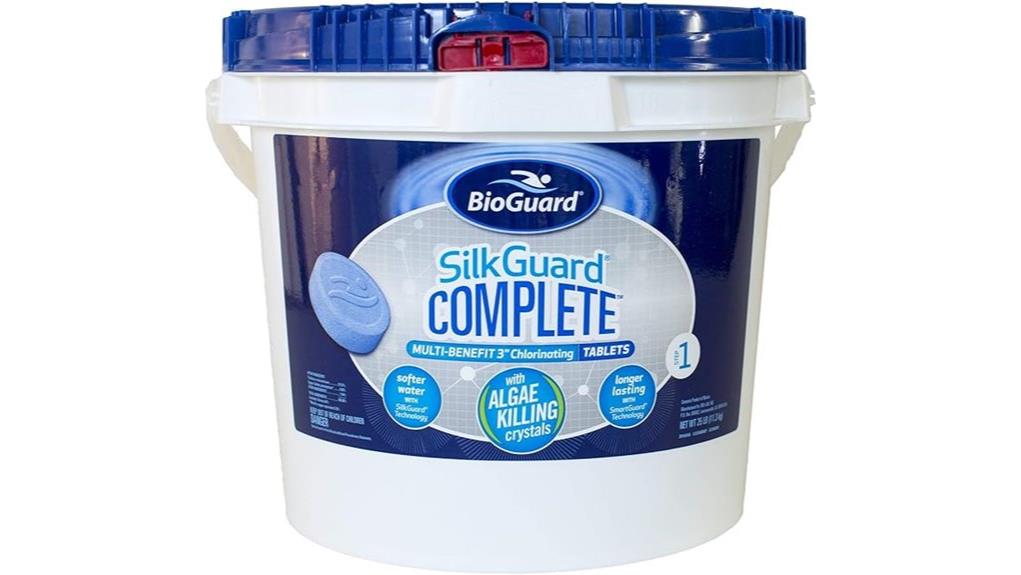
You’ll find BioGuard SilkGuard Complete 3” tablets deliver slow, controlled chlorine release in a rugged polymer matrix, keeping free-chlorine levels steady over 24–72 hours with less consumption than fast-dissolving tabs. Integrated algicide crystals and scale inhibitors help prevent blooms and protect equipment in both salt and conventional chlorinated systems. Use approved floaters or feeders, calibrate flow for pool volume, and test frequently to avoid over-chlorination. Continue for practical tips, setup guidance, and troubleshooting.
Some Key Takeaways
- 3-inch slow-dissolving tablets provide steady chlorine residuals with predictable declines over 24–72 hours.
- Polymer matrix reduces crumbling and lowers consumption compared with fast-dissolving alternatives.
- Built-in algicide crystals and scale inhibitors improve algae resistance and protect equipment.
- Suitable for floaters, feeders, and saltwater systems, but large size limits some feeder compatibility.
- Requires regular testing and dispenser calibration to avoid over-chlorination and stabilizer buildup.
Quick Verdict and Key Specs for BioGuard SilkGuard Complete 3” Chlorinating Tablets
Although you might expect variable performance from bulk chlorine, the BioGuard SilkGuard Complete 3” Chlorinating Tablets deliver steady, slow-dissolving sanitation designed for continuous use. You’ll find a 3-inch tablet, 25 lb package containing 400 ounces by unit count, Model 52366BIO. The formulation provides sustained chlorine residuals, integrated algae-fighting crystals, and scale/stain inhibitors to protect equipment. Expect measurable improvements in water clarity and softened water without frequent dosing. Use in floaters, feeders, or automatic feeders across chlorinated and saltwater systems. The design emphasizes cost efficiency via long dwell times and reduced consumption compared with fast-dissolving alternatives.
Real-World Performance: Sanitation, Algae Control, and Tablet Dissolution
When you dose BioGuard SilkGuard Complete 3” tablets into a floater, feeder, or chlorinator, the slow-dissolving polymer matrix yields a steady chlorine residual that maintains sanitizer levels with minimal adjustment. You’ll observe consistent sanitation longevity across varied loads; measured free chlorine declines predictably over 24–72 hour windows. Algae resistance is improved due to embedded algicide crystals and sustained residuals that interrupt bloom initiation. Tablet integrity remains high under standard flow and temperature ranges, with limited crumbling. Monitor dispersion patterns—placement, flow rate, and saturation affect local residuals—so you can calibrate device settings to achieve uniform pool-wide sanitation.
How to Use These 3” Tablets Safely and Get Steady Chlorine Levels
Start by placing the 3″ BioGuard SilkGuard tablets only in approved dispensers—floaters, inline feeders, or automatic chlorinators—so you can control dissolution rate and maintain uniform residuals. Wear gloves when handling tablets; avoid skin contact and inhalation. Set feeder flow or floater vent to match pool volume and expected bather load. Test frequently for free chlorine, combined chlorine, pH, and cyanuric acid; adjust feed accordingly. Monitor stabilizer levels to prevent over-stabilization and reduced efficacy. Inspect dispensers weekly for blockages or uneven wear. Document dosing, test results, and maintenance actions to guarantee steady, safe chlorination.
Compatibility With Pool Types and Common Systems (Salt, Chlorinated, Feeders)
Having established safe dosing and dispenser practices, now check how BioGuard SilkGuard 3″ tablets interact with different pool systems and equipment. You’ll find Saltwater compatibility—tablets are formulated for chlorinated and salt-chlorination systems, releasing stabilized chlorine that complements salt generators without excessive corrosion risk. In conventional chlorinated pools, they provide steady residuals ideal for routine automation. For inline or standalone feeders, confirm feeder compatibility: use recommended dispenser materials, adjust feed rates to tablet dissolution, and avoid direct tablet-to-plastic contact. For all systems, monitor free chlorine and stabilizer levels, inspect equipment for scale or discoloration, and follow feeder maintenance schedules.
Pros, Cons, and Who Should Buy
Although formulated for steady, long-lasting chlorination, the SilkGuard 3″ tablets deliver a clear set of trade-offs you should weigh: you get reliable, slow-dissolving sanitizer with built-in algae inhibitors, scale reduction, and equipment-protective chemistry, yielding consistent free chlorine and softer water. Pros: predictable residuals, reduced dosing frequency, compatibility with salt and feeder systems, and operational cost effectiveness for season-long maintenance. Cons: large 3″ size limits feeder options, potential over-chlorination if not monitored, and tablets contain stabilizers that raise environmental impact concerns if discharged improperly. Who should buy: pool operators seeking low-maintenance, equipment-friendly chlorination with monitored dosing.
Some Questions Answered
Do These Tablets Contain Cyanuric Acid (Stabilizer)?
No, these tablets don’t list added cyanuric acid; they’re stabilized by formulation but manufacturer data doesn’t state free CYA content. You should perform cyanuric testing regularly to verify pool CYA levels if concerned. If CYA accumulates, consider stabilizer alternatives such as unstabilized chlorine (calcium hypochlorite) and routine dilution via partial water replacement. Follow measured dosing and monitor CYA to maintain recommended stabilizer concentrations for effective sanitation.
Are They Safe for Vinyl and Fiberglass Liners?
Yes — you can use them with vinyl and fiberglass liners. Their SilkGuard technology and slow-dissolving formula minimize harsh chlorine spikes that cause liner discoloration and material degradation. Still, you should monitor sanitizer levels, maintain recommended free chlorine and stabilizer ranges, and avoid tablet contact with liner surfaces to prevent localized bleaching or staining. Regular testing and proper chlorinator placement keep vinyl compatibility and reduce liner discoloration risk.
Can I Store Unopened Tablets Outdoors?
No, you shouldn’t store unopened tablets outdoors. You’ll risk temperature effects degrading active chlorine and compromising packaging integrity through moisture, UV and thermal cycling. Store dry, cool, and ventilated—ideally 50–80°F—in original sealed container on a pallet off the ground, away from direct sunlight and combustible materials. Inspect packaging integrity periodically; if you see swelling, corrosion, or moisture intrusion, relocate indoors and follow manufacturer disposal or return guidance.
Do Tablets Release Chlorine Evenly in Cold Water?
Yes — they still release chlorine in cold water, but cold start release is slower. You’ll notice temperature dependent efficacy: lower water temps reduce dissolution rate, so steady chlorine output is diminished initially. Expect prolonged, reduced-release periods until water warms. To compensate, measure free chlorine frequently and adjust dosage or tablet count. This methodical approach maintains target sanitizer levels despite temperature-driven kinetics affecting tablet dissolution.
Are Algae-Fighting Crystals Separate or Integrated?
They’re integrated into the tablet formulation: you’ll find algae-fighting crystals embedded within each tablet for consistent algae prevention. This design maintains chlorine compatibility, ensuring steady release without separate dosing. You’ll measure normal tablet use, not add crystals separately, which reduces handling errors. Because crystals are within the matrix, they minimize uneven dissolution and surface residue on your feeder or pool walls, supporting predictable sanitizer delivery and equipment protection.