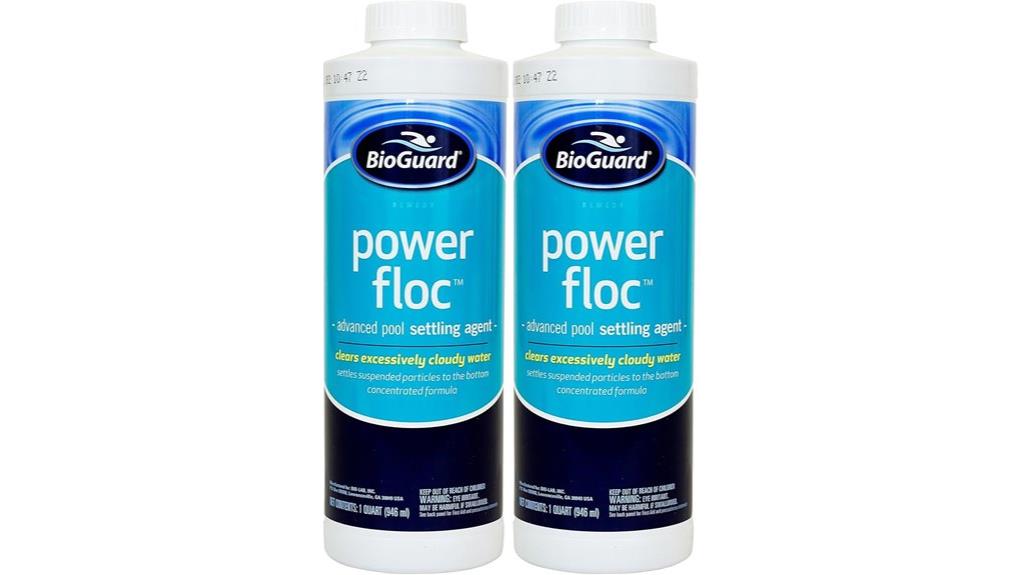
You’ll find BioGuard Powerfloc’s two‑quart pack pulls fine suspended particles together so they settle fast, clearing rain‑washed and pump‑down haze quicker than single‑dose flocculants when your chemistry and filtration are in order. You’ll dose precisely (8 fl oz/10k gal), pour with the pump running, then shut it off to vacuum settled waste. It’s cost‑effective for seasonal owners who face repeated cloudy runs, though very fine colloidal haze or poor chemistry may need repeat treatment—more details follow.
Some Key Takeaways
- Two 1-quart bottles (64 fl oz total) provide multiple doses and better per-dose value than single-use flocculants.
- Acts like a polymer coagulant, rapidly aggregating fine suspended particles and algae for easier removal.
- Typical dose: 8 fl oz per 10,000 gallons; increase slightly for heavy debris or post-storm cleanup.
- Requires pump circulation during application, then pump-off vacuuming to waste after particles settle.
- Works fast on rain-wash and pump-downtime haze, but results depend on pool chemistry and may need repeat treatment.
How BioGuard Powerfloc Works and What’s in the 2-Pack
BioGuard Powerfloc pulls fine suspended particles together so they settle out of the water, making cloudy pools clear and letting your filter pick up the bulk more easily. You’ll appreciate the 2-pack: two 1-quart liquid bottles (64 fl oz total) that match typical dosing and reduce repeat buys. Functionally, it speeds algae clarification by aggregating dead and live cells for vacuum removal. Compared to single-dose flocculants, the pack gives value and continuity. Chemical composition isn’t fully disclosed on packaging, but performance indicates a polymer coagulant optimized for pool use. You’ll find it practical, potent, and cost-effective.
Real-World Test: Clearing Cloudy Pools After Rain and Pump Downtime
After seeing how the two-quart supply and polymer action work in controlled conditions, it’s time to test Powerfloc where it matters: rain-washed pools and systems left idle. You’ll judge speed, clarity, and ease versus typical clarifiers. In rainy, debris-heavy runs Powerfloc settled haze faster than a basic floc; you saw clearer water within a day when pool chemistry was balanced. After pump downtime, it aggregated stagnant fine particles reliably, matching many customer experiences about quick visual improvement. It’s not magic—results depend on preexisting chemistry and filtration—but in direct comparisons it proved noticeably stronger and more consistent.
Dosage, Step-by-Step Application, and Filter/Vacuum Follow-Up
Start by measuring your pool volume and dosing precisely: add 8 fl oz of Powerfloc per 10,000 gallons as the initial dose, then increase slightly for heavier debris loads. You’ll pour around the perimeter with pump running, noting application timing—best mid-day for circulation, avoid immediate bather entry. Wait until particles settle (or form flakes), typically hours to overnight. Shut off pump before vacuuming to waste; use a slow, deliberate vacuum to avoid resuspension. Compare to alternatives: Powerfloc’s predictable dose and fast settle help filters, but follow safety precautions—gloves, eye protection, and keep children away during treatment.
Performance Breakdown: Speed, Clarity Results, and Limitations
While Powerfloc works fastest when debris load is high, you’ll typically see visible settling within a few hours and full clarification by overnight in most pools. You’ll notice rapid settling when water carries lots of suspended particles; the flocculant aggregates fines so your filter and vacuum remove them efficiently. Clarity results are strong compared with basic clarifiers—sparkle returns and algae remnants settle predictably. Limitations: very fine colloidal haze can leave a residual haze that needs repeat dosing or additional filtration time, and treated particles require manual vacuuming. Overall, performance is reliable but depends on initial cloudiness and follow-up removal.
Value Verdict: Who Should Buy the 2-Pack and Alternative Options
If you want reliable, predictable clearing power and expect to treat cloudy water more than once a season, the 2-pack of BioGuard Powerfloc offers straightforward value: you get two quart bottles (64 fl oz total) at a per-dose cost that beats single bottles and keeps a backup on hand for post-storm or post-vacation cleanups. You should buy it if you’re a seasonal owner who faces repeated haze after storms or pump downtime, or budget conscious buyers who want lower cost-per-treatment. Alternatives: single bottles for rare use, generic flocculants for lower price but variable results, or shock-plus-clarifier combos for algae control.
Some Questions Answered
Is Powerfloc Safe for Vinyl and Fiberglass Pool Surfaces?
Yes — you can use Powerfloc on vinyl and fiberglass; it’s vinyl safe and formulated to settle particles without harsh abrasion. You’ll find it compares favorably to harsher flocculants, clearing haze while protecting surfaces. In surface testing, it aggregates fine debris for easier vacuuming and won’t damage liners when used per directions. Stick to recommended dosing and remove settled matter promptly to maintain finish and prolong filter life.
Can Powerfloc Be Used With All Pool Sanitizers (Chlorine, Salt, Bromine)?
Yes — it works universally with chlorine, salt and bromine sanitizers. You’ll find sanitizer compatibility solid because Powerfloc’s active flocculant mechanically aggregates particles rather than chemically reacting with sanitizers. Compared to some treatments that require sanitizer adjustments, this one rarely forces changes. You should still follow dosing and avoid overdosing; vacuum out settled debris promptly to prevent sanitizer demand spikes and maintain water balance for best, consistent results.
How Long After Application Can Pets or Children Swim?
You should wait until the flocculation process finishes and the water’s clear before letting pets or children swim — typically 24 hours or until treated particles settle and you’ve vacuumed them out. For safety guidelines, compare clarity and chemical levels (pH, sanitizer) to normal bathing ranges; don’t rush back in if water’s hazy. If you’ve shocked the pool, follow shock hold times too. When in doubt, wait longer.
Does Powerfloc Affect Pool pH or Require Rebalancing Chemicals?
No, Powerfloc won’t materially change your pool’s pH, and you won’t usually need major rebalancing after use. You should still watch for pH drift and check levels because any chemical addition can produce minor chemical interactions. Compared to acid or alkali dosing, flocculants are neutral in pH impact, but if you’re near limits, test and adjust chlorine and pH as needed before allowing swimmers back in.
Can Powerfloc Be Stored in Freezing Temperatures?
No — you shouldn’t store Powerfloc in freezing temperatures. Its freeze stability is limited, so freezing can degrade performance and clarity results. For best results, follow storage precautions: keep bottles sealed, upright, and stored above freezing in a cool, dry place away from direct sun. Compared to refrigerated storage, room-temperature, frost-free conditions preserve efficacy and shelf life; avoid repeated freeze-thaw cycles that compromise the formula.