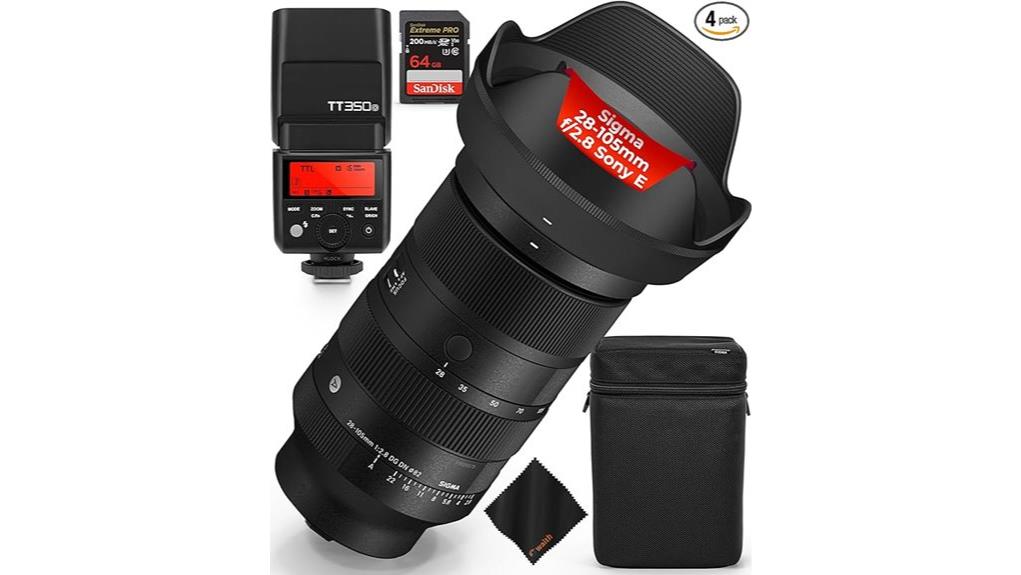
You’ll get a rare constant f/2.8 wide‑to‑short‑tele that balances strong center sharpness with smooth central bokeh and controllable chromatic aberration; corners peak around f/5.6–f/8 and microcontrast is impressive at f/2.8. Autofocus is quiet and responsive for stills and moderate video, and the weather‑resistant, compact build handles handheld use and close‑ups to 15.8 cm. The kit includes a Godox TT350S flash, 64GB UHS‑I card, and hood — more practical detail follows.
Some Key Takeaways
- Constant f/2.8 across 28–105mm offers versatile low‑light performance and consistent depth‑of‑field control.
- Excellent center sharpness; corners peak at f/5.6–f/8 with good microcontrast and edge resolution.
- Quiet, responsive HLA autofocus and weather‑resistant build suit stills and moderate video use.
- Compact, well‑balanced form with 15.8 cm close‑focus enables tight close‑ups without extension tubes.
- Strong value as an all‑in‑one portrait, event, and travel lens; consider lighter zooms or primes for ultimate sharpness.
Full Specs and What’s in the Box : Quick Summary for Buyers
While you scan gear lists, here's a concise, technical summary of what you get: the Sigma 28–105mm f/2.8 DG DN Art for Sony E (constant f/2.8, 15.8 cm minimum focus, HLA quiet AF, weather-resistant construction), a Sigma LCF-82 III front cap, Sigma LCR II rear cap, and dedicated lens hood; a Godox TT350S Mini Thinklite TTL flash (Sony ADI/P-TTL, HSS, 2.4 GHz radio, 16 channels/3 groups, 328 radio range) with diffuser, mini stand and protective case; a 64GB Extreme PRO UHS‑I SDXC card (U3/V30, 30–90 MB/s write range) suitable for 4K and raw/burst shooting; and a Waith microfiber cloth (pouch included). You’ll note robust build, sensible weight distribution for handheld use, and standard 82mm filter compatibility—everything aimed at versatile, professional workflows without unnecessary extras. This kit is ideal for mirrorless camera enthusiasts seeking a balanced set of essential gear for everyday and professional use.
Optical Performance in the Real World : Sharpness, Bokeh, and Low-Light Behavior
Because the Sigma 28–105mm f/2.8 DG DN Art pairs a constant bright aperture with modern optical design, you get consistently strong center sharpness across the range and usable corner performance when stopped down. In practical shooting you'll notice microcontrast and edge resolution remain dependable at f/2.8, though corners need f/5.6–f/8 for peak uniformity. Bokeh is smooth centrally, with natural falloff; background highlights show controlled onion-ring rendering and modest aperture-blade character. In low light the fast aperture plus competent coating keeps flare and coma flare in check; chromatic aberration is well-controlled in raw files and easily corrected in post. This makes it a versatile choice for photographers who care about filter selection and optical control, especially when using lens filters to manage reflections and contrast.
Autofocus, Build, and Handling : HLA AF, Weather Resistance, and Close-Focus Use
Although it’s compact for a constant‑f/2.8 zoom, the Sigma 28–105mm puts a lot of usable tech in your hand: the HLA autofocus system is quiet and responsive for stills and moderate video work, the chassis feels robust with weather‑sealing where it counts, and the 15.8 cm minimum focus distance lets you frame tight close‑ups without resorting to extension tubes. You’ll notice HLA responsiveness across focal lengths, locking quickly on contrast shifts with minimal hunting. Weather sealing reassures in damp conditions; seals are at mounts and rings rather than full immersion rated. Close focus is practical, and handling ergonomics favor balance and intuitive control. Don’t forget to protect unused hot shoes with stylish hot shoe covers to keep moisture and dust out when you’re shooting outdoors.
Flash, Storage, and Accessories Tested : Compatibility With Godox TT350S, Memory Card Performance, and Included Gear
If you rely on compact flash and tidy accessories, the bundled Godox TT350S, 64GB UHS‑I card, and cleaning gear give you a practical, ready‑to‑shoot kit. You’ll find TTL compatibility solid with Sony ADI/P‑TTL and high‑speed sync, so exposure automation works across the 28–105mm range; wireless 2.4 GHz control is reliable for multi‑flash setups. The 64GB UHS‑I card’s write speeds (30–90 MB/s) handle RAW bursts and 4K video without obvious buffering, though peak continuous shooting will still depend on camera buffer depth. Included caps, hood, diffuser, stand, case, and cloth are utilitarian and well matched. The kit pairs especially well with wireless flash triggers for streamlined multi‑flash control and portability.
Who Should Buy This Lens : Use-Case Recommendations, Alternatives, and Value-for-Money Verdict
Moving from accessories and real‑world handling to who’ll get the most from the Sigma 28–105mm f/2.8 DG DN Art, think of it as a single‑lens solution for photographers who need wide-to-short-tele coverage with constant bright aperture and robust build. You’ll appreciate portrait versatility—fast f/2.8, short tele focal lengths, and 15.8 cm close focus—if you shoot events or studio work without swapping lenses. Travel practicality is strong: one durable, weather‑resistant optic replaces several primes. Alternatives include lighter zooms or specialty primes if you prioritize weight or ultimate sharpness. Value hinges on your need for constant aperture and convenience. It also pairs especially well with a heavy-duty tripod for stable shooting in outdoor and travel scenarios.
Some Questions Answered
Is This Lens Compatible With APS-C Sony E Bodies?
Yes — you can mount this Sony E mount full frame lens on APS C bodies, and it’ll work fine. You’ll keep autofocus and exposure metering, but the APS C crop sensor narrows the field of view, effectively multiplying focal length by about 1.5×, so your 28–105mm behaves like ~42–157mm. You’ll lose some wide-angle coverage but gain reach; image quality and vignetting remain well controlled for typical APS C use.
Can I Use 82MM Filters Like Polarizers and ND on This Lens?
Yes — you can use 82mm filters like polarizers and ND on this lens. You’ll mount standard 82mm filters or 82mm adapters to the front thread; make sure you get slim filters to avoid vignetting at 28mm. Note that rotating filters (especially polarizers) will cause filter rotation relative to the lens; check for filter rotation issues with lens hood or stacked filters. Evaluate using 82mm adapters for step-up or special filters.
Does the Lens Extend or Change Length While Zooming?
Yes — the lens extends noticeably as you zoom from 28mm to 105mm. You’ll see physical barrel rotation minimal, but the outer barrel telescopes forward, altering length and shifting balance. That extension is smooth and damped, typical for internal-external hybrid designs. It can affect handling on gimbals or when using filters; expect slight front-heavy torque at longer focal lengths and plan support accordingly.
Is Lens Stabilization Required When Paired With In-Body Stabilization?
No, you don’t strictly need lens stabilization if your camera has effective in-body stabilization, but it can help. Optical VR can complement IBIS via firmware integration that coordinates lens and body corrections, improving compensation at longer focal lengths and for panning. If your camera supports coordinated stabilization, rely on IBIS plus lens VR when available; otherwise, prioritize lenses with VR for added stabilization and sharper handheld results.
How Long Is the Autofocus Motor Lifespan or Service Interval?
There’s no fixed lifespan; manufacturer specs don’t list exact motor hours, and user reports suggest reliable performance over several years with typical use. You should expect thousands to tens of thousands of actuations before issues, but heavy professional use shortens that. Monitor autofocus behavior, noise, and responsiveness; service when you see degradation. Follow recommended cleaning and firmware updates, and log usage to plan preventive maintenance based on actual wear.