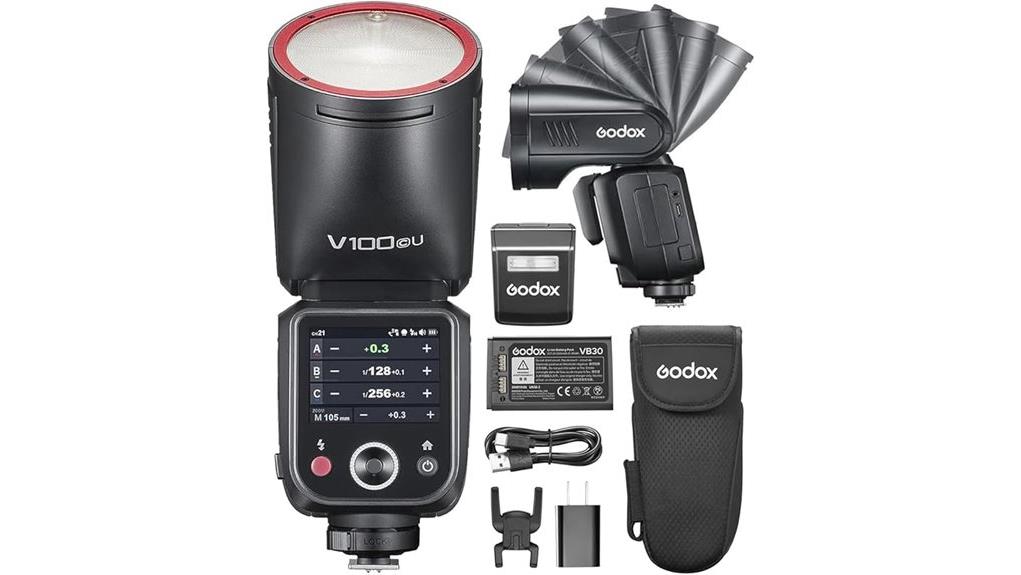
You’ll get a Canon‑native round‑head flash that delivers reliable E‑TTL and consistent HSS to 1/8000 s, with repeatable real‑world output for portraits and events. The VB30 Li‑ion pack gives fast recycles and USB‑C charging, though full‑power bursts slow performance. A 2.3‑inch touchscreen, detachable SU‑1 sub‑flash and magnetic round head improve control and modifier compatibility. Firmware quirks exist with older bodies and third‑party triggers, and more detailed performance notes follow.
Some Key Takeaways
- Canon‑compatible V100‑C delivers reliable E‑TTL/E‑TTL II metering and consistent exposures with updated firmware on Canon EOS bodies.
- Round head design yields softer shadows, smoother wrap, and better modifier compatibility than rectangular heads.
- HSS works up to 1/8000 s with predictable output falloff at extreme shutter speeds.
- VB30 rechargeable battery (2980 mAh) gives fast recycle times, ~50–100 full‑power flashes, and USB‑C charging.
- 2.3‑inch touchscreen, detachable SU‑1 sub‑flash, and Godox 2.4G X wireless provide versatile on‑camera control and grouping.
Quick Verdict and Key Specs: Is the Godox V100-C Worth Buying for Canon Users?
Although it builds on the V1 platform, the Godox V100-C delivers a clear upgrade for Canon shooters: you get a 100 Ws round-head flash with E-TTL/E-TTL II support, 1/8000 s HSS, a rechargeable 7.2 V/2980 mAh Li‑ion battery, a 2.3-inch color touchscreen, built‑in Godox 2.4G X wireless, and a detachable SU‑1 sub‑flash — all in a single unit compatible with Canon EOS bodies. You’ll appreciate power range, fast recycle, and touchscreen control. Note compatibility quirks with older non-EOS models and third‑party triggers. Overall value is strong; durability and demand should support solid resale value. Perfect Tripods offers related tripod and grip accessories to help stabilize on-location flash setups and improve shooting ergonomics with the Godox V100-C, including options for tripod compatibility.
How the V100-C Performs On-Camera: TTL, HSS, Recycle Times and Real-World Output
Having covered specs and value, let’s look at on‑camera performance: the V100‑C delivers reliable E‑TTL metering with Canon bodies, consistent HSS up to 1/8000 s, and fast recycle times from its 7.2 V/2980 mAh Li‑ion pack. You’ll see strong TTL consistency across varied scenes and modifiers; exposure errors are rare once firmware and camera TTL settings are updated. HSS reliability holds at extreme shutter speeds with predictable falloff. Recycle performance is rapid at moderate power, slowing only at repeated full‑power bursts. Real world output matches spec guide numbers, producing usable, repeatable light for portraits and event work. It also pairs well with a variety of flash triggers for expanded off‑camera control.
Controls, Battery and Usability: Touchscreen, VB30 Battery Life, Charging and Ergonomics
When you grab the V100‑C, the 2.3‑inch full‑color touchscreen makes menu changes and mode switching fast and intuitive, with responsive touch controls for TTL/manual selection, flash compensation, modeling lamp levels, and wireless X‑system settings. You’ll notice excellent Touchscreen responsiveness for quick adjustments on set. The VB30 Li‑ion cell delivers solid Battery longevity—manufacturer notes ~70 minutes average runtime and 50–100 full‑power flashes with cooling. Charging convenience comes via USB‑C and compatibility with VC26T or V1 docks for rapid turnaround. Ergonomic design balances head size and grip, with controls positioned for one‑handed operation and stable hot‑shoe mounting. This review also considers selecting the right AC adapter to ensure reliable power and charging performance.
Lighting Features That Matter: Round Head, Modeling Lamp, SU-1 Sub‑Flash and Wireless X System
On set, the V100‑C’s round head and integrated lighting features give you versatile, natural falloff and precise control: the circular head produces softer shadows and easier wrap for portraits compared with rectangular heads, the 2 W LED modeling lamp offers 10 adjustable levels (continuous or interrupt) for previewing catchlights and shadow behavior, and the detachable SU‑1 sub‑flash provides 22 power steps to add controlled fill without reorienting the main head. You’ll appreciate Round head benefits for modifiers and smoother falloff. Modeling lamp uses include exposure preview and focus assist. SU 1 fill lets targeted secondary light. Wireless X integration supports master/receiver control and one‑tap grouping. For photographers choosing gear, selecting the right head type can significantly improve portrait results by matching modifiers and control to shooting style, especially when considering tripod heads.
Who Should Buy the V100-C and What Alternatives to Consider
If you need a compact, round‑head E‑TTL flash that balances battery endurance, HSS up to 1/8000 s, and integrated wireless control, the Godox V100‑C is a strong choice. You’ll benefit if you shoot run‑and‑gun events, portrait sets requiring portable modeling lamp, or mixed ambient/high‑speed work where Canon E‑TTL and the Godox 2.4G X System matter. Its battery life and magnetic round head improve workflow; studio compatibility is acceptable for small setups but larger studios may prefer higher‑power strobes. Consider budget alternatives like used V1/V1 Pro units or entry Godox TT-series flashes if you need lower cost. Gear Guide serves enthusiast photographers and camera fans with product info and buying advice, useful for those researching digital cameras.
Some Questions Answered
Does the V100‑C Work With Non‑Canon Cameras Using Adapters?
Yes — you can use the V100‑C on non‑Canon bodies with an adapter, but functionality varies. Lens compatibility is mechanical via the hot shoe adapter, yet electronic E‑TTL features often won’t translate, so you’ll rely on manual mode. Trigger reliability depends on the adapter quality and whether your trigger supports Godox 2.4G X System; native X triggers work best. Test firmware and connections before critical shoots to make certain consistent performance.
Can the VB30 Battery Be Used in Other Godox Flashes?
Yes — the VB30 battery is compatible with several other Godox models that use the same VB30 form factor. You can expect reliable battery compatibility across supported Godox flashes, but you shouldn’t assume cross brand batteries will fit or perform safely. Always verify model-specific compatibility, firmware updates, and manufacturer guidance. Use only approved chargers and avoid third‑party cells unless they explicitly state compatibility and meet safety/quality standards.
Is the Round Head Compatible With Standard Softboxes and Modifiers?
Yes — the round head fits modifiers well and supports adapter compatibility. You’ll mount universal magnetic or iron-ring adapters (sold separately) to attach standard softboxes, grids, and beauty dishes. Make sure replacement rings meet quality specs for secure fit and correct light shaping. Some modifiers require specific adapter sizes; verify dimensions before purchase. The detachable red ring allows varied adapter options, but the head itself isn’t waterproof, so avoid moisture exposure.
Can the Flash Firmware Be Updated Over Usb‑C Without a Computer?
No — you can’t perform USB‑C updating directly on the unit without a computer. You’ll need a computer or compatible device to run Godox firmware tools and transfer updates via USB‑C. On‑camera updates aren’t supported natively; the flash requires connection to update software (or use a compatible Godox hub/charger workflow that supports firmware flashing). Always back up settings and update to the latest firmware per Godox instructions.
Are Replacement Red Rings and Parts Sold Separately by Godox?
Yes — Godox offers replacement rings and spare parts, but you should source genuine components. You’ll find removable red plastic rings, batteries, SU-1 sub‑flash modules, USB cables and other spare parts through official Godox dealers or authorized service centers. Use genuine parts to maintain performance and safety; replacements must meet quality standards. Check Godox support for availability, compatible part numbers, firmware compatibility, and warranty implications before purchasing.