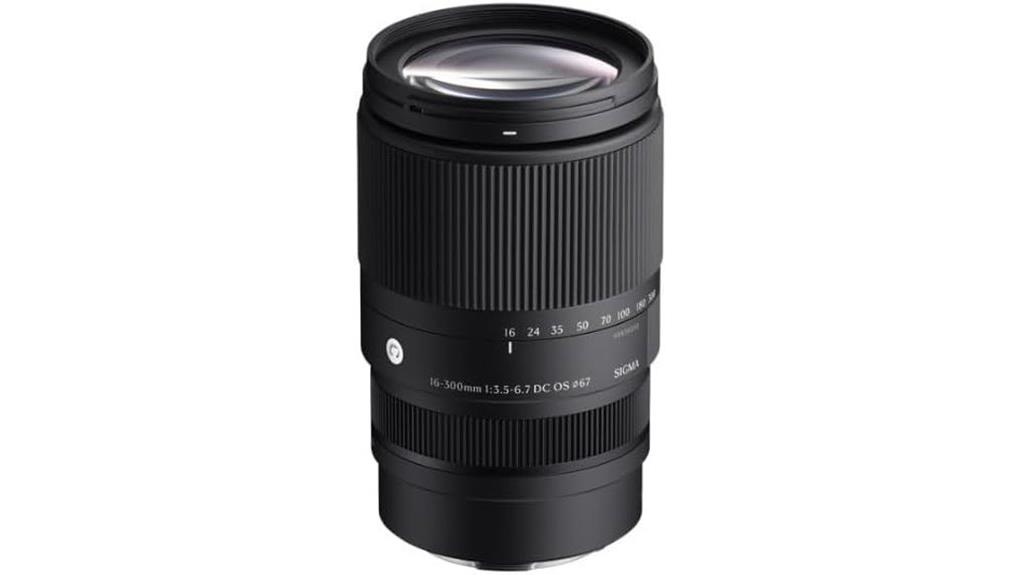
You’ll get a compact, weather‑resistant APS‑C all‑in‑one zoom covering 16–300mm (≈24–450mm equiv.) with a variable f/3.5–6.7 aperture, 1:2 close focus, nine‑blade diaphragm and OS rated up to ~6 stops. Autofocus uses Sigma’s HLA system for fast, accurate tracking though it can hunt in low contrast. Center sharpness is strong to ~100mm, edges and long end soften; chromatic aberration rises at extremes. Keep going and you’ll find detailed tests, sample images and practical verdicts.
Some Key Takeaways
- All-in-one 16–300mm (24–450mm equiv. on APS-C) zoom for Canon RF-mount APS-C bodies, ideal for travel versatility.
- Variable aperture f/3.5–6.7 limits low-light and shallow-depth control, especially at telephoto lengths.
- Strong center sharpness from 16–100mm; edges and extreme telephoto show softness and increased chromatic aberration.
- Optical Stabilization (up to 6 stops wide, 4.5 at tele) and HLA AF enable reliable handheld shooting and smooth video tracking.
- Weather-resistant, lightweight (~1 lb) build with 1:2 close-focus makes it practical for travel, portraits, and casual wildlife.
What the Sigma 16-300mm RF Actually Is and Who It’s For
The Sigma 16-300mm F3.5-6.7 DC OS Contemporary for Canon RF is an all-in-one, APS-C zoom that packs wide-angle to super-telephoto coverage (16–300mm, an 18.8x ratio) into a compact, weather-resistant package; you get a working focal range from 84° down to strong telephoto reach with a maximum magnification of 1:2, nine-blade diaphragm control, and HLA-driven autofocus tuned for high speed and accuracy. You’ll find it’s aimed at photographers who want single-lens versatility: travel companion for hike-to-city shoots, entry pros shifting between genres, and videographers needing stabilized reach. It’s a practical, budget alternative to multi-lens kits. It’s a great choice for mirrorless shooters looking for essential gear that minimizes lens changes on the go.
Key Specs That Matter: Focal Range, Aperture, Stabilization, and AF
Because you’ll rely on this lens for everything from sweeping landscapes to distant wildlife, its core specs — focal range, aperture behavior, stabilization, and autofocus — determine real-world usability more than any single number on the spec sheet. The 16–300mm range gives exceptional focal versatility on APS-C, covering 24mm-e to 450mm-e equivalents, so you can frame wide scenes and distant subjects without swapping optics. Aperture tradeoffs are explicit: f/3.5–6.7 limits low-light and depth-of-field control at telephoto. OS provides up to 6 stops wide, 4.5 at tele, and the HLA AF delivers fast, smooth tracking for moving subjects. For photographers who shoot demanding, high-speed action and shoot large files, pairing this setup with fast Cfexpress cards ensures reliable write speeds and buffer clearing.
Real-World Performance: Image Quality, Autofocus, and Video Tests
While you won't get flagship-grade sharpness at every focal length, the 16–300mm delivers practical, usable image quality across its range: center sharpness is strong from 16–100mm, softening gradually toward the edges and more noticeably at the longest reaches, where diffraction and reduced effective aperture (f/6.7) limit fine detail. In sharpness tests you’ll see contrast hold up well stopped down to f/5.6–8. Autofocus using the HLA system produced reliable focus tracking on moving subjects; occasional hunting appears in low-contrast scenes. Low light performance is acceptable with OS engaged; stabilization comparison favors this lens over unstabilized kit optics for handheld tele work. This makes it a versatile choice for DSLR enthusiasts and photographers looking for essential gear that covers wide to telephoto ranges.
Handling, Build, and Durability: Weather Resistance, Weight, and Ergonomics
Although it’s compact for an 18.8x all-in-one zoom, you’ll notice the Sigma 16–300mm’s 1-pound build balances portability with a reassuringly solid feel: magnesium-alloy and high-quality polycarbonate components give structural stiffness without unnecessary bulk, and the dust- and splash-resistant construction—paired with a water- and oil-repellent front element—provides practical protection for field use in mixed weather. You’ll find weather sealing effective against light rain and spray; seals around the mount and moving groups limit particulate ingress. Ergonomically, the barrel’s diameter and textured zoom ring deliver consistent grip comfort, while weight distribution minimizes fatigue during extended handheld use. For photographers shooting outdoors, pairing the lens with a dedicated camera rain cover can further protect your gear in heavier conditions.
Should You Buy It? Practical Pros, Cons, and Best Use-Cases
Having covered how the 16–300mm feels and handles in mixed conditions, let’s look at whether it fits your shooting needs. You’ll appreciate the single-lens coverage for budget travel—one APS-C zoom replaces multiple primes, reduces carry weight (1 pound), and offers 16–300mm flexibility. Pros: robust OS (up to 6 stops), high-speed HLA AF, 1:2 close-focus, weather resistance, usable for landscapes, portraits, and stopgap wildlife telephoto work. Cons: variable f/3.5–6.7 limits low-light and depth-of-field control; edge sharpness and chromatic aberration can drop at extremes. Buy if you want versatile convenience over specialist optical perfection. This lens is especially appealing to photographers focused on telephoto versatility who want fewer lenses while covering wildlife and sports situations.
Some Questions Answered
Does It Come With a Lens Hood and Caps in the Box?
Yes — the package includes a lens cap and a hood pouch. You’ll get front and rear caps to protect elements and a dedicated soft hood pouch that stores the supplied petal-style hood when not mounted. The pouch and caps are designed to fit the 67 mm filter thread profile and the lens barrel ergonomics. They’re water-resistant compatible with the lens’ dust- and splash-resistant construction and support secure transport and quick deployment.
Is It Compatible With Canon RF Full-Frame Adapters or Only APS-C Bodies?
It's designed for APS-C RF bodies, not full-frame; using a Canon RF full-frame adapter will likely force crop mode or cause vignetting concerns. You can physically mount it, but expect heavy corner darkening and potential sensor-crop fallback. Autofocus performance remains high-speed and accurate on supported APS-C bodies; on adapted full-frame cameras AF may still work but could be less reliable at extreme edges due to optical mismatch and vignetting.
Can I Use This Lens for Astrophotography or Low-Light Long Exposures?
You can, but with limitations: the variable f/3.5–6.7 max aperture reduces light gathering for faint star field work, so you'll push high ISO and encounter high ISO noise. Use wide end, fast mounts, and long exposures with sturdy tripod and OS off for astrophotography; prefer shorter exposures and stacking to limit star trailing. For deep-sky or pristine low-light long exposures, a faster, fixed-aperture lens will perform better.
How Does Warranty Coverage Handle Moisture or Impact Damage?
Warranty exclusions typically deny coverage for moisture ingress from misuse and impact damage, so you shouldn't expect repair under warranty for those causes. If moisture or shock occurs, the repair process involves inspection, a fault report, and component replacement billed to you; Sigma or the service center will provide an estimate before proceeding. Keep proof of proper use and consider paid repair or third-party insurance for accidental damage not covered.
Are Third-Party Teleconverters Supported or Recommended?
No — you shouldn’t expect official teleconverter compatibility, and using third-party teleconverters isn’t recommended. Teleconverter compatibility isn’t guaranteed with this all-in-one zoom’s optical design and AF system, and adding one will likely cause image degradation: reduced resolution, contrast loss, increased aberrations, slower autofocus, and possible AF hunting. If you require extra reach, you’ll get more reliable results with a native longer lens or dedicated teleconverter-approved optics designed for RF-mounted APS-C systems.