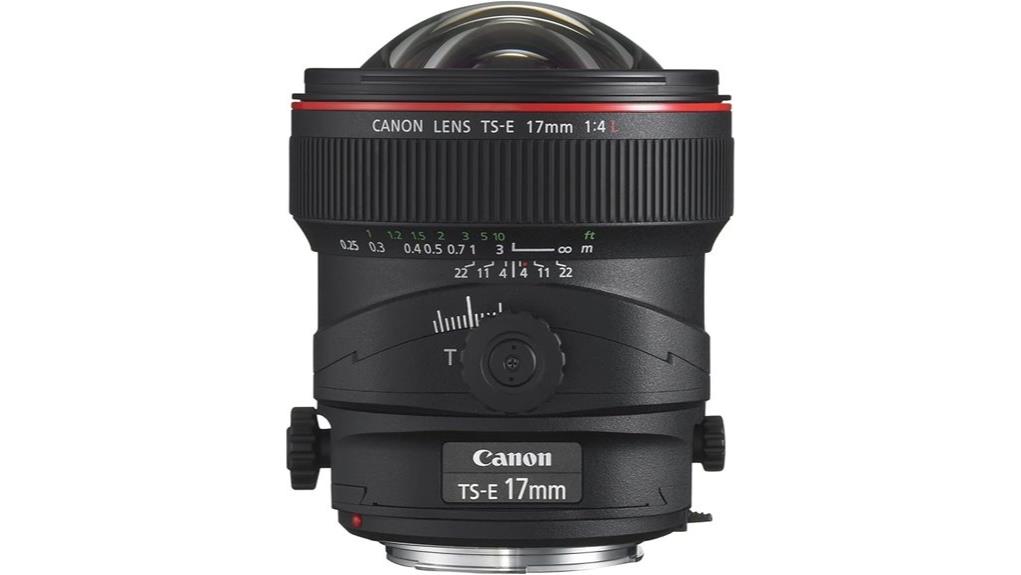
You’ll find the Canon TS‑E 17mm f/4L UD delivers rock‑solid, all‑metal handling and precise controls with ±12mm shift and ±6.5° tilt for rigorous perspective correction and Scheimpflug adjustments. Optically it’s sharp centrally by f/5.6–f/8, with mild wide‑open edge softness and low lateral CA; distortion is well controlled for 17mm. It’s tailored for architecture, interiors and fine‑art landscapes where repeatable geometry matters, and the next section explains practical techniques and tradeoffs.
Some Key Takeaways
- Exceptional build: all-metal construction and 820 g weight deliver durable, balanced handling with precise, tactile tilt/shift controls.
- Optical strengths: high center resolution stopped down (f/5.6–f/8) with strong microcontrast and modest corner falloff.
- Wide-open performance: mild softness and edge astigmatism at f/4, improving noticeably when stopped down.
- Tilt/shift functionality: ±12mm shift and ±6.5° tilt allow effective keystone correction and Scheimpflug control for architecture and landscapes.
- Practical use: ideal for pro architectural, interior, and landscape work when paired with sturdy tripods and careful incremental adjustments.
First Impressions and Build: Handling, Weight, and Controls
Pick the TS-E 17mm up and you’ll immediately notice its substantial, purposeful build: the all-metal construction and 820 g weight give it a balanced heft that communicates durability without being unwieldy on a tripod. You evaluate ergonomics assessment by handling the oversized focus and tilt/shift rings: knurled surfaces provide tactile feedback, detents are firm, and rotation resistance is consistent for fine adjustments. Control layout is logical—shift axis, tilt axis, and rotation locks are reachable without repositioning your grip—supporting workflow efficiency. Fit and finish are precise; machining tolerances reduce play, aiding repeatable, instrument-like operation in field use. Protect your gear with custom camera foam to keep lenses secure during transport.
Optical Performance: Sharpness, Distortion, Flare, and Chromatic Aberration
When you stop down to f/5.6–f/8 the TS-E 17mm delivers impressively high center resolution and a usable, if slightly softer, edge performance that benefits markedly from the tilt/shift corrections; wide-open at f/4 you’ll notice mild softness and edge astigmatism typical of extreme ultra-wides. You’ll find excellent edge acuity improvement when stopping down, with microcontrast rendition remaining strong in the center and slightly reduced toward corners. Distortion is well-controlled for a 17mm, requiring minimal correction. Flare is restrained by coatings but bright sun at oblique angles produces noticeable veiling. Lateral chromatic aberration is low, axial CA modest near wide apertures. Using a polarizing filter can further enhance skies and reduce reflections when shooting landscapes with this lens, especially when combined with polarizing filters for photography.
Tilt and Shift in Practice: Perspective Correction and Creative Focus Examples
Using the TS-E 17mm’s tilt and shift controls lets you correct converging verticals on tall buildings while keeping foreground and background elements simultaneously sharp, or alternatively craft a selective plane of focus that isolates subjects in a sweeping ultra-wide scene. You’ll use shift to rectify converging lines precisely, preserving proportional geometry without heavy cropping. Tilt lets you angle the focal plane for deliberate selective focus, producing miniature effect or isolating foreground detail across expansive vistas. Combine modest tilt with lateral shift to build layered composition—foreground, midground, background—in a single exposure. Execution demands careful viewfinder evaluation and incremental mechanical adjustments. This approach pairs well with sturdy support and accessories like precision tripods to maximize stability and alignment.
Real-World Use Cases: Architecture, Landscape, and Interior Shooting Tips
Although the TS-E 17mm’s extreme wide angle and generous shift range invite dramatic compositions, you’ll get the most reliable architectural results by planning camera placement, level, and shift direction before you compose. Use shift to correct convergence on facades, keeping verticals parallel without cropping; bracket shifts for full-gallery coverage. For landscapes, exploit edge-to-edge sharpness and minimal chromatic aberration to stitch panoramas and frame night skies with careful focus and exposure to limit coma. Inside, prioritize tripod placement and measured shifts for wide interiors, calibrate tilt for selective focus, and check micro-adjustments to maintain straight lines and consistent depth. Mastering zoom lens techniques like careful composition and shift use improves overall image quality and creative control for photographers mastering zoom lenses.
Value and Alternatives: Who Should Buy the TS-E 17mm and Comparable Lenses
If you prioritize absolute control over perspective and the widest possible rectilinear field of view for architecture, interiors, or expansive landscapes, the TS-E 17mm delivers unique capabilities that justify its premium positioning. You’ll value its ±12mm shift and ±6.5° tilt for keystone correction and Scheimpflug control, plus UD/aspherical optics that minimize chromatic aberration. As a buyers guide note, professional architects, real-estate stylists, and fine-art landscapers who demand pixel-level edge performance should buy it. Casual users should consider lighter alternatives or adapter-dependent alternative mounts for mirrorless bodies, such as corrected ultra-wides or smaller tilt-shifts, for lower cost and weight. For mirrorless camera enthusiasts, pairing the lens with purpose-built essential gear can improve handling and results.
Some Questions Answered
Does This Lens Support Autofocus on Any Camera Bodies?
No — the TS-E 17mm f/4L doesn’t offer autofocus on any camera bodies. You’ll rely on manual focusing techniques, using live view magnification, focus peaking (if available), and careful tilt/shift adjustments to set focus. For precise work, you’ll use tripod, cable release, and depth-of-field calculations to guarantee critical sharpness. Note autofocus compatibility is irrelevant here; the lens is designed for deliberate, manual control and perspective correction.
Can I Use Front Filters Like ND or Polarizers?
Yes — you can use front filters, but you’ll need care. The lens has a removable front cap and a rotating mount for orientation, so square or large round filters work best to avoid vignetting. Screw-on circular polarizers are possible if you use a large enough adapter or filter holder that mounts to the rotating front mount; otherwise, standard screw-in filters will vignette due to the ultra-wide 17mm coverage.
Is the Lens Weather-Sealed for Outdoor Shoots?
No — the lens isn’t weather-sealed. You shouldn’t assume protection from rain, dust, or heavy moisture; weather sealing? is effectively absent. For build durability? the TS-E 17mm uses robust L-series construction and solid mechanical shift/tilt components, so it’s tough but not sealed. You should use caution outdoors: carry a protective cover, avoid exposure in bad weather, and consider a rain sleeve or camera housing for reliable field use.
How Heavy Is the Lens When on a Mirrorless Adapter-Equipped Camera?
On a mirrorless camera with an EF adapter, the lens plus adapter weighs about 820 grams plus the adapter (roughly 50–120 g), so expect ~870–940 g total. You’ll notice the weight balance shifts forward, affecting handling ergonomics: you’ll need a firm grip or support to prevent nose-heavy torque. For critical work, use a tripod or L-bracket and consider lens/adapter placement to optimize center-of-gravity and reduce fatigue.
Does It Accept Canon Tilt-Shift Extension Tubes or Bellows?
No, it isn’t designed for Canon tilt-shift extension tubes or bellows; extension compatibility is limited by the TS-E 17mm’s complex mount and mechanical clearance. You’ll likely hit interference between the rear group and tube/bellow mount, and tilt/shift mechanisms can obstruct proper sealing and flange distance. If you need close focus, you’ll get unpredictable results and potential damage; use dedicated close-up optics or test carefully with custom adapters.