You’ll get a versatile Sony a7 III bundle that pairs a 24MP Exmor R sensor and BIONZ X with front‑end LSI for low‑light detail and clean high‑ISO RAWs, full‑pixel 4K oversampled from 2.4x, and HLG/S‑Log3 for grading. The 693‑point hybrid AF and 10 fps drive give fast acquisition and reliable tracking; IBIS plus OSS smooths handheld video. Kit lens and accessories are basic but useful; keep going to see detailed tests, pros, cons, and value comparisons.
Some Key Takeaways
- Full-frame 24MP sensor and BIONZ X with front-end LSI deliver high dynamic range, low-light performance, and clean detail up to ISO 6400.
- 4K UHD uses full-pixel readout with 2.4x oversampling for sharp footage; 1080p supports 120 fps for slow motion.
- 693-point hybrid AF and 10 fps continuous shooting provide fast subject acquisition and reliable tracking for stills and run-and-gun video.
- In-body stabilization plus lens OSS improves handheld video; HLG and S-Log3 offer strong grading latitude for professional workflows.
- Bundle provides a usable starter kit (28–70mm OSS, two 64GB cards, spare battery), but kit lens and bag are limited for long-term enthusiasts.
Sony a7 III Performance Highlights: Sensor, AF, and Video Capabilities
Explore the a7 III’s core strengths: its 24MP full-frame Exmor R BSI CMOS sensor paired with the BIONZ X processor and front-end LSI delivers high dynamic range, low noise at elevated ISOs, and fast readout for clean detail; the 693-point hybrid AF system combines dense phase-detection coverage with reliable contrast detection for quick subject acquisition and tracking; and video capability includes UHD 4K up to 30 fps using 2.4x oversampling with full-pixel readout to minimize moiré/aliasing, plus 1080p up to 120 fps for smooth slow motion and HLG/S-Log3 gamma for expanded grading latitude. You’ll exploit full frame dynamics and improved low light sensitivity, rely on consistent autofocus tracking across wide-frame scenes, and benefit from robust video oversampling that preserves resolution and reduces aliasing for professional-grade footage. The bundle includes a curated selection of essential accessories tailored for mirrorless camera enthusiasts.
What’s Included in This Bundle and How Each Accessory Performs
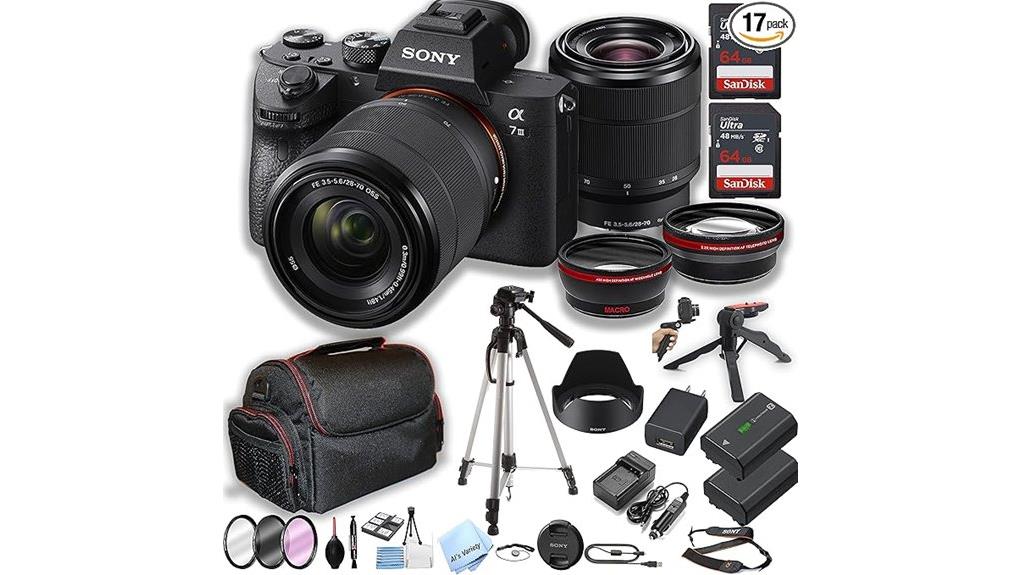
The bundle pairs the a7 III body and a basic FE 28–70mm f/3.5–5.6 OSS kit lens with a thorough set of power, storage, stabilization, and optical extras so you can shoot immediately and adapt to common scenarios; below I’ll assess each item’s practical performance and limitations. You get two 64GB Sandisk cards—adequate for 4K clips at conservative bitrates—and a spare high-capacity battery that noticeably extends battery life during long shoots. The tripod and GripPod provide stable framing but limited height and damping. Conversion lenses and 55mm filters are inexpensive; optical quality is modest. The camera gadget bag offers minimal case protection. For photographers who shoot extensively outdoors, having a reliable spare camera battery on hand can keep you shooting through long days without interruption.
Real-World Image and Video Results: Low Light, Action, and Portrait Tests
When you push the a7 III into challenging conditions it proves its strengths: the 24MP BSI sensor and BIONZ X processor deliver clean images up to ISO 6400 with usable detail retention and controlled luminance noise. You’ll find low light portraits retain skin tone and microcontrast when shooting RAW and applying modest NR; the kit 28–70mm with OSS helps but isn’t a fast portrait lens. For action, the 693-point AF and 10 fps drive lock subjects reliably; tracking excels in good light. Video benefits from 4K oversampling and in-body plus lens-based action camera stabilization combos for smoother handheld footage. For lighting-sensitive shoots, pairing the camera with LED light panels can dramatically improve image quality in low-light scenarios.
Pros, Cons, and Who Should Buy This Bundle (Use-Case Recommendations)
Although not perfect for every photographer, this bundle gives you a technically capable, versatile entry into full-frame imaging: the a7 III body supplies excellent dynamic range, high-ISO performance, 693-point AF and 10 fps shooting, while the FE 28–70mm kit lens and included stabilization/accessory kit cover common needs for travel, portraits, and run-and-gun video. You’ll appreciate robust autofocus, 4K oversampled footage, dual batteries and spare media. Pros: complete starter kit, stabilization, mobility. Cons: kit lens limits reach/fast aperture, conversion attachments degrade optics. Ideal for budget buyers, travel photographers, beginner videographers; advanced enthusiasts may use it as a capable secondary system. Consider adding an external monitor to improve framing and exposure when shooting video with this kit external camera monitors.
Price vs Value: Comparing This Bundle to Buying Body and Lenses Separately
You’ll want to compare the bundle’s asking price against current street prices for the a7 III body plus standalone lenses and accessories to see whether the package actually saves money or masks compromises. Calculate cost-per-feature: the international a7 III body, genuine FE lenses versus the included 28–70 kit and conversion optics, and two 64GB cards. Consider depreciation on the used market, probable resale, and how included adapters affect upgrade paths. Factor insurance costs for added accessories and travel suitability of the kit (weight, bulk, durability). If you plan pro glass, separate purchases often offer better long-term value. Also weigh battery options and runtime for mirrorless shooting, including third-party versus OEM solutions for camera batteries.
Some Questions Answered
Is This Bundle Eligible for Manufacturer Warranty Registration Internationally?
Yes — you can often register the camera internationally, but warranty transferability and regional restrictions matter. You’ll need to confirm the camera’s international version status and the seller’s warranty terms; some regions restrict service to locally purchased units or require proof of purchase within that territory. Accessories and thirdparty accessories typically aren’t covered by Sony. Contact Sony support with the serial number to verify registration eligibility and any regional limitations.
Can the Kit Lens Be Upgraded to a Native E-Mount Third-Party Lens Easily?
Yes — you can upgrade the kit lens to a native E‑mount third‑party lens easily. You’ll mount any Sony FE or E lens directly, preserving autofocus, image stabilization and EXIF communication; if you choose non‑E lenses, adapter options (mechanical or electronic) let you retain aperture control and AF performance on some models, though others may force manual focus. Check compatibility charts and AF/IS support per adapter to avoid surprises.
Does the Bundle Include Any Spare Camera Body Screws or Replacement Parts?
No, the bundle doesn’t include spare screws or dedicated replacement parts. You get batteries, chargers, caps, straps, filters, conversion lenses, tripod and cleaning tools, but no body screws or manufacturer spare components. If you need spare screws or replacement parts, you’ll want to source them from Sony service, authorized dealers, or third‑party repair suppliers. Keep receipts and serial numbers for warranty or official part ordering.
Are the Included Batteries Compatible With USB In-Camera Charging?
Yes — the included main and spare high-capacity batteries support USB charging via the a7 III body when you use a compatible USB-C cable and power source. USB charging? is available for convenient top-ups, but it’s slower than external chargers and won’t power the camera as efficiently during heavy use. Battery lifespan? depends on charge cycles, heat, and usage patterns; expect gradual capacity decline over hundreds of cycles.
Will the Wide/Tele Conversion Lenses Affect Autofocus Performance?
Yes — the wide/tele conversion lenses can affect autofocus performance. You’ll likely see increased autofocus latency and reduced subject tracking accuracy because converters alter focal length, light transmission, and may introduce optical aberrations that confuse phase-detect sensors. The a7 III’s 693-point system compensates well, but expect slower acquisition, occasional hunting, and narrower AF coverage at extremes. For critical fast-action work, use native optics or test converters thoroughly under your shooting conditions.