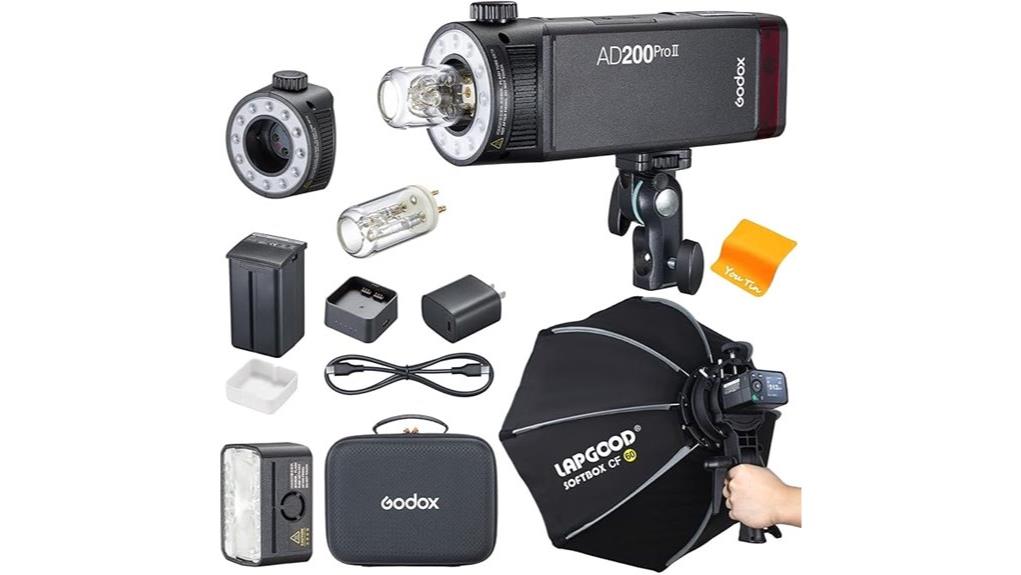
You’ll get a GN60, hot‑shoe‑mountable strobe with TTL/HSS, interchangeable heads, and a bright bi‑color modeling lamp that’s handy for location portrait and mixed‑light work. It’s compact and light, charges fast over USB‑C PD, and gives precise 0.1‑stop power steps, but it leans on a single battery and lacks weather sealing. TTL and HSS are reliable, though sustained high‑rate firing needs cool‑down. Keep going and you’ll find full testing, real battery numbers, and accessory notes.
Some Key Takeaways
- Compact, hot‑shoe‑mountable strobe offering GN60 with 1/512–1/1 power in 0.1‑stop steps for precise control.
- Reliable TTL and usable HSS for mixed‑light location portraiture with consistent flash durations.
- Interchangeable heads and bright bi‑color modeling lamp (≈5800K ±100K) with pro mode mapping intensity to output.
- Lightweight, single‑battery design with USB‑C PD fast charging; expect a day of mixed shooting but bring spares.
- Great value for portable studio output and TTL convenience, limited by single‑battery dependence and minimal weather sealing.
What the Godox AD200 Pro II Is and Who It’s For
Think of the Godox AD200 Pro II as a compact, versatile off‑camera flash that packs studio‑level output into a 2‑pound, hot‑shoe‑mountable package—ideal if you need portable power without lugging monolights. You’ll find a compact system that balances heft and flexibility: interchangeable heads, bi‑color modeling lamp, and robust wireless control. It’s tailored for photographers who shoot location portraits and mixed lighting, offering TTL/HSS and precise power steps. Critics will note limited weather sealing and a single battery, but for portrait work where mobility, consistent color, and studio features matter, it’s a compelling, pragmatic choice. It’s especially useful for photographers who use gimbals for video and stills because its compact size and balanced weight complement gimbal stabilizers when shooting on the move.
Hands‑On Performance: Power, Flash Modes, and Modeling Lamp Results
Put the AD200 Pro II to work and you’ll quickly notice it delivers studio-level output in a compact package: the GN60 provides plenty of punch for portrait work, the 1/512–1/1 power range in 0.1‑stop increments gives you fine control, and TTL/HSS behave reliably on mixed-light shoots. You’ll appreciate consistent flash durations across settings and usable high speed sync for ambient balancing. Modeling lamps are bright, bi‑color, and pro mode maps lamp intensity to flash output; color rendering stays stable near 5800K with ±100K variance. Heat control is improved, though continuous heavy bursts still warm the head. This kind of gear is ideal for photographers who use flash diffusers to soften light and control contrast.
Portability, Battery Life, and Charging (Real‑World Expectations)
Having covered power and modeling performance, let’s look at how the AD200 Pro II handles on location. You’ll appreciate the compact build and lightweight carry—about 2 pounds—making it easy to stash in a bag or the supplied carry case. The single lithium battery comfortably lasts through a day of mixed shooting; manufacturer claims a week, but expect real use to require recharging every few days or sooner under heavy bursts. Rapid charging via USB‑C PD is a practical plus, cutting downtime between shoots. Heat management is improved, though sustained high‑rate firing will still demand occasional rests. For photographers who travel or shoot on location frequently, pairing the AD200 Pro II with dual battery chargers can keep you shooting longer without interruption.
Compatibility, Wireless Control, and Softbox/Accessory Use
While the AD200 Pro II works with most major camera systems via hot‑shoe and supports Canon E‑TTL II, Nikon i‑TTL, Sony, Olympus, Panasonic, and Fujifilm protocols, you’ll get the most seamless experience using Godox’s 2.4G X system and an X-series trigger. You’ll appreciate reliable remote triggering, one‑tap pairing, and group labeling on both the head and X3 trigger for multi‑light setups. Mount compatibility is straightforward via the hot‑shoe and included AD‑E2 holder, though third‑party adapters may vary. Softbox adapters like the LAPGOOD CF60 attach securely, but check fit and light falloff when switching heads or modifiers. For photographers who use off-camera setups regularly, pairing the AD200 Pro II with compatible wireless flash triggers simplifies multi-light control and improves workflow.
Value Assessment: Pros, Cons, and Who Should Buy This Unit
When you weigh the AD200 Pro II against its price and features, it stands out as a compact, versatile strobe that punches well above its weight—offering TTL/HSS, a high GN60 output, bi‑color modeling lamps, and fast USB‑C PD charging in a pocketable package. You’ll appreciate the strong value: portable power, stable color, long modeling‑lamp runtime, and modern connectivity. Downsides include single‑battery dependence, no weather sealing, and slightly plastic build quality compared with pro monolights. If you need on‑location speed, TTL reliability, and a budget alternative to heavier kits, this unit’s a smart buy for hybrids and traveling pros. It’s especially useful for photographers who prioritize portable power and mobility when shooting outdoors.
Some Questions Answered
Does the AD200 Pro II Support TTL Metering With Third‑Party Triggers?
Yes — you can get TTL compatibility with the AD200 Pro II, but it depends on trigger firmware and trigger model. If your third‑party trigger fully supports the Godox 2.4G X system and has updated firmware, you’ll retain E‑TTL / i‑TTL / camera TTL functions. If the trigger’s firmware lacks proper Godox protocol support, TTL may fail and you’ll be limited to manual. Check trigger firmware updates and compatibility lists before buying.
Can You Use the Flash Submerged With Waterproof Housing?
No — you shouldn’t submerge the flash even inside generic underwater housings unless the housing is rated for your setup and has passed professional pressure testing. The AD200 Pro II isn’t water‑resistant and its ports, battery and modeling heads are vulnerable. If you insist on underwater work, buy a purpose‑built underwater housing made for that flash, verify pressure testing for your depth, and understand service/warranty will likely be voided if you proceed.
Is There an Optional AC Power Adapter for Studio Use?
Yes — you can use an AC adapter for studio power. Godox offers optional AC adapters that let you run the unit continuously instead of relying on the lithium battery. You’ll get more consistent recycle times and avoid battery swaps, but you’ll lose portability. Check compatibility with the AD200 Pro II model and make sure the adapter supplies the correct voltage/current. Confirm manufacturer specs and warranty implications before buying.
Are Spare/Replacement H200J II Heads Sold Separately?
Yes — you can buy spare heads; availability varies by retailer and region. Check Godox dealers and major photo stores for H200J II spare heads as replacement options. Pricing fluctuates: expect replacement pricing similar to other 200‑series heads, often lower than a full unit but not cheap. Compare OEM vs third‑party sellers, warranty coverage, and return policies before you buy to avoid surprises.
Does the Unit Accept Aftermarket Softboxes and Speedring Mounts?
Yes — you can use aftermarket softboxes and mount adapters with the unit. The AD200 Pro II accepts common speedring mounts and many third‑party softboxes designed for the Godox H200-style heads or bare‑bulb mounts. You’ll want to confirm softbox compatibility and check adapter diameter/type before buying, since some cheap mounts can be loose or block ventilation. Overall, quality adapters give reliable fit and light control, but test fit first.