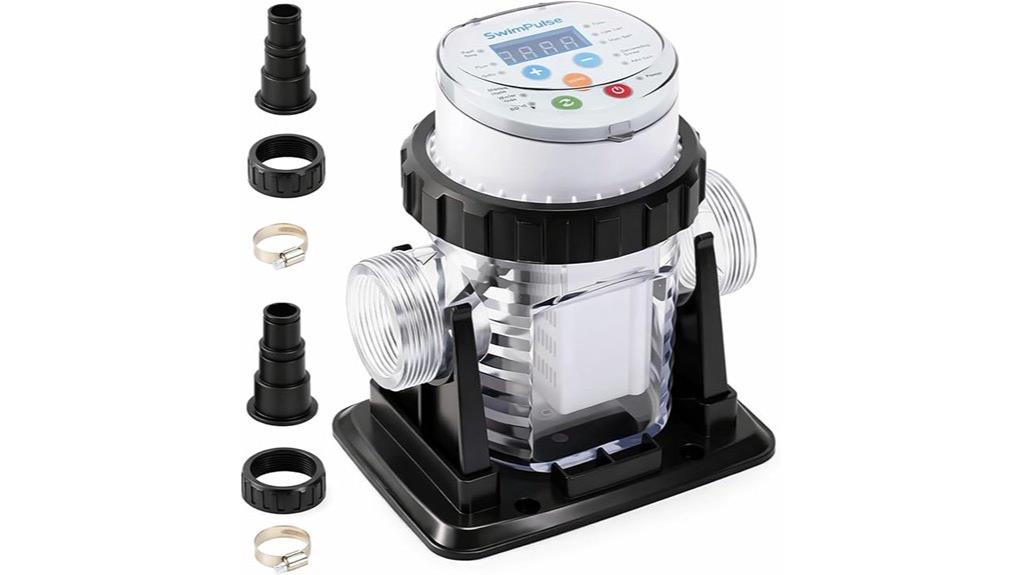
You’ll get a compact automated saltwater chlorinator that converts dissolved salt into chlorine and self‑cleans its cell to reduce scale. Sensors monitor salinity and output in real time and the unit auto‑adjusts to maintain target free‑chlorine, minimizing manual dosing and spikes. Install is quick for foldable or fixed above‑ground pools under 15,000 gallons with provided fittings and low‑voltage wiring; monthly checks and occasional cell cleaning extend life. Continue for setup, operation, and troubleshooting details.
Some Key Takeaways
- SPMA15 continuously converts dissolved salt to chlorine, automating sanitization for above-ground pools up to ~15,000 gallons.
- Self-cleaning cell and real-time sensors stabilize chlorine output and salinity, reducing manual dosing and scale buildup.
- Easy installation: mount control box by filtration outlet, use supplied adapters/brackets, and follow grounding and torque specs.
- Built-in timer (1–12 hours), LED controls, and alerts enable runtime matching to bather demand and proactive maintenance.
- Good value for residential pools—low chemical costs and warranty-backed support; choose alternatives for larger or commercial needs.
How the SwimPulse SPMA15 Works and Who It’s Best For
Operate the SwimPulse SPMA15 by letting its salt chlorine generator continuously convert dissolved salt into chlorine while the self-cleaning cell and sensors monitor output and salinity, so you get automated, consistent sanitization without daily dosing. You’ll rely on real-time feedback to maintain target chlorine residuals, reducing manual testing and chemical additions. For varied user profiles — single owners, family pools, seasonal users — programmable timer and alerts let you match runtime to load and bather demand. The device optimizes pool chemistry by adjusting production to salinity and usage patterns, minimizing corrosion risk and ensuring predictable microbial control.
Quick Setup: Installing the SPMA15 on Foldable and Fixed Above‑Ground Pools
Now that you understand how the SPMA15 automates chlorination and monitors salinity, get the unit mounted and configured for your specific above‑ground pool. You’ll position the control box near the filtration outlet, avoid contact with the pool liner, and use the included adapter for secure plumbing. For foldable pools, clamp mounting minimizes stress on soft walls; for fixed frames, use supplied brackets and torque specifications. Connect low‑voltage leads, ground per local code, and verify electrical safety before powering. Input pool volume, set the timer, and run diagnostics. Document serial/installation date for warranty and future troubleshooting.
Performance in Real Use: Chlorine Output, Self‑Cleaning Cell, and Automatic Salt Detection
Although the SPMA15 looks simple, its real-world performance hinges on three measurable systems: chlorine output consistency, the effectiveness of the self-cleaning cell, and the reliability of automatic salt detection. You’ll see stable chlorine consistency when flow and salinity stay within spec; output adjusts to maintain target free chlorine, minimizing spikes. The self-cleaning cell reduces scale accumulation, improving cell longevity, but periodic inspection verifies rake-back efficacy. Automatic salt detection alerts you before salinity drifts out of range, protecting output and cell life. Measure residual chlorine and inspect cell plates monthly to validate system claims and calibrate dosing.
Everyday Operation: Timer, LED Controls, Maintenance, and Troubleshooting Tips
Having confirmed consistent chlorine output, you’ll spend most of your time interacting with the SPMA15’s timer and LED controls, performing routine maintenance, and applying straightforward troubleshooting when alerts appear. You set the built‑in timer for 1–12 hours daily; verify scheduled runtime against measured free chlorine and adjust incrementally. Use LED calibration only if status indicators misalign with diagnostic readings; run calibration after power cycles. Clean the self‑cleaning cell monthly, inspect connections and salt readings, and record salt and output trends. For timer troubleshooting, reset to factory defaults, test with manual override, and consult error codes before replacing components.
Value Verdict: Cost, Warranty, Returns, and When to Choose an Alternative
When you weigh the SPMA15‘s upfront cost against its automated features and reduced chemical spend, it delivers a competitive total cost of ownership for above‑ground pools up to 15,000 gallons. You’ll recoup investment through lower chlorine purchases and reduced maintenance time. Check warranty details: manufacturer-backed coverage is provided (confirm period with vendor) and covers cell defects; warranty limits on wear items may apply. Amazon’s voluntary 30-day return policy gives trial flexibility. Choose an alternative if your pool exceeds capacity, you need commercial-grade output, or you require longer warranty/onsite service; otherwise SPMA15 balances cost and function.
Some Questions Answered
Is the SPMA15 Safe for People With Sensitive Skin or Eyes?
Yes — you’ll likely find SPMA15 safer for sensitive skin and eyes than traditional chlorine pools, because its gentle formulation produces lower free chlorine levels. You should still test for personal reactions: allergen testing or patch exposure is advisable if you have known sensitivities. The unit monitors salt and chlorine automatically, maintaining steady output, but you’ll want to verify local water chemistry and follow manufacturer guidance to minimize irritation risks.
Can the System Run on Solar Power or Low-Voltage Setups?
No — the unit isn’t designed for solar compatibility or low voltage operation. You’ll need a standard AC power source matching the manufacturer’s specifications. Trying to run the SPMA15 on a solar inverter or modified low-voltage supply can void warranties and compromise the self-cleaning cell, sensors, and timer. If you require solar or low-voltage integration, consult an electrician and SwimPulse support for approved power conversion solutions and safety compliance.
Are Replacement Cells or Parts Sold Separately by Swimpulse?
Yes — you can buy replacement cells and spare parts separately from SwimPulse. You’ll locate OEM replacement cells, adapters, and common spare parts through SwimPulse support or authorized retailers; they list compatible part numbers for model SPMA15. You should verify cell serial compatibility and warranty coverage before purchase. Keep records of your unit’s MPN/ASIN and consult technical support to confirm correct spare parts and expected lead times.
Does Saltwater Affect Pool Liners or Surrounding Deck Materials?
Yes — saltwater can cause salt corrosion if concentrations or splashes contact vulnerable surfaces. You should evaluate material compatibility: vinyl liners tolerate typical pool salinity but can degrade from improper chemistry or aged material. Metal fittings, fasteners, and some composite deck fastenings may corrode without stainless or coated hardware. You should maintain correct salinity, monitor chlorine/salt levels, rinse splash areas, and use compatible, corrosion-resistant materials and finishes to mitigate damage.
Can Multiple SPMA15 Units Be Linked for Larger Pools?
No — you can’t reliably link multiple SPMA15 units in parallel for capacity scaling. The SPMA15 is sized and calibrated for single-unit control up to 15,000 gallons; chaining units can create conflicting sanitizer feedback, uneven salt sensors, and timer/control conflicts. For larger pools, you should select a higher-capacity model or consult SwimPulse technical support for approved multi-unit configurations or synchronized installation procedures to guarantee stable chlorine output and sensor accuracy.