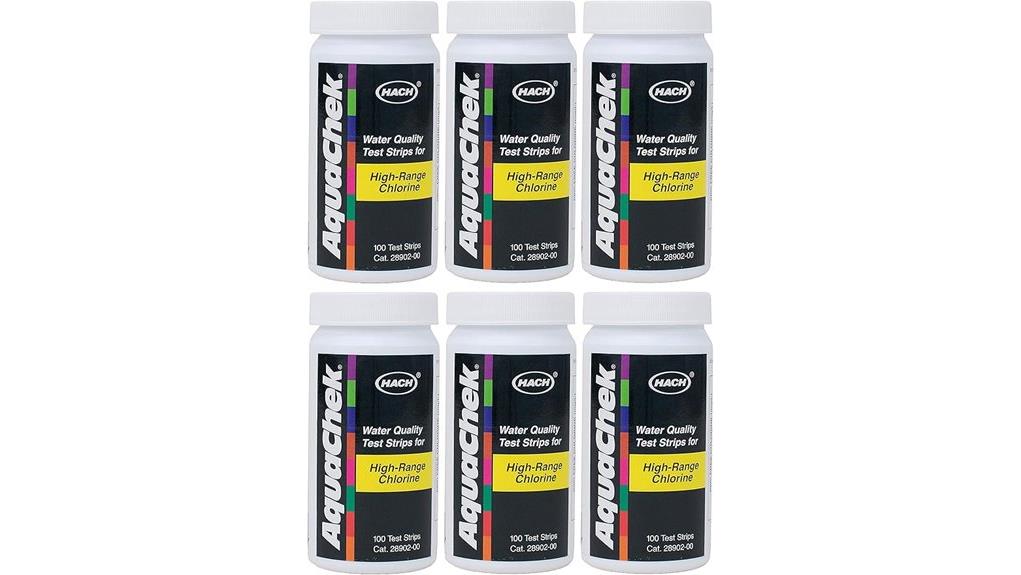
You’ll get a rapid single-dip check for very high free-chlorine levels up to 600 ppm, ideal for spot audits, incident response, and professional oversight. The strips detect free (not combined) chlorine in discrete color bands, showing results in seconds without calibration. Use 1–2 s dips, record at 0/5/15 s, and dilute (1:10 or 1:100) for extreme concentrations then multiply back. They’re practical for surface-disinfection verification; continue for detailed use, limits, and handling tips.
Some Key Takeaways
- Measures free chlorine only, with a high range up to 600 ppm suitable for surface-disinfection checks rather than pool maintenance.
- Quick single-dip method yields color results in seconds; compare immediately and record at 0s, 5s, and 15s for stability.
- Uses discrete color bands (not continuous ppm), so it flags high concentrations but lacks fine precision near thresholds.
- For very high levels dilute samples (1:10 or 1:100) and multiply readings back to estimate actual ppm.
- Practical pros: 100 strips per bottle, rapid reads, no calibration; cons: not for low-level testing and color interpretation can be subjective.
Quick Verdict and Who Should Use Aquachek High Range Chlorine Test Strips
If you need to confirm very high free-chlorine levels quickly, Aquachek High Range Chlorine Test Strips deliver: a 100‑strip bottle (sold in packs of six) measures free chlorine up to 600 ppm with a single dip and gives results in seconds, making them practical for verifying surface disinfection or detecting extreme chlorine spikes. You’ll get fast checks ideal for professional users who need rapid confirmation without lab delay. The strips are compact, require no calibration, and minimize handling time. Use them for routine spot audits, incident response, or oversight where quick, reliable presence/absence data for extreme chlorine is required.
What the Strips Measure and How Accurate They Are (Range, Detection Limits, Timing)
Understand exactly what you’re measuring: these AquaChek High Range strips detect free (not combined) chlorine across a wide span—up to 600 ppm—so they’re designed to flag very high concentrations rather than routine pool levels. You get High range sensitivity for surface-disinfection checks and safety confirmations. Detection increments cover from low double-digits to 600 ppm; manufacturer guidance and color chart define discrete bands rather than continuous ppm. Results appear in seconds, reflecting Rapid detection limits suitable for quick on-site decisions. Accuracy is adequate for presence/level confirmation but not a substitute for lab-grade titration when precise ppm is required.
Real-World Test Results: A Step-by-Step Single-Dip Test and Example Readings
Grab a strip, dip it once, and read the color change within seconds to get a practical indication of free chlorine levels up to 600 ppm. You’ll use the single dip technique with timing consistency: immerse 1–2 seconds, remove, and compare immediately. Record real world readings at 0s, 5s, and 15s to confirm stability. For very high concentrations, perform sample dilution (1:10 or 1:100) using distilled water, then multiply back to report ppm. Example: undiluted reads ~60 ppm; 1:10 diluted reads 6 ppm → report 60 ppm. Log temperature and time for repeatable, data-driven results.
Pros, Cons, and Comparison to Standard Chlorine Strips for Surface Disinfection
While standard low-range chlorine strips are designed for pool and drinking-water checks, AquaChek High Range strips target the very high concentrations you’d encounter during surface disinfection—measuring free chlorine up to 600 ppm in seconds with a single dip—so you’ll get a direct, practical readout where typical strips top out and become unusable. You’ll benefit from High range sensitivity that differentiates 50–600 ppm, giving actionable data for disinfection verification. Pros: rapid result, single-dip simplicity, 100 strips per bottle. Cons: not suitable for low-level testing, limited color precision near thresholds. Field durability is strong; packaging protects strips for routine on-site use.
How to Buy, Store, and Get Reliable Results From These Strips
Now that you know how these high-range strips differ from standard ones and where they shine, here’s how to buy, store, and get reliable readings. Buy from reputable retailers or the manufacturer’s site; check pack quantity (100 strips per bottle, six bottles per pack) and verify lot codes. For reliable results, dip once, read within seconds, and compare to the high-range chart for up to 600 ppm. Storage tips: keep bottles sealed, store at 15–25°C away from sunlight and humidity. Shelf life: check expiration and use within manufacturer-stated months after opening. Handling precautions: avoid wet hands, close cap immediately, and don’t mix lots.
Some Questions Answered
Are These Strips Safe to Handle Without Gloves?
No — you should wear gloves and avoid skin contact. These strips detect extremely high free chlorine (up to 600 ppm), and residual reagent or transferred chlorine can irritate skin. You’ll get results in seconds with a single dip, but handle the bottle and wet strip with nitrile gloves, discard used strips safely, and wash hands after handling. Following these steps minimizes chemical exposure and guarantees accurate, consistent readings.
Do the Strips Detect Combined Chlorine or Chloramines?
No — the strips detect free chlorine, not combined chlorine (chloramines). You’ll get a rapid, single-dip reading proportional to free chlorine concentration up to 600 ppm. If you need to quantify combined chlorine or chloramines, you’ll have to use a different test method (total chlorine minus free chlorine or specific chloramine tests). For surface disinfection validation, rely on the high-range free chlorine result as the actionable metric.
Can Expired Strips Still Indicate High Chlorine Qualitatively?
Yes — expired strips can still indicate very high chlorine qualitatively, but you shouldn’t rely on them quantitatively. Over time sensitivity drift and color stability degradation occur, so faint or borderline readings become unreliable. If you only need a yes/no for extremely high free chlorine, expired strips often still show a strong color change, yet for any critical verification use fresh strips or a calibrated instrument to avoid false negatives or underestimates.
Are Readings Affected by Strongly Colored or Dirty Surfaces?
Yes — strongly colored or dirty surfaces can skew readings. You should clean heavily stained areas first because surface staining or soils can mask the test pad color change. Also control lighting conditions: poor or colored light can make interpretation unreliable. For best accuracy, wipe or rinse the surface, perform the single-dip test on a clean representative spot, and read the result in neutral, bright light to minimize false negatives or ambiguous high-range indications.
Is There a Recommended Disposal Method for Used Strips?
Yes — you can usually discard used strips in household trash, but follow local regulations if they classify chemical test materials as hazardous waste. After single dip use, let strips dry, seal them in a small bag, and place them in your regular garbage unless guidance states otherwise. If your area requires special handling, take them to a hazardous waste facility. Document disposal per workplace or institutional protocols for compliance.