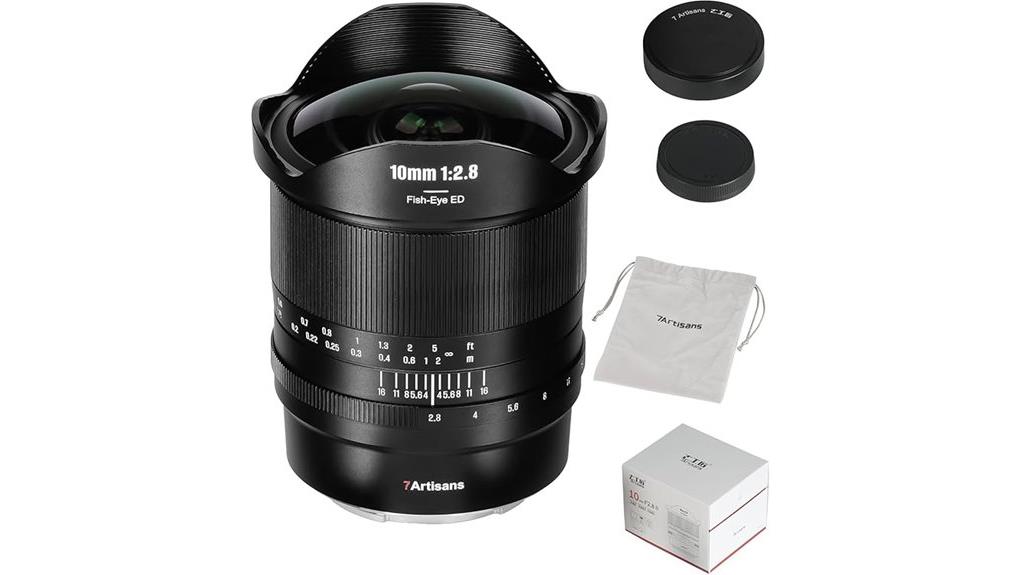
You’ll get an extreme 185° fisheye that prioritizes immersive, dramatic perspective over convenience, so expect bold foreground dominance and creative distortion. Center sharpness is strong around f/2.8–f/5.6, but edges soften with curvature and micro‑astigmatism. It’s compact, solid, fully manual on RF with a long, smooth focus throw—no AF or weather sealing. F2.8 helps low‑light and astro work though corner coma and vignetting persist. Keep going and you’ll find detailed tips on handling, correction, and workflow.
Some Key Takeaways
- 185° fisheye delivers extreme immersive perspective with pronounced foreground dominance and creative distortion ideal for travel and architecture.
- Fast F2.8 center sharpness is strong at F2.8–F5.6, while edges show curvature, micro-astigmatism, and declining detail.
- Manual-focus RF-mount build is compact, solid, and smooth, but lacks autofocus and weather sealing, slowing fast-paced work.
- Good low-light and astro capability thanks to F2.8, but edge coma and vignetting require stopping down and careful focusing.
- Post-processing needs accurate lens profiles and selective de‑distortion to correct warp, vignetting, and recover usable framing.
Who This 7artisans 10mm F2.8 II Is For
Who benefits most from the 7artisans 10mm F2.8 II? You will if you prioritize dramatic perspective over absolute convenience. Travel photography shooters who crave immersive scenes get a compact, manual-focus tool that forces deliberate framing and yields striking environmental context. Architecture enthusiasts gain a provocative, ultra-wide tool for exaggerated interiors and facades, especially when you plan corrective post-processing. You won’t love it if you need autofocus, fast-paced shooting, or bulletproof edge-to-edge rectilinear rendering. It’s best suited to patient photographers who control composition, accept manual focus, and exploit the lens’s extreme view to create bold, spatially complex images. Its compactness and specialized design make it a natural fit for wide-angle lenses enthusiasts seeking dramatic perspective.
What the Lens Delivers Optically (185° Fisheye, Sharpness, Bokeh)
Although the 185° fisheye projection immediately overwhelms the frame, it gives you an expansive, immersive perspective that redefines spatial relationships and compels creative composition. You get a pronounced 185° impression: scenes feel theatrical, foregrounds dominate and backgrounds recede, which forces deliberate framing. Center sharpness is impressive at F2.8–F5.6; fine detail holds well. Edge sharpness falls off noticeably and shows curvature and micro-astigmatism, so expect softer peripherals unless you stop down and correct in post. Bokeh is unconventional—busy, onion-ringed highlights near the center and smeared towards edges—useful for mood, less for classical subject isolation. This lens is ideal for photographers who enjoy exploring immersive perspectives and creative distortion effects.
Handling, Build, and RF-Mount Manual-Focus Experience
Shifting from optical behavior to how the lens feels in your hands, the 7artisans 10mm F2.8 II is compact and solidly built for a manual-focus RF optic. You’ll notice a reassuring weight and metal construction that resists flex, though weather sealing’s absent. The textured grip on the barrel aids handling, preventing slips during low-angle shooting. Focus action is smooth and damped, with a long, predictable focus throw that supports precise near-to-infinity framing; however, no focus scale lighting or AF assistance can slow fast-paced work. Mounting feels snug; overall, it’s tactile and purposeful but clearly aimed at deliberate shooters. For operators who frequently use shoulder rigs and similar supports, its balance and handling pair well with camera shoulder rigs to improve comfort during extended shoots.
Astrophotography and Low-Light Performance (F2.8, Star Preservation)
Because the 7artisans 10mm F2.8 II gives you an F2.8 aperture on a 185° field, it captures a lot of sky light and lets you use shorter exposures than slower ultra-wides, which helps keep stars sharp and minimizes trailing on handheld or short-tracking shots. You’ll benefit from brisk shutter speeds and lower ISO, reducing noise versus smaller-aperture fisheyes. Manual focus demands care—use live view magnification and focus peaking. Optics render many pinpoint stars, though edge coma and vignetting remain noticeable at wide-open. For serious astrophotography, combine disciplined low light techniques with selective stopping down to improve corner fidelity while watching star trailing. For best results when using this lens at night, consider pairing it with ND filters to manage exposure and preserve image quality.
Post-Processing, Distortion Correction, and Recommended Workflow
When you bring the 7artisans 10mm F2.8 II into post, prioritize lens-profile correction first to guarantee the extreme fisheye warp and recover a more usable, rectilinear framing for compositional clarity. You’ll load or create accurate lens profiles to correct field curvature, peripheral stretch, and vignetting while preserving central sharpness. Apply selective de-distortion rather than blind auto-correct to avoid unnatural geometry. Use batch processing for sequences or astro stacks to guarantee consistent correction across frames. Finish with spot-specific tweaks: perspective control, chromatic aberration removal, and micro-contrast adjustments. Be critical—overcorrection flattens the lens’s distinctive spatial character. Consider also selecting an appropriate tripod head to maintain precise framing and stability during capture.
Some Questions Answered
Does the Lens Include Weather Sealing or Moisture Protection?
No, it doesn’t offer dedicated weather resistance or moisture protection. You’ll need to assume basic mechanical build without sealed gaskets, so shooting in rain, heavy humidity, or dusty conditions risks internal contamination. For critical work, you should use external protection—rain covers, protective sleeves, or a sealed camera body—and avoid changing lenses in wet environments. That conservative approach preserves optics and maintains long-term performance.
What Is the Filter Compatibility or Accessory Mounting Options?
You can’t use front screw-on filters on this fisheye, so filter options are limited; you’ll rely on a rear cap for protection and a dedicated lens hood to shield stray light. You’ll need gel or holder-style filters designed for rear or specialized mounts, and creative workarounds for ND/grad needs. Critically, expect added post-processing for corrections—accessory mounting is constrained, so plan gear around the lens’ fixed optical front.
Is There Any Warranty or Manufacturer Support for Canon RF Users?
Yes — you’ll rely on Canon support for mount-specific issues, but the lens itself comes with the manufacturer’s Limited warranty from 7artisans. You’ll need to register and keep proof of purchase; warranty covers defects, not user damage or wear. For RF mount compatibility problems you should contact Canon support first; for optical or build defects file a claim with 7artisans under their Limited warranty procedures.
How Heavy Is the Lens and How Does It Balance on Small Bodies?
The lens is fairly light, so you’ll find lightweight handling on small bodies. It’s compact and won’t pull your camera down, giving compact balance that’s comfortable for handheld shooting. You’ll notice a front-heavy tendency with extreme tilts, but it’s manageable; use a short handgrip or strap for stability. Critically, the manual-focus ring and solid build help maintain control, though you’ll want to monitor balance with heavier accessories attached.
Are Electronic EXIF or Aperture Data Transmitted to the Camera?
No — it doesn’t transmit electronic metadata or aperture reporting to the camera. You’ll manually set focus and aperture on the lens, and the camera won’t record electronic EXIF aperture values. That limits in-camera exposure logging and lens-identification data, so you’ll need to track settings manually or add metadata later. For critical workflows, plan to note aperture and exposure or use external logging tools to preserve accurate shooting data.