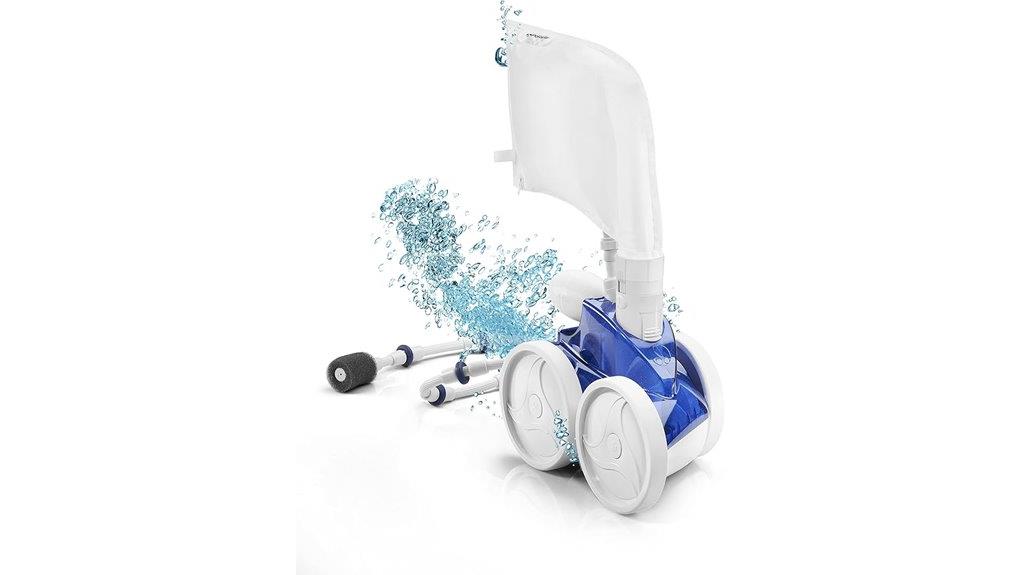
You’ll get fast, reliable debris removal with the Polaris Vac-Sweep 380 if you fit a proper booster pump and manage the hose and bag. Its triple Venturi jets and 2.25″ inlet handle leaves, pebbles, and acorns efficiently, finishing most inground pools in about three hours. Walls scrub adequately; floors clean consistently. Hose length and pump flow critically affect suction and sweep. Expect simple setup, routine bag maintenance, and guidance on optimizing pump and routing if you want full performance.
Some Key Takeaways
- Reliable pressure-side cleaner that finishes most standard inground pools in about three hours.
- Uses a separate Polaris booster pump and triple Venturi jets for propulsion and strong debris suction.
- Large 2.25″ inlet and single-chamber bag pick up leaves, pebbles, and acorns effectively.
- Performance drops with inadequate booster pump flow or excessively long, kinked hose runs.
- Best for buyers wanting strong cleaning and simple operation, but expect booster pump cost and bag maintenance.
Quick Verdict : Is the Polaris Vac-Sweep 380 Worth Buying?
If you want a reliable pressure-side cleaner that tackles large debris and scrubs floors and walls without fuss, the Polaris Vac-Sweep 380 is worth strong consideration. You’ll get fast coverage (under three hours), a 2.25″ inlet for leaves and pebbles, and self-propelled operation—features that improve cleaning efficiency. In a value assessment, the 380 balances performance and simplicity for in-ground pools. In a cost comparison, factor the required booster pump and single-chamber bag maintenance; these raise lifetime costs versus suction cleaners but outperform many peers on debris handling. You’ll appreciate its targeted utility if you prioritize large-debris removal. Vingli pool vacuum features and benefits include a lightweight design for easy maneuverability and a powerful suction that captures fine debris. Additionally, its energy-efficient operation allows for extended use without significantly increasing your utility bills. This makes it an ideal choice for pool owners looking for a cost-effective cleaning solution.
How the Vac-Sweep 380 Works and What’s in the Box
Because the Vac-Sweep 380 uses triple Venturi jets driven by a separate Polaris booster pump, it converts high-pressure water into strong, self-propelled motion and suction that scrubs walls and sweeps the floor while funneling large debris into its 2.25″ inlet. You’ll appreciate the clear pressure mechanics: booster pump feeds jets, Venturi effect creates propulsion and intake, and the unit’s touch control moderates travel. In the box you get the Vac-Sweep 380 unit, a 31-foot feed hose, and a single-chamber debris/filter bag. Evaluatively, debris capacity suits typical yard fallout; setup is user-installed with minimal steps.
Real-World Performance : Cleaning Speed, Debris Pickup, and Surfaces
Having outlined how the booster pump and triple Venturi jets power the Vac-Sweep 380 and what’s included, let’s examine real-world cleaning performance. You’ll finish most standard inground pools in three hours or less; progress is predictable and repeatable. Cleaning consistency is strong on flat floors—large 2.25″ inlet and single-chamber bag grab leaves, pebbles, acorns. Wall scrubbing is adequate but slower. Suction variability shows up with marginal booster pump flow or long hose runs: weak flow reduces sweep pattern and debris pickup. On vinyl, fiberglass, gunite and pebble surfaces it performs reliably; tile needs occasional manual touch-up.
Compatibility, Installation, and Setup With a Booster Pump
When preparing to run the Polaris Vac-Sweep 380 you’ll need a dedicated booster pump sized to deliver consistent flow to the cleaner’s triple Venturi jets; inadequate pump capacity or excessive hose length will degrade sweep pattern and debris pickup. You should verify booster sizing against Polaris recommendations—flow, head pressure, and rpm—so the Vac-Sweep’s agitation and large 2.25″ inlet work as specified. Hose routing matters: minimize kinks, avoid sharp bends, and keep the supplied 31-foot feed hose as direct as possible to reduce friction loss. Install the pump on a stable pad, plumb with proper unions, and test system balance before operation.
Pros, Cons, Warranty, and Who Should Buy This Model
While the Vac-Sweep 380 delivers robust debris pickup and reliable wall-and-floor scrubbing thanks to its triple Venturi jets and large 2.25″ inlet, you should weigh those strengths against its booster-pump requirement and hose-management needs. Pros: efficient 3-hour clean cycles, large inlet, compatible with multiple surfaces, self-propelled operation. Cons: requires separate Polaris booster pump, plastic parts susceptible to wear, hose tangling if not managed. Warranty: 1-year manufacturer defect coverage; 30-day voluntary return window. Who should buy: you if you prioritize strong cleaning and can commit to maintenance. Maintenance tips: inspect hoses, clean debris bag, monitor long term durability.
Some Questions Answered
Can It Run Without a Polaris Booster Pump?
No — it requires pump assistance; it won’t run effectively on suction alone. You’re relying on a separate Polaris booster pump to supply the triple venturi jets that drive self-propelled movement and sweeping action. Without that booster, you’ll have limited suction, reduced debris capture, and impaired wall/floor scrubbing. If your system can’t add a booster, expect poor performance; don’t assume standard pool suction will suffice.
How Often Should the Debris Bag Be Emptied?
Empty the debris bag after each heavy debris event or every 3–7 uses, whichever comes first. You should follow a maintenance schedule: inspect the single-chamber debris capacity weekly during peak leaf season and monthly in low-use periods. If flow or suction drops, stop and empty immediately. Regular checks prevent overload, protect the booster pump and maintain cleaning performance. Replace bag if torn or clogged to preserve peak operation and longevity.
Is the Hose Compatible With Other Polaris Models?
Yes — the 31-foot feed hose offers reasonable hose interchangeability with many Polaris pressure-side models, but you’ll need to verify connector compatibility. You’ll swap hoses among similar-era Polaris units that use the same diameter fittings and quick-connect styles. Check the hose diameter, cuff type, and booster pump connection before mixing. If fittings differ, adapters or original-model hoses are recommended to maintain seal integrity and peak vacuum performance.
Can It Operate in Pools With Steps or Attached Spa?
Yes — it can. You’ll find the Vac-Sweep 380 handles step navigation and small elevation changes, plus often provides adequate spa clearance when installed correctly. Its self‑propelled drive and 31′ hose let it traverse steps and clean adjacent spa entrances, but performance depends on step geometry and booster pump pressure. You should test in your pool and adjust hose length and booster pump flow to guarantee reliable step access and spa clearance.
Are Replacement Bags and Hoses Readily Available?
Yes — replacement bags and hoses are readily available. You’ll find OEM and aftermarket filters from major pool suppliers and online retailers; aftermarket filters often cost less and meet specs. Hoses (31-foot sections) and couplings are common stock items. Check for seasonal discounts to lower purchase costs. Evaluate material compatibility and thread fittings before buying to guarantee reliable performance and maintain the vacuum’s debris capture and flow characteristics.