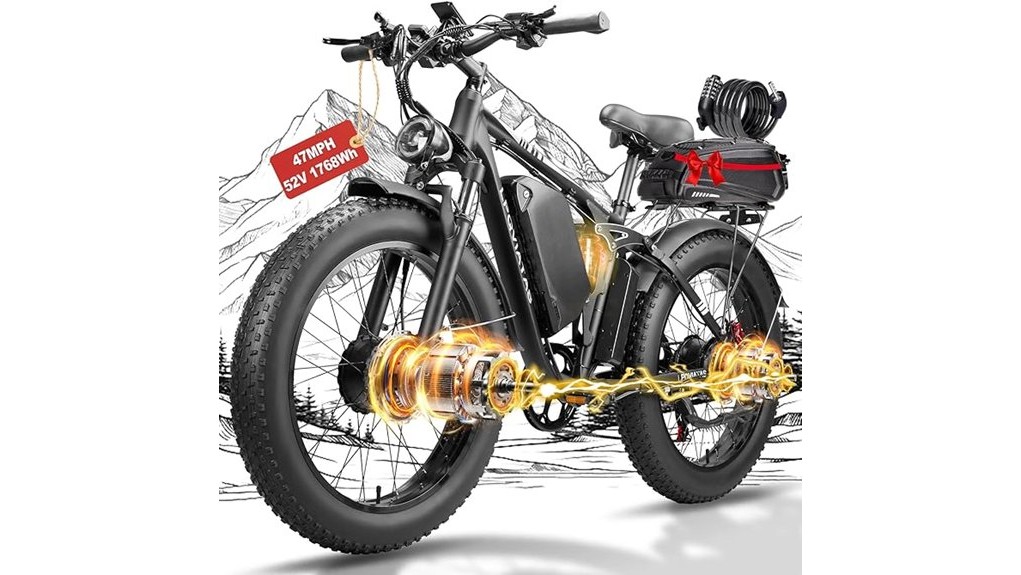
You’ll get brutal, instant torque and near‑46 mph top speed from dual 4,500W brushless motors with selectable single‑ or dual‑motor AWD, but you’ll trade agility for a heavy 38.8 kg chassis and coarse suspension. The detachable 1,768 Wh battery delivers long PAS range (~90–105 miles) yet only ~37 miles true e‑only, and thermal duty limits can force power tapering under sustained load. Brakes and build are capable but demand rigorous upkeep—keep going for full operational and purchase considerations.
Some Key Takeaways
- Dual 4,500W brushless motors deliver up to 9,000W peak with instant torque and selectable single- or dual-motor modes.
- Detachable 52V 34Ah (1,768 Wh) battery yields ~90–105 miles PAS and ~37 miles pure-electric range.
- Robust aluminum full-suspension frame and fat 4-inch tires provide comfort but increase weight and steering inertia (~38.8 kg).
- Dual hydraulic 4‑piston brakes are strong, but prolonged descents may stress heat management and require careful maintenance.
- Thermal limits, BMS monitoring, and duty-cycle power tapering can affect sustained high-load performance and longevity.
What the 9000W-Peak-Dual-Motor-Ebike Offers at a Glance
Frequently, the 9000W-Peak-Dual-Motor-Ebike delivers uncompromising power and utility in a compact package: dual 4,500W brushless motors (9,000W peak) and 220 N·m torque push you to a claimed 46 MPH with AWD capability for 42° climbs, while a detachable 52V 34Ah (1,768 Wh) battery supports PAS ranges of roughly 90–105 miles and pure-electric runs near 37 miles. You’ll get robust chassis, fat tires, full suspension and hydraulic brakes suited for mixed urban and off-road use. Assess compliance with safety regulations for street use, plan storage solutions, and follow maintenance tips to preserve performance. This setup is ideal for riders who want to boost off-road thrills while retaining practical daily-use versatility.
How the Dual 4500W Motors Perform: Speed, Torque, and Climbing
Because the bike pairs two 4,500W brushless motors into a 9,000W peak setup, you’ll get rapid acceleration, high sustained torque, and genuine all‑wheel drive that translate into real-world top speeds near 46 MPH and a peak torque figure of about 220 N·m. You’ll feel instant throttle response and confident hill climbs—factory claims up to 42°—with selectable single or dual‑motor modes to modulate traction. High RPM efficiency keeps power delivery linear at speed, but thermal management concerns are real during prolonged high‑load runs; expect duty‑cycle limits and possible power tapering. Ride aggressively only with cooling pauses. This configuration appeals to adventure riders who need robust power and handling for off‑road terrain.
Battery, Range, and Charging: Real-World PAS vs Pure-Electric Results
Shifting focus from motor performance to energy delivery, we need to understand how the 52V 34Ah (1,768 Wh) battery behaves under PAS versus pure‑electric use. You’ll see PAS yields 90–105 miles in prime conditions thanks to pedal input and higher real world efficiency; pure‑electric cuts range to ~37 miles. Monitor battery health via BMS logs and voltage sag under load. Practice strict charging etiquette: avoid full‑depth discharges, charge to 80% for storage, and use recommended charger. Expect temperature effects to reduce capacity in cold; heat accelerates degradation. Critically, don’t treat specs as guaranteed in mixed terrain and load. For riders wanting longer outings, consider range extender options from specialty sellers to supplement the main pack.
Ride Quality and Build: Suspension, Brakes, Wheels, and Durability
While the dual‑crown lockable fork and rear shock absorb roughly 85% more impact than the stock of a hardtail, you’ll still feel the bike’s 38.8 kg mass in quick direction changes and on tight trail features. You get competent damping and clear ride adjustability via preload and lockout, but tuning is coarse compared with premium units. Four‑inch fat tires mask small bumps, yet increase steering inertia. Dual hydraulic 4‑piston brakes deliver predictable stopping power; heat management on long descents is adequate but not exceptional. Aluminum frame shows no immediate frame fatigue, though weld quality should be inspected for long‑term stress. Riders should carry essential trail gear including a multi‑tool for on‑trail adjustments and repairs.
Who Should Buy This Ebike and Practical Buying Advice
If you need a high‑power, off‑road commuter that can sprint up steep grades and haul cargo, this 9,000W‑peak dual‑motor ebike fits that role—but it’s not for casual riders or tight‑trail purists. You should buy it if you demand AWD traction, 46 MPH top speed, heavy payload capacity, and long PAS range for mixed urban/off‑road routes. Consider commuter considerations: battery weight, charging logistics, and mounting cargo. Expect rigorous maintenance and strong brakes. Verify legal compliance in your jurisdiction—speed/class limits often restrict use on streets or trails. If you can’t manage complexity or legal risk, choose a milder model. Our shop focuses on gear for cargo ebikes and riders who take their ebikes on outdoor adventures.
Some Questions Answered
Does It Require a Driver’s License or Registration?
You probably need to follow local laws: many jurisdictions treat high-power e-bikes as mopeds or motorcycles, so driver’s license, registration, and plates can be required. Check state/country regulations for speed/power thresholds and required safety equipment. Also explore insurance options—some insurers exclude heavy e-bikes or require moped/motorcycle policies. Don’t assume bike rules apply; document technical specs and consult authorities to confirm legal requirements and insurance coverage.
Can the Battery Be Easily Replaced Aftermarket?
Yes — you can replace the battery aftermarket, but check compatibility first. You’ll want to verify battery compatibility with the 52V 34Ah form factor, connector standards and BMS protocol. Swapability options depend on modular design and mounting; nonstandard housings or proprietary pins can limit choices. You should inspect connectors, voltage, capacity and physical fit, and be prepared to adapt wiring or firmware if the aftermarket pack isn’t an exact match.
Are Replacement Parts Readily Available Globally?
Yes — spare availability is mixed; you’ll find common wear items (tires, brake pads, tubes, derailleurs) fairly accessible, but model-specific components (dual 4500W motors, proprietary LCD, battery pack) are less so. You should rely on global distributors for motor and battery replacements; contact authorized channels or specialist e-bike parts suppliers. Be prepared for longer lead times, higher costs, and compatibility checks — supply is spotty outside major markets.
Is Assembly or Setup Service Offered at Purchase?
Yes — you’ll get Free installation options and some sellers offer On site setup for this model. Expect basic bolt-on assembly at delivery: handlebars, front wheel, pedals, and battery seating. Professional on-site technicians handle torque checks, brake bleed, and electronic calibration for an added fee in certain regions. Verify with the retailer: offerings vary by country, and warranty terms sometimes require certified setup to remain valid.
What Warranty and Customer Support Response Times Are Provided?
You get a limited warranty with unspecified duration in the spec sheet, so verify warranty duration before purchase. Support responsiveness is reportedly variable; manufacturer provides email/phone channels but response times aren’t guaranteed. You should expect initial replies within days, not hours, and prepare for follow-ups. Critically inspect warranty terms for coverage limits, exclusions, and claim procedures, and document issues promptly to improve chances of timely remediation.