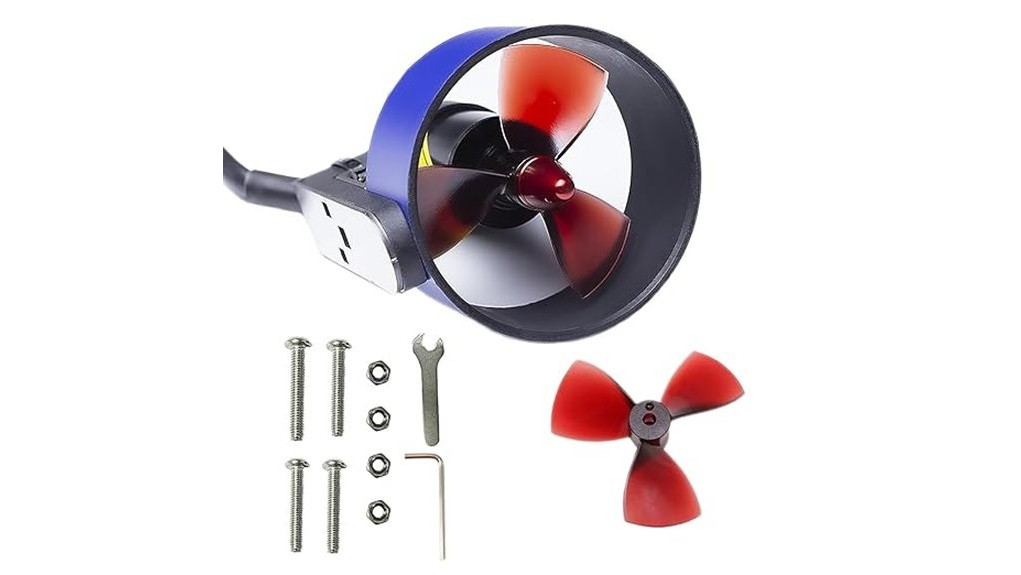
You’ll get a compact 800W brushless U5 thruster delivering up to 7 kg thrust on a 12–24V system (max 29.4V/7S LiPo) while weighing 0.64 lb. It needs an external ESC with PWM control, stainless fasteners, and waterproof cable glands for 50 m operation. Perform static thrust testing at 12/18/24V, monitor input power and motor temp, and conduct step depth trials to verify sealing and cavitation onset. Continue for detailed setup, ESC selection, and test protocols.
Some Key Takeaways
- Compact 800W brushless thruster offers up to 7 kg peak thrust near 24V while weighing just 0.64 lb.
- Operates on 12–24V nominal (supports up to 29.4V); recommended 24V LiPo for peak performance.
- Requires external ESC with standard RC PWM; verify ESC rating ≥800W and PWM timing compatibility.
- Freshwater-only, 50 m potted waterproofing; perform stepped depth and cavitation tests before deployment.
- Pros: high thrust-to-weight and corrosion-resistant mechanics; cons: no battery/ESC included and limited warranty.
What the U5 CCW Is and Who Should Consider It
What makes the U5 CCW useful for your project? You get a compact 800W brushless underwater thruster designed for freshwater use, delivering up to 7 kg thrust while weighing 0.64 lb. It runs on 12–24V (supports up to 29.4V) and requires an external ESC with PWM control. Construction uses high-strength plastic and stainless-steel bearings for corrosion resistance and 50 m potted waterproofing. This unit suits beginner builders and serves as a hobbyists choice when you need measurable thrust, low mass, and modular control components. Note: battery, ESC, and control electronics are not included. A great addition for kayak and outdoor enthusiasts is pairing it with portable fish finders to enhance on-water exploration and fishing experiences.
Key Specs and Electrical Requirements at a Glance
Having covered what the U5 CCW offers, here’s a compact summary of the key specifications and electrical requirements you need to plan for integration. You’ll need 12–24V nominal supply (supports up to 29.4V/7S LiPo); recommended is a 24V LiPo—choose battery chemistry and capacity to match 800W peak and expected runtime. Motor is brushless, 800W, max thrust 7 kg. Thruster requires external ESC accepting PWM; verify PWM signal timing and frequency compatibility with your ESC (standard RC PWM). Unit is not self-contained; procure appropriate wiring, connectors, and waterproofing for 50 m rated operation. Consider pairing the thruster with emergency power banks designed for water-based activities to ensure reliable backup power during extended trips.
Real-World Performance: Thrust, Efficiency, and Depth Testing
When you evaluate the U5 CCW‘s real-world performance, focus on measured thrust, electrical efficiency, and pressure-related behavior across depth rather than just bench ratings. You should run static thrust tests at 12V, 18V, and 24V; expect up to 7 kg peak near 24V under ideal conditions. Monitor input power and compute efficiency (N/kg per watt). Conduct stepped depth trials to 50 m max rating, watching for sealing issues and reduced output from pressure drag. Inspect for propeller cavitation onset at high RPMs and log motor temperature to detect thermal throttling. Report repeatable metrics with instrumentation and test protocol. Also verify compatibility with common tow tethers and kayak mounting systems before deployment.
Installation, Control, and Battery/ESC Compatibility Tips
After measuring thrust, efficiency, and pressure behavior, you’ll need to set up the U5 CCW with compatible power and control hardware to reproduce those results reliably. For installation tips, mount the thruster using stainless fasteners to avoid galvanic issues and align the propeller axis within 1° to minimize vibration. Use silicone potting-compatible cable glands and guarantee braid strain relief. For ESC compatibility, choose a brushless ESC rated ≥800W continuous at your system voltage (up to 29.4V) and supporting PWM input. Configure throttle endpoints, low-voltage cutoff for your LiPo, and test motor direction on bench before waterproof deployment. For kayak anchoring and stable station-keeping, consider integrating the thruster with anchor systems designed for small craft to improve holding power.
Pros, Cons, and Recommended Use Cases (Buy or Skip)
Although compact and powerful for its size, the U5 CCW targets niche DIY and light ROV builds rather than general-purpose propulsion: it delivers up to 7 kg (15.43 lb) thrust from an 800 W brushless motor across 12–24 V (supports up to 29.4 V), is rated to 50 m depth with potted sealing and stainless bearings, and needs an external ESC and battery (recommended 24 V LiPo) to operate—so you’ll get high thrust-to-weight and corrosion-resistant mechanics but must provision compatible ESCs, waterproof cable glands, and strain relief to reproduce measured performance reliably. Pros: compact, high thrust-to-weight, corrosion-resistant, good for buoyancy control and modular ROVs; propeller balancing aids efficiency. Cons: fresh-water only, requires external ESC/battery, limited warranty, unknown long-term noise reduction performance. Recommended: buy if you’re building a lightweight ROV and will run waterproofing tests; skip for heavy-duty or saltwater projects. Our shop also focuses on vhf marine radios and other gear for paddlers and water adventurers.
Some Questions Answered
Can This Thruster Be Used in Saltwater With Extra Protection?
Not recommended, but you can with extensive corrosion mitigation and sacrificial anodes; expect reduced lifespan. You’ll need full externalizing of electronics, conformal coatings, dielectric grease on connectors, stainless-fastener checks, and routine inspection intervals (monthly). Install sacrificial anodes near the motor housing, use marine-grade cabling and potting reinforcement, and limit deployments to shallow, short-duration missions. Warranty won’t cover saltwater damage; document maintenance and test thrust/insulation regularly.
Are Spare Propellers or Repair Parts Available Separately?
Yes — spare propellers and limited repair parts are available. You’ll source OEM 80 mm CCW props and screws from the seller or authorized distributors; warranty parts are limited to one month. For broader repair sourcing, obtain stainless bearings and potted-seal components from third-party marine suppliers using the U5 model specs (12–24V, 800W). Keep part IDs and UPC/ASIN handy to validate compatibility and avoid mismatches.
What Connectors and Wire Gauges Are Pre-Installed?
You get no waterproof connector pre-installed; power leads are exposed, heavy gauge silicone-insulated wires (~10 AWG equivalent) terminated with bare tinned ends. Signal/pulse lead is thinner (~22 AWG) with an insulation sleeve. For bench hookup you’ll use those bare leads or add your own terminal block or waterproof connector assembly. If you need factory-installed connectors, you’ll have to fit them yourself or request custom wiring from the seller.
Is There an Approved Mounting Bracket or Template?
No, there isn’t an approved mounting bracket or template supplied. You’ll need to fabricate mounting templates or custom brackets to suit your hull. Use the thruster’s body dimensions and screw pack positions to draft mounting templates in CAD, pick corrosion-resistant fasteners, and guarantee load-bearing surface area for 7 kg thrust. Verify alignment, seal penetrations, and allow for prop clearance. Test-fit with temporary fixtures before final installation.
Can Multiple U5 Units Be Synced for Coordinated Thrust?
Yes — you can sync multiple U5 units for coordinated thrust. You’ll use PWM synchronization with a common PWM reference and ensure each ESC accepts identical PWM timing. Implement a control networking scheme (CAN/RS485/TTL) to distribute setpoints and monitor RPM/temperature. Match firmware response, calibrate deadbands, and test thrust balance in-water. Provide separate power feeds, fuse each line, and log performance to verify coordinated thrust and fault isolation.