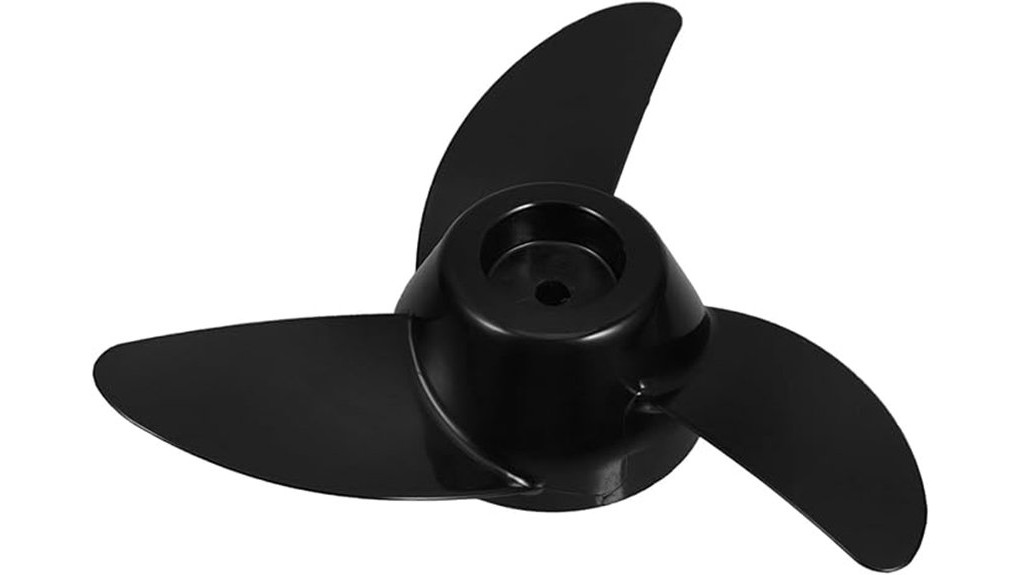
You’ll find the Toddmomy electric thruster propeller gives strong low-speed thrust for kayaks and small boats while staying lightweight and affordable. It’s made of thickened PS blades with basic hardware (nut, washer, rod, wrench) and fits common shaft sizes if you confirm bore and keyway dimensions. Installation is straightforward for trolling motors or drill rigs, though impact resistance lags metal props. It’s smart for casual anglers and budget retrofits; keep reading for tests, fit tips, and longevity notes.
Some Key Takeaways
- Delivers good thrust-to-weight for price, ideal for trolling and light boat propulsion.
- Made from matte black PS with thickened blades; durable for casual use but less impact-tolerant than metal.
- Fits small shafts with supplied nut, washer, rod; confirm shaft diameter, keyway, and screw hole spacing before installation.
- Works well adapted to drills or trolling motors; check alignment, torque, and runout after mounting.
- Best for kayaks, pontoons, and beginners; choose metal/composite props for heavy-duty or high-RPM saltwater use.
Quick Verdict: Is the Toddmomy Electric Thruster Propeller Worth Buying?
While it’s not a premium metal prop, the Toddmomy Electric Thruster Propeller delivers solid performance for its price. You’ll find good value in its thrust-to-weight ratio and reduced manual effort during trolling. Assess torque transfer, blade geometry, and material fatigue risk objectively: thickened PS blades give acceptable durability but lower impact tolerance than metal. Portability features—lightweight form factor and compact dimensions—simplify transport and rapid swaps on kayaks or pontoons. Installation ergonomics and compatibility with drill-adapted setups make it practical for casual users. You should buy it if you prioritize affordability, ease of use, and situational versatility over extreme longevity. For kayakers and outdoor enthusiasts, consider models optimized for propeller kayaks to match your typical water adventures.
What You Get: Exact Specs, Parts Included, and Build Quality
Because the Toddmomy propeller packs a compact footprint and a straightforward parts kit, you get a ready-to-install replacement that balances portability with basic robustness. You receive a 12.5 cm diameter PS propeller (8.66 x 8.66 x 2.17 in, 0.43 lb) plus nut, washer, rod and wrench; package dimensions 9.06 x 9.06 x 2.36 in. Material finish is matte black PS with thickened blades for durability. Screw hole diameters specified (0.8 cm / 0.6 cm). Packaging presentation is minimal but protective. Build quality is utilitarian—fit and tolerances adequate for trolling motors and drill-adapted setups, not precision marine engineering. This compact, easy-to-install setup is well suited for kayaks and fish finders enthusiasts looking to upgrade or replace small electric thrusters.
How to Install and Adapt the Propeller to Motors or Drills
When fitting the Toddmomy propeller to an electric trolling motor or a drill-adapted shaft, begin by confirming shaft diameter and keyway/mount compatibility so you avoid misalignment and excessive play. Measure shaft and prop bore; use supplied rod, nut, washer and appropriate shaft adapters for secure coupling. Create or use mounting templates to mark hole centers and verify screw hole diameters (0.8 cm/0.6 cm) before drilling. Align keyway, slide prop fully onto shaft, torque nut to specified preload, and check axial/runout under rotation. For drill installations, secure coupling with set screws and retest alignment after short operational run. For kayak repair and gear maintenance, always carry basic essential gear to handle adjustments and emergency fixes on the water.
Performance Test: Thrust, Durability, and Real-World Use Cases
After verifying fit and alignment in the previous section, you’ll want to quantify the Toddmomy propeller’s performance under controlled conditions: measure static and dynamic thrust with a calibrated load cell or spring scale, record rotational speed (RPM) at given voltages or drill settings, and log shaft current to estimate efficiency. You’ll compare thrust-to-current ratios across speeds to infer hydrodynamic efficiency and project battery longevity under realistic loads. Inspect thickened PS blades after endurance cycles for cracking, deformation, or nut loosening. Note vibration signatures and noise levels during runs; increased vibration often correlates with reduced efficiency and accelerated wear in real-world kayak, pontoon, and drill-mounted use. Also consider testing mounting and safety hardware used for water adventures to ensure secure, corrosion-resistant connections suitable for kayaks and other small boats.
Who Should Buy This Propeller and Alternatives to Consider
If you need a low-cost, lightweight replacement or upgrade for small electric trolling motors, kayak drills, or pontoon drives, the Toddmomy propeller fits that role well due to its thickened PS blades, simple pin-style mounting, and compact 12.5 cm diameter. You should buy it if you’re a beginner angler seeking affordable thrust, value compact storage, or retrofit drill-driven setups on small craft. It’s optimized for low to moderate loads, easy installation, and minimal maintenance. Consider metal or composite alternatives for heavy-duty use, higher RPMs, or prolonged saltwater exposure; they’ll offer superior fatigue resistance and efficiency. Many paddlers also prioritize carrying essential safety gear when heading out on kayak adventures.
Some Questions Answered
Is This Propeller Safe for Saltwater Use Long-Term?
No — you shouldn’t expect long-term saltwater durability. The PS plastic blades resist general corrosion but the metal hub, nut and rod can suffer electrochemical attack without proper corrosion resistance measures. You’ll need galvanic isolation (non-conductive spacers, sacrificial anodes) and regular rinsing, inspection, and lubricant/anti-corrosion coatings to extend service life. For prolonged saltwater use, consider stainless or marine-grade replacements and routine maintenance.
Can I Balance or Sharpen the Blades Myself?
Yes — you can perform blade balancing and edge sharpening yourself, but you should proceed carefully. Use a prop balancer or string method to detect imbalance, then remove material symmetrically from the heavier blade edge. For edge sharpening, file or sand along the existing bevel at consistent angles; avoid removing too much plastic or creating heat. Recheck balance after sharpening and test at low speed to confirm vibration-free operation and safe performance.
Does It Fit Left- and Right-Hand Rotation Motors?
No — it’s not inherently ambidextrous; you’ll need to verify left handed compatibility before use. The propeller’s geometry shows rotation symmetry in a single orientation, so it’s optimized for one rotation direction. If your motor spins opposite, you’ll either need the mirrored (left‑hand) prop or a hub specifically designed for reversible rotation. Check blade pitch and screw-hole alignment; mounting hardware must match left/right thread standards.
What Warranty or Return Policy Applies to This Product?
Warranty details vary by seller and region; you should check the product listing or contact Toddmomy for specific coverage. Typically, manufacturers offer limited warranty against defects and a seller return timeframe (often 30 days) for undamaged items. If you receive a defective propeller, document damage, retain packaging, and request warranty service or a return within the stated return timeframe. Keep order records and photos to support claims.
Are Replacement Parts Available Separately?
Yes — you can source replacement parts separately: spare blades and mounting hardware are available as individual components. You’ll get a single prop, nut, washer, rod, and wrench with the unit, but vendors or aftermarket suppliers commonly sell blades and mounting hardware for drill-adapted and trolling-motor setups. Check seller listings or parts catalogs for PS-compatible blades, 0.8/0.6 cm screw-hole fittings, and replacement nuts/washers to guarantee fit and balance.