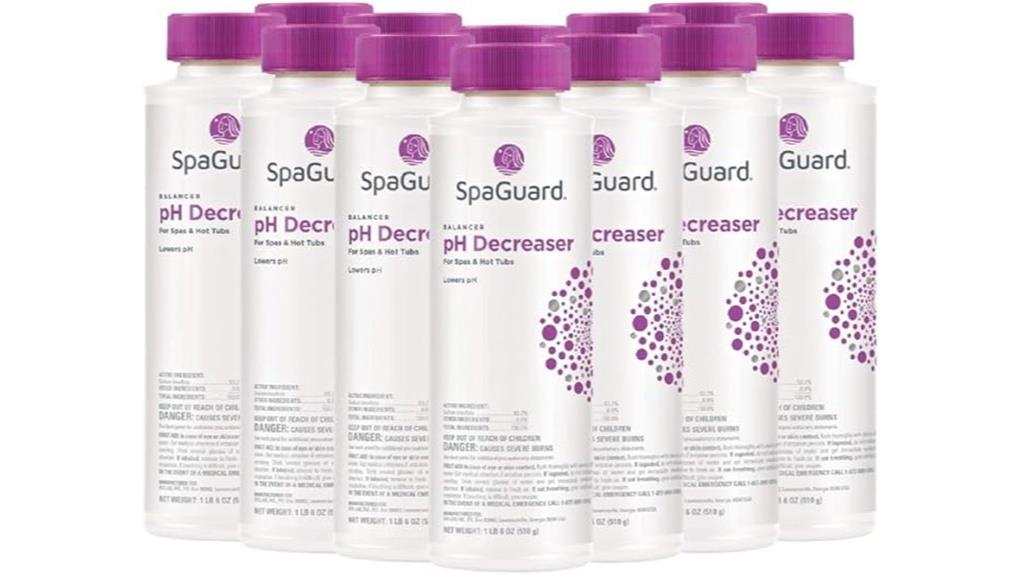
You’ll get twelve individually sealed 22‑oz tubs (264 oz total) of dry, granular SpaGuard pH Decreaser that reliably and gradually lowers pH and total alkalinity to prevent scale and cloudy water. You’ll dose measured amounts dissolved in a bucket, add with the pump running, wait 30–60 minutes and retest. The product minimizes abrupt swings and protects equipment, though tubs are single‑use plastic; keep gloves and goggles on. Continue for full specs, dosing charts, and alternatives.
Some Key Takeaways
- SpaGuard Pack of 12 contains twelve 22 oz sealed tubs (264 oz total) for convenient, measured pH/alkalinity reduction.
- Granular acidic formula dissolves for gradual pH and alkalinity lowering, minimizing abrupt swings and cloudy water.
- Individually sealed tubs simplify dosing, reduce errors, and suit managers of multiple spas or regular maintenance routines.
- Follow testing, pre-dissolve granules, run the pump, wait 30–60 minutes, and retest while using gloves and goggles.
- Pros: consistent formulation and manufacturer support; cons: single-use plastic tubs and higher cost versus bulk alternatives.
SpaGuard pH Decreaser Pack of 12 : Quick Verdict and Who It’s Best For
Cutting pH and alkalinity with SpaGuard pH Decreaser Pack of 12 gives you a straightforward, reliable way to balance spa water: each 22 oz granular unit reduces pH and total alkalinity gradually to prevent scale and cloudy water while maximizing sanitizer effectiveness. You’ll want this if you manage multiple spas, follow a regular maintenance schedule, or serve diverse customer demographics requiring consistent water quality. The product’s dry, measured dosing simplifies protocols, limits dosing errors, and protects equipment. Use it to correct mineral imbalances predictably, extend component life, and integrate into SpaGuard chemical regimens for efficient operational control.
What’s in the Box and Key Product Specs (22 Oz Units, 264 Oz Total)
If you found the quick verdict helpful, here’s exactly what you get in hand: the box contains twelve individually sealed 22 oz units of SpaGuard pH Decreaser (264 oz total), each labeled with model 42254BIOX12, UPC 017541612296, and ASIN B01LYK7D6M. You’ll receive dry, granular formula units intended for incremental dosing. Ingredient breakdown is listed on each container for regulatory compliance; active acidic salts dominate the composition. Packaging materials are durable, moisture-resistant plastic tubs with tamper-evident seals and printed safety instructions. Weight per unit is 22 ounces; total pack weight equals 264 ounces for inventory and storage planning.
How It Performs: Lowering pH, Controlling Alkalinity, and Preventing Scale
When you add SpaGuard pH Decreaser to spa water, its dry acidic salts dissolve and incrementally lower both pH and total alkalinity, stabilizing the water chemistry to prevent scale formation and maintain sanitizer efficacy. You’ll observe controlled pH regulation as the granular formula reduces excessive alkalinity without abrupt swings, enabling predictable adjustments. Alkalinity control buffers against rapid pH rebound, minimizing cloudy water and mineral precipitation. Scale prevention results from sustained lower pH within target ranges, reducing calcium and other mineral deposition on surfaces and equipment. Confirm chemical compatibility with your sanitizer and sequestering agents for peak performance.
Using It Correctly: Dosage, Timing, and Safety Tips for Spas and Hot Tubs
Having set proper pH and alkalinity to prevent scale and maintain sanitizer action, you’ll now focus on correct dosing, timing, and safety to keep levels stable without harming equipment. Use water testing before any addition and consult dosage charting: add measured grams per 100 gallons to lower pH incrementally. Apply granules dissolved in a bucket, broadcast slowly with pump running; avoid adding undissolved product to filters. Follow application timing—wait 30–60 minutes between small adjustments, retest, then repeat. Wear safety equipment (gloves, goggles), store dry, and ventilate during use. Record results for trend analysis.
Value Analysis: Cost Per Ounce, Pros/Cons, Alternatives, and Final Buying Recommendation
Because you’ll likely compare unit economics and performance, start by calculating the cost per ounce: the 12-pack totals 264 oz (22 oz × 12), so divide the pack price by 264 to get a precise $/oz figure you can benchmark against alternatives. Do a clear price breakdown including shipping/taxes. Pros: reliable granular formula, gradual control, protects equipment, consistent dosing. Cons: single-use plastic tubs, limited eco-credentials, you’ll pay for brand packaging. Consider cheaper bulk sodium bisulfate or generic spa pH reducers for lower $/oz. Recommendation: buy SpaGuard if you prioritize formulation consistency and manufacturer support; otherwise opt for bulk alternatives.
Some Questions Answered
Can This Product Be Used in Swimming Pools as Well?
Yes — you can use it in pools, but check pool compatibility and municipal regulations first. The granular pH decreaser lowers pH and total alkalinity and will function in pool water chemistry, but dosing differs from spa use due to larger volume and circulation. Calculate dose per volume, add gradually, retest, and adjust. Confirm local municipal regulations for chemical handling, storage, and discharge to guarantee compliance before widespread pool use.
Is It Safe for Use With Saltwater or Chlorine-Free Sanitizers?
Yes — you can use it with saltwater systems and non-chlorine sanitizers, but monitor chemistry closely. SpaGuard pH Decreaser shows saltwater compatibility and minimal sanitizer interaction when dosed per instructions. You’ll want to test pH and total alkalinity frequently after dosing, avoid overdosing that can transiently reduce sanitizer effectiveness, and follow manufacturer guidance for salt cell/system manufacturer limits to prevent corrosion or sensor interference.
Does It Have Any Fragrance or Dyes That Could Irritate Skin?
No — the formulation has no added fragrance presence or dye content that would intentionally irritate skin. You’ll handle a dry, granular acid product designed to lower pH and alkalinity; irritation risk derives from chemical acidity and improper dosing rather than fragrances or dyes. You should wear gloves, avoid splashes, follow dosing instructions, and maintain correct pH to minimize skin irritation and protect equipment.
How Long Does One Treatment Take to Show pH Changes?
You’ll see initial pH reduction within 15–30 minutes after dosing; that’s the rapid adjustment phase. You’ll then monitor and retest after 1–2 hours as the product disperses. Full, stable pH and alkalinity readings typically occur within 4–24 hours as gradual stabilization completes. For best results, circulate water during treatment, avoid bathing until levels stabilize, and adjust dose incrementally based on repeated measurements.
Are There Storage Temperature Limits or Shelf-Life Details?
There’s no specific shelf-life printed, but you should treat storage duration as at least a few years when kept sealed; consult manufacturer for exact warranty details. Store dry, in original container, away from moisture and extremes. Recommended temperature ranges are typical room conditions (approximately 50–86°F / 10–30°C); avoid freezing or sustained high heat. If granules cake or discolor, discard and replace to guarantee performance.