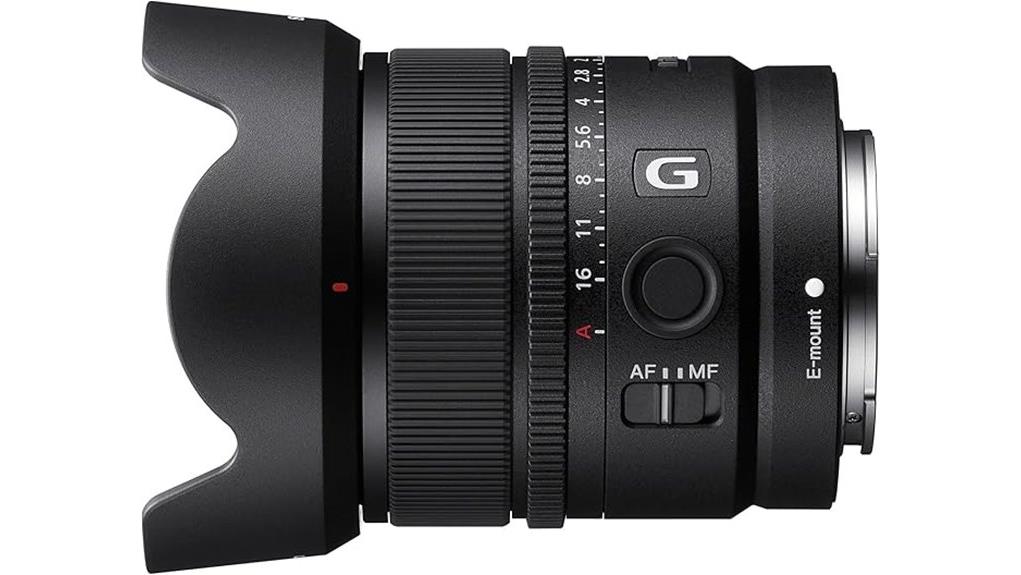
You’ll get an ultra-wide 15mm f/1.4 G for Sony E APS-C that’s built for creators who need fast low-light performance and film-friendly handling. It delivers excellent center sharpness at f/1.4, improving edges by f/2.8, with creamy bokeh and Nano AR II contrast control. Dual linear motors give swift, stable AF and minimal breathing for movies. Lightweight, weather-resistant, and tactile, it’s a pro-grade prime with a few APS-C and price trade-offs—more specifics follow.
Some Key Takeaways
- Ultra-wide 15mm f/1.4 G-series prime delivers excellent center sharpness at f/1.4 with edge improvement by f/2.8 and slight corner softness stopped down.
- Dual linear motors enable fast, reliable AF and smooth movie-mode AF shifts with minimal focus breathing for video work.
- Creamy close-distance bokeh and seven-blade aperture produce pleasing highlight rendition for creative shallow-depth shots.
- Lightweight 219 g weather-resistant build, tactile controls, and solid metal mount suit run-and-gun creators and travel shooters.
- Strengths: low-light speed, Nano AR II contrast, and advanced optics; trade-offs: APS-C only, moderate 55mm filters, premium price.
What the SEL15F14G Is and Who It’s For
What makes the SEL15F14G stand out is its combination of ultra-wide 15mm perspective with a fast f/1.4 aperture, designed specifically for Sony E-mount APS-C shooters who need low-light performance, impactful foreground-to-background separation, and cinematic framing. You’ll find the lens targets content creators, landscape photographers, vloggers, and indie filmmakers — the clear target users. Its compact 219g build, dust‑ and moisture‑resistance, and smooth linear-motor AF support diverse versatility scenarios: run‑and‑gun vlogging, controlled studio wide shots, low-light interiors, or sweeping landscapes. You’ll appreciate ergonomic controls and minimized focus breathing for disciplined, dependable operation. It’s an excellent choice for mirrorless camera enthusiasts looking for essential, versatile gear like mirrorless camera accessories to complement their setup.
Real-World Sharpness, Bokeh, and Low-Light Performance (Samples)
Having established who this lens is for, let’s examine how it performs on image quality in real use: sharpness across the frame, character of the bokeh, and low‑light capabilities illustrated with sample situations. You’ll find excellent center resolving power at f/1.4, with edge sharpness improving by f/2.8; wide-angle field shows minor corner softness stopped down. Creamy bokeh appears unusually pleasing for 15mm when close to subjects, with seven-blade rendering that keeps highlights smooth. In low light you can push ISO with confidence — Nano AR II helps maintain contrast and natural color rendition — yielding usable, detailed files. Our shop carries dedicated tools for lens calibration that help ensure your lens and camera body deliver peak real-world performance.
Autofocus, Video Behavior, and Handling During Shoots
While shooting with the SEL15F14G, you’ll notice the autofocus is fast and consistently accurate thanks to its dual Linear Motors, which lock quickly even in low light and during subject shifts. You get reliable fast tracking for moving subjects and smooth shifts in movie mode; AF responsiveness is immediate with minimal lag. Rare focus hunting appears only in extreme low contrast scenes and resolves quickly. For critical work you should verify lens calibration on your body to eliminate front/back bias. Handling is predictable: focus is quiet, breathing is minimized, and continuous AF feels film-friendly for run-and-gun shoots. If you want to improve your results and comfort during long sessions, consider upgrading your setup with the right camera grip to enhance stability and handling.
Build, Weather Resistance, and Ergonomics for Travel/Vlogging
Because Sony built the SEL15F14G with a dust- and moisture-resistant construction and a lightweight 219 g body, you’ll find it rugged enough for most travel and vlogging scenarios without adding bulk to your kit. Its compact build keeps shoulder and kit weight down while preserving a solid metal mount and balanced feel on APS-C bodies. Weather sealing gives confidence in variable conditions; you can shoot in mist or dustier environments with less hesitation. Tactile controls—smooth focus ring and customizable control switch—work well for one-person rigs. Overall ergonomics are travel ready, intuitive, and purposeful for real-world content creation. For photographers who value protection for their gear, pairing this lens with a quality waterproof camera bag can help keep your equipment dry and safe.
Verdict: Strengths, Trade-Offs, and Recommended Alternatives
Although compact and lightweight, the SEL15F14G delivers striking optical performance and practical features that make it a top pick for APS-C content creators: its fast f/1.4 aperture and advanced element lineup produce sharp images and pleasing bokeh in low light, Nano AR Coating II minimizes flare, and the dual linear motors plus reduced focus breathing give reliable, smooth AF for both stills and video. You’ll appreciate its build, low weight, and weather resistance, though the premium price demands a price comparison. Trade-offs: no full-frame reach and moderate 55mm filter size. In competitor roundup, consider Sigma and Samyang alternatives for value. The site also offers guidance on choosing the right zoom lens for various shooting situations, including tips for maximizing performance with prime lenses and zooms like this zoom camera lenses review.
Some Questions Answered
Does It Accept Internal or In-Camera Stabilization With All Sony Bodies?
Yes — you’ll rely on in-body stabilization (IBIS) in compatible Sony bodies; the SEL15F14G itself lacks optical stabilization on most copies despite some specs listing optical support. You’ll get the best results when your camera’s IBIS and in-camera lens correction are both enabled, letting the body correct distortion and use sensor-shift steadiness. Test combinations, since effectiveness varies by camera model and firmware; update firmware for peak compatibility.
Is There a Dedicated Af/Mf Switch on the Lens Barrel?
Yes — you get a dedicated AF switch on the barrel and a responsive Focus ring. You’ll flip the AF switch for quick manual override, while the Focus ring gives precise, mechanical-feel control when you want fine adjustments. The AF switch and dual linear-motor AF deliver fast, quiet autofocus for video, and the Focus ring remains smooth with minimal backlash for deliberate manual pulls. Weather-sealed ergonomics aid real-world handling.
Can It Be Used for Astrophotography With an APS-C Sensor?
Yes — you can use it for astrophotography on an APS-C sensor. Its f/1.4 aperture and solid low light performance let you capture faint stars with shorter exposures; two linear motors keep focus accurate for stacked frames. Coma control is good but not perfect at extreme corners on APS-C; expect slight star stretching wide-open. Stop to f/2–f/2.8 for improved sharpness and reduced aberrations for best results.
Are There Compatible Step-Up/Down Filters or Accessory Adapters?
Yes — you can use compatible step-up/down filters and adapters, but check thread compatibility first. The lens uses a 55 mm filter thread, so you’ll fit 55 mm filters directly or use step-up rings (55→larger) to attach bigger filters without vignetting. Step-down (larger→55) risks mechanical obstruction and vignetting, so avoid unless optical tests clear it. You can also use filter adapters for holder systems if you need square or variable ND solutions.
What Is the Closest Focusing Distance for Macro-Style Shots?
The closest focusing distance is 0.19 m (7.5 in). You’ll get strong ultra-wide perspective but limited true macro magnification. Use Close focus technique to maximize subject size and foreground impact; you’ll still need careful framing. For higher detail, combine shorter focus steps and Focus stacking to increase apparent magnification and depth of field. Expect creative wide-angle close-ups rather than 1:1 macro; plan lighting and composition accordingly.