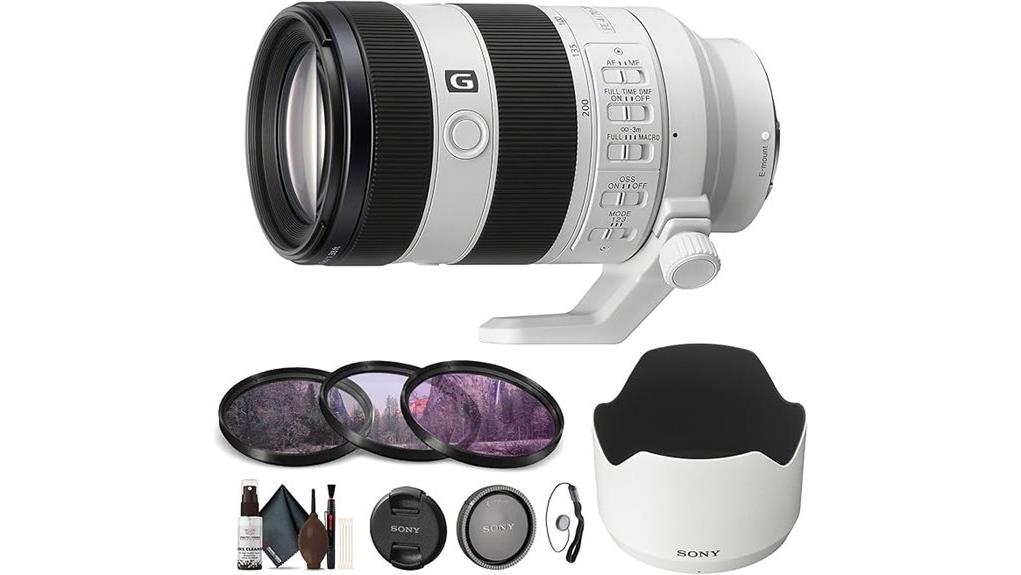
You’ll get a travel-friendly, full-frame 70–200mm f/4 that’s 15% lighter than its predecessor, with built-in OSS, consistently high center sharpness and neutral color. It delivers creamy bokeh at longer focal lengths, true 0.5x macro across the zoom range with usable working distances, and quick predictable AF for handheld and close-up work. Weather-sealed, compact and well-balanced on mirrorless bodies, it’s ideal for field portraits and mobile wildlife — keep going and you’ll find detailed test notes and comparisons.
Some Key Takeaways
- Lightweight, travel-friendly 70–200mm f/4 G with built-in OSS and weather sealing for reliable field use.
- Consistently high center sharpness across the zoom range with mild corner falloff at 200mm wide open.
- True 0.5x macro capability from 70–200mm, offering usable working distance and sharp close-up results without extensions.
- Neutral color rendition and good microcontrast produce natural skin tones, fine detail, and creamy bokeh at longer focal lengths.
- Balanced handling, compact barrel, damped controls, and a tidy tripod collar make it great for travel, portraits, and mobile wildlife.
Sony FE 70-200mm F/4 G OSS II at a Glance (Key Specs and What’s New)
While remaining compact and 15% lighter than its predecessor, the Sony FE 70-200mm F/4 G OSS II delivers a precise, full-frame telephoto experience with an f/4–22 aperture range, continuous 0.5x macro capability, and built-in Optical SteadyShot stabilization. You’ll appreciate the compact design and weight reduction for extended handheld use and travel. Optical layout includes aspherics, Super ED glass, and Nano AR II coatings. Controls are straightforward, focus is responsive, and weather sealing lets you work outdoors confidently. Price positioning targets enthusiasts seeking pro features without pro-size cost, balancing performance, durability, and portability. Perfect Tripods recommends pairing this lens with a lightweight, sturdy tripod for best results when shooting at longer focal lengths lightweight tripods.
How This Lens Performs: Sharpness, Color, and Bokeh at 70–200mm
Moving from the lens’s design and features to image performance, you’ll find the FE 70-200mm F/4 G OSS II delivers consistently high center sharpness across the focal range with only mild corner falloff at 200mm wide open. You’ll notice microcontrast that renders fine detail without oversharpening, and stopping to f/5.6–8 tightens edges. Color rendition stays neutral and accurate; skin tones and foliage look natural with minimal shift. Creamy bokeh appears at longer focal lengths and wide apertures, producing smooth highlights and strong background separation that isolates subjects cleanly. Overall control of aberrations and coatings keeps flare low and contrast high. This balance of optical quality and build makes it an excellent choice for portrait photographers seeking portrait lens performance.
Macro and Close-Up Use: Real-World 0.5x Results and Focusing Behavior
Dialing in the 0.5x capability on the FE 70-200mm F/4 G OSS II gives you true close-up performance across the zoom range, letting you frame subjects like flowers or small products without extension tubes or a separate macro lens. You’ll get consistent 0.5x reproduction from 70–200mm, maintaining sharp central detail and subject isolation. The lens preserves a usable working distance—about 10.2 inches at 70mm—so you won’t crowd skittish subjects. AF is quick and predictable, though you’ll notice mild focus breathing during frame-to-frame adjustments; it’s manageable for stills but worth noting for critical focus stacking or video macro sequences. This makes the lens a versatile option for photographers who prefer using close-up filters instead of dedicated macro glass.
Handling, Stabilization, and Build for Travel and Outdoor Work
With its 15% lighter, more compact body and weather-sealed construction, the FE 70-200mm F/4 G OSS II feels markedly more travel-ready than its predecessor, letting you carry it longer and shoot in damp or dusty conditions without worry. You’ll notice improved travel ergonomics: shorter barrel, balanced weight on mirrorless bodies, and a tidy tripod collar that won’t snag. Optical SteadyShot meaningfully reduces shake at longer focal lengths and for handheld macro work, letting you use slower shutter speeds. Controls are damped and precise; focus and zoom rings offer predictable resistance. Build quality is robust, with purposeful weather sealing for outdoor reliability. Our store offers a range of camera backpacks ideal for carrying lenses like this on outdoor shoots.
Who Should Buy It and Alternatives to Consider
If you often work outdoors and need a compact, weather-sealed telephoto that doubles as a true close‑up tool, the FE 70‑200mm F/4 Macro G OSS II is worth strong consideration. You’ll appreciate its 0.5x macro across the zoom for product detail and portrait lighting control at longer working distances. Its dust‑ and moisture‑resistant construction, lighter weight, and Optical SteadyShot make it practical for travel, field portraits, and wildlife compatibility when mobility matters. Consider alternatives if you need f/2.8 low‑light reach (70‑200mm f/2.8) or greater macro magnification (100mm+ dedicated macro lenses). Many telephoto shooters also benefit from mastering telephoto-specific techniques like proper stabilization to maximize sharpness and reach.
Some Questions Answered
Does It Come With a Lens Hood and Carrying Case?
No, it doesn’t include a lens hood or a carrying case. You’ll get the lens, 72mm filter kit, lens cap keeper and cleaning kit plus Sony USA authorization. For protection you’ll want to add a compatible lens hood to control flare and a soft pouch or dedicated case for transport; the lens is compact and lightweight, so a soft pouch offers decent protection, but a padded hard case gives better impact resistance for travel.
Is There Weather Sealing Equivalent to Professional G Master Lenses?
Yes — you’ll get weather resistant construction with good environmental sealing, but it isn’t identical to flagship G Master-level sealing. You can confidently use the lens outdoors in light rain, dust, and typical field conditions thanks to its dust- and moisture-resistant design, yet you shouldn’t expose it to prolonged heavy rain or submersion. Treat it like robust pro-grade gear while using additional protection in extreme environments.
Can It Be Used on APS-C Bodies and What’s the Crop Effect?
Yes — you can use it on APS C bodies; APS C compatibility is native with Sony E-mount. You’ll get an effective focal length of about 105–300mm (1.5x crop factor), so framing is tighter and reach increases for telephoto work. Autofocus, stabilization and macro 0.5x remain functional. Expect shallower apparent depth of field and slightly different working distances versus full-frame, useful for wildlife, sports and close-up detail.
Does It Support Internal Zoom and Focus Breathing Reduction?
Yes — the lens uses internal zoom, so the barrel doesn’t extend during focal changes, and that helps minimize focus breathing. You’ll still notice slight focus breathing during significant focus shifts, but mechanical design and internal focusing reduce its magnitude compared with external-zoom designs. For video or critical focus pulls, you should test at your working focal and focus distances, because minor breathing remains and can be more evident at close macro distances.
Are Firmware Updates Needed for Compatibility With Newer Cameras?
Yes — you should check for firmware compatibility periodically. Camera firmware updates can improve communication, autofocus performance, and stabilization with newer bodies; the lens may also receive firmware patches. If you use mount adapters, verify both adapter and body support updated protocols. Update lens firmware only via authorized tools and follow release notes. Keep backups and test after updates to confirm AF, OSS, and metadata behave as expected.