You’ll get a compact, pro‑grade APS‑C hybrid that pairs a 26MP Exmor R sensor with BIONZ XR processing for tight microcontrast, clean shadows, and reliable high‑ISO use. The 425‑point hybrid AF plus on‑chip AI locks and tracks faces and eyes instantly, and 4K60 comes from 6K oversampling for crisper detail. The pocketable 16–50mm kit and tilting LCD suit run‑and‑gun work, but plan on spare batteries and fast cards—keep going and you’ll find detailed workflow and limitations.
Some Key Takeaways
- 26MP Exmor R APS‑C sensor plus BIONZ XR yields finely detailed images with strong microcontrast and reliable high‑ISO performance for prints and crops.
- 425‑point hybrid AF with AI subject detection delivers fast, accurate real‑time eye/face tracking and low‑light AF reliability.
- 4K60p internal recording (6K oversampled) produces clean, high‑detail footage; clean HDMI enables external recording for longer high‑bitrate takes.
- Compact 16–50mm PZ kit lens and tilting LCD make it ideal for travel, street, and run‑and‑gun hybrid work.
- Operational limits include dual UHS‑I SD slots (U3/V30, ≤64GB), modest battery life, and the need for spare batteries and fast card workflow.
Best Quick Take: Who the Sony Alpha 6700 Kit Is For
While the Alpha 6700 delivers pro-grade stills and 4K60p video, it’s best for hybrid shooters who need compact portability without sacrificing advanced AF, stabilization, and color fidelity. You’ll get a versatile kit ideal for pros upgrading bodies and serious enthusiasts who shoot mixed photo/video assignments. Its fast AI-driven AF, dual stabilization, and tilting LCD help when you’re composing quick street photography frames or run-and-gun video. The bundled 16–50mm keeps size minimal for travel and candid work. If you want an authoritative beginners guide to APS-C hybrid systems, this kit balances capability, ergonomics, and workflow efficiency. This makes it a strong choice for photographers building out an essential gear kit for mirrorless cameras.
What the 26MP APS-C Sensor and BIONZ XR Deliver in Real Use
Don’t be fooled by the APS-C badge — the 26MP Exmor R sensor and BIONZ XR engine work together to extract far more usable detail, dynamic range, and low‑light performance than you’d expect from a crop frame body. You’ll get finely resolved 26MP files with tight microcontrast and precise demosaicing that preserve texture for cropping and print. BIONZ XR accelerates noise suppression and tonal mapping, delivering cleaner shadows and extended highlights without mushy detail. Color rendition is natural and stable across ISOs, aiding skin tones and product color accuracy. In practice, the combo balances resolution, DR, and usable high‑ISO performance. For photographers who measure and fine‑tune exposure settings, using a dedicated light meter can help ensure those extended highlights and cleaner shadows are captured optimally.
How the Hybrid AF, AI Subject Recognition, and Stabilization Perform
Because Sony pairs a dense 425‑point hybrid AF array with a dedicated AI processing unit, you’ll get rapid, highly accurate subject detection and tracking across stills and video. The AI enables real time tracking that locks and maintains focus on faces, eyes, and complex subjects with minimal hunting. Low light performance improves thanks to single-pixel level stabilization feedback and sensitive AF sensors, so focus stays usable well past typical APS‑C limits. Touch AF responsiveness on the tilting LCD is immediate for repositioning focus. Subject switching speed between moving targets is fast and predictable, making the system reliable for hybrid shooters. For photographers who like to fine‑tune focus performance, lens calibration tools and microadjustment routines can help optimize accuracy across different lenses.
Real-World Video Results: 4K60, 6K Oversampling, and Recorder Workflow
Test 4K60 footage reveals the a6700’s 6K oversampling delivers noticeably cleaner 4K with crisper fine detail, fewer moiré artifacts, and improved color gradation compared with native 4K downscaling. You’ll see higher edge acuity and texture fidelity in practical shoots, especially with controlled lighting and low ISO. Recording internally yields efficient MP4 files, but pairing an external recorder via clean HDMI gives you higher sustained bitrates and easier color grading latitude. Monitor exposure and heat on prolonged 4K60 takes; use dual SD workflow to offload clips. For professional delivery, prioritize stable bitrates, REC709/HLG profiles, and careful LUT management. Consider using an external camera monitor for better framing and accurate exposure assessment during demanding shoots external camera monitors.
Kit Lens, Accessories, and Out-of-the-Box Shooting Experience
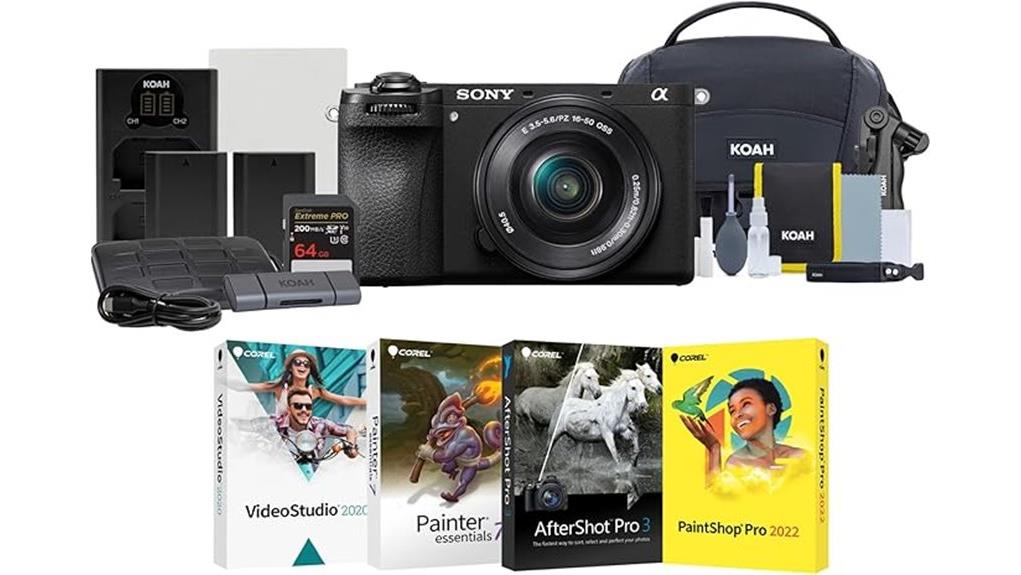
Having established how the a6700 handles high-resolution video, it’s worth examining what you get out of the box and how the kit lens and accessories affect first shoots. You’ll find the 16–50mm PZ lens compact, with smooth power zoom and OSS aiding steady handheld pulls; lens handling is predictable though limited at maximum aperture. Accessory organization is tidy: gadget bag, cleaning kit, screen protector, card and reader all reduce setup friction. Tactile controls on the body are positive, giving direct access to exposure and focus. The startup workflow is straightforward—insert card, attach lens, quick menu setup—and you’re shooting. Many DSLR enthusiasts and photographers appreciate having a selection of essential gear available to streamline shoots and protect equipment.
Battery, Connectivity, and Media Limits You Should Know
When you push the a6700 into extended shoots, plan around its battery and media constraints: the camera uses a lithium‑ion battery (not included), so you’ll need spares for long days, and the dual SD slots accept UHS‑I cards only—max supported card size is 64 GB with U3/V30 speed class—limiting sustained high‑bitrate 4K60 recording unless you swap cards or offload frequently. Expect modest charge longevity versus larger pro bodies; factor in record time, screen usage, and image stabilization. Check port compatibility for USB 3.0 transfers and video out; use fast offload workflows or external recorders to avoid media bottlenecks. Consider purchasing dedicated spare camera batteries to keep shooting during full-day sessions.
Practical Verdict: Strengths, Weaknesses, and When to Buy
Although compact, the a6700 delivers pro-level imaging and AF performance you can rely on, combining a 26 MP BSI APS-C sensor, BIONZ XR processing, and AI-driven hybrid AF to produce detailed stills and clean 4K60 video with robust subject tracking. You’ll get exceptional autofocus for street portraits and fast-paced shoots, plus dual stabilization that steadies handheld video. Weaknesses: limited native lens reach in the kit, modest battery endurance, and single-card UHS-I speed ceilings. Buy if you prioritize compact pro image quality, advanced AF, and hybrid workflow; skip if you need extended battery life or top-tier pro lens systems. If you frequently transfer large photo and video files, consider a fast memory card reader to speed up your workflow.
Some Questions Answered
Does the Kit Include Spare Batteries or a Battery Charger?
No, the kit doesn’t include a battery spare or charger included. You’re provided the camera body, lens and accessories listed, but batteries aren’t included and no separate charger is mentioned. You’ll need to obtain a compatible NP‑FV or specified lithium‑ion replacement and an external USB charger or use the camera’s USB charging if supported. For continuous shooting or travel, plan for at least one spare battery and a reliable charger to avoid downtime.
Is the Camera Weather-Sealed for Rain and Dust Exposure?
No — the camera isn’t fully weather-sealed for heavy rain or dust. You’ll find limited environmental resistance and some dustproof testing-type protections at seams, but it lacks a stated ingress protection rating. Don’t rely on it for prolonged exposure; use rain covers or sealed lenses for true weather work. If you need certified weather sealing/ingress protection, choose a body with explicit IP ratings or pro-level sealing specifications.
Can the Kit Lens Be Easily Replaced With Full-Frame Lenses?
Yes — you can replace the kit lens with full-frame lenses using adapters. You’ll need adapter compatibility with Sony E‑mount and must account for flange distance differences; Sony’s short E‑mount flange distance preserves infinity focus with many adapted full‑frame optics. Choose high‑quality adapters that maintain electronic contacts or optical correction if required. Expect possible vignetting, crop factor and autofocus performance variations depending on lens and adapter design.
Does the Package Come With a Warranty Card or Registration Instructions?
Yes — the package doesn’t list a physical warranty card, but you get standard retailer return policy details and manufacturer support info; you’ll follow the online registration process. You’ll register the product through Sony’s warranty registration portal using the UPC and model (ILCE-6700L/B) and purchase proof. Warranty duration and terms follow Sony’s standard coverage; check the included retailer paperwork for the exact warranty duration and registration process steps.
Are Lens Filters or a Lens Hood Included With the 16–50mm?
No, the 16–50mm kit lens doesn’t include a lens hood or filter options in the package. You get the retractable Sony E PZ 16–50mm F3.5–5.6 OSS, but no hood or dedicated filters are listed among the eight items. If you need protection or creative control, you should purchase compatible screw-on filters (check the lens front diameter) and an appropriate hood designed for this compact, retractable zoom.