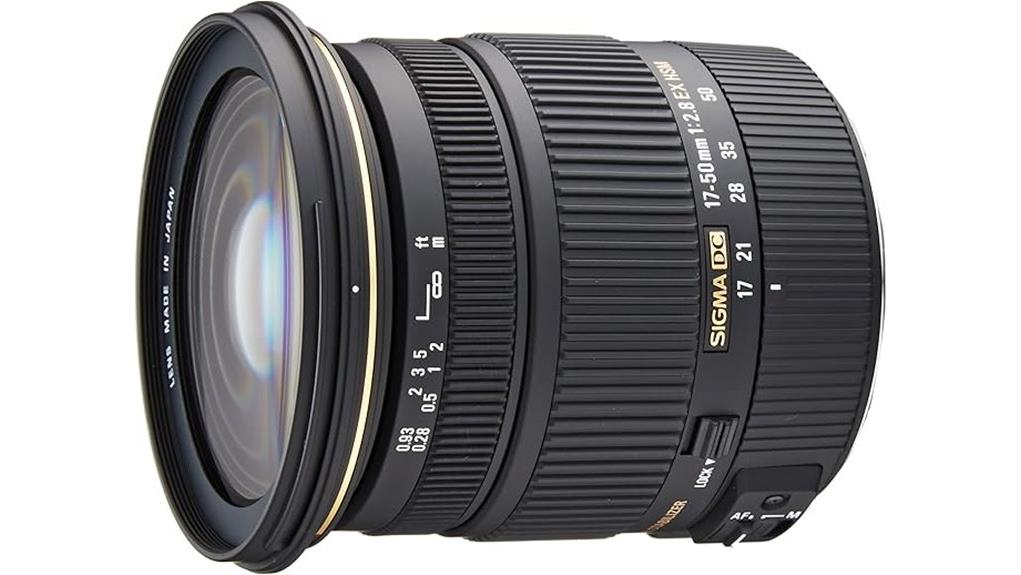
You’ll find the Sigma 17–50mm f/2.8 EX DC OS HSM FLD is a compact, fast-aperture APS-C zoom that gives professional-grade center sharpness, usable corner performance stopped down, and smooth bokeh. You’ll get a constant f/2.8 for depth control, HSM AF that’s quick and quiet, and OS that yields roughly four stops of stabilization. It’s solidly built with a 77mm thread and manageable weight, and if you want more specifics, keep going.
Some Key Takeaways
- Constant f/2.8 aperture across 17–50mm provides consistent exposure and good shallow depth-of-field control for APS-C Canon DSLRs.
- Sharpness: strong center resolution at all focal lengths; corners improve when stopped down to f/4–f/5.6.
- HSM autofocus is fast and quiet, while OS stabilization yields about four stops of handheld benefit.
- Build is solid with metalized mount, smooth zoom/focus rings, 77mm filters, but limited weather sealing and noticeable weight.
- Excellent value versus pro zooms: high optical quality and coatings (FLD/aspherical), but heavier and some corner vignetting on larger sensors.
Who Should Buy the Sigma 17–50mm F/2.8 EX DC OS HSM FLD
If you shoot with an APS-C Canon DSLR and need a versatile walk-around lens, the Sigma 17–50mm f/2.8 EX DC OS HSM FLD is aimed at you: its constant f/2.8 aperture and 17–50mm range cover wide-angle landscapes through short telephoto portraits while maintaining consistent exposure and shallow depth-of-field control. You’ll benefit if you’re a travel photographer or event shooter requiring fast aperture, compact zoom reach, and OS for low-light handheld work. The HSM guarantees responsive AF, FLD and aspherical elements control aberrations, and 77mm filters support accessories. It’s optimized for APS-C workflows, not full-frame sensors. This lens is a great fit for mirrorless camera enthusiasts transitioning from DSLRs who want high-quality, compact glass essential gear.
Real-World Sharpness and Image Quality at 17mm, 35mm, and 50mm
Moving from who the lens suits to how it actually renders, we’ll examine sharpness and image quality at the three key focal settings photographers use most: 17mm, 35mm, and 50mm. At 17mm you get strong center resolution; corners soften wide-open but recover by f/4–f/5.6, with moderate vignetting on APS-C. At 35mm mid-frame sharpness is very consistent and contrast remains high; corner sharpness is acceptable stopped down. At 50mm the optic delivers its best micro-contrast and edge clarity by f/4, producing pleasing subject separation. Bokeh rendition is smooth for a zoom, with minimal nervous highlights and controlled background blur. This lens is a solid choice for enthusiasts looking to improve their kit with a high-quality zoom that balances sharpness and handling.
Autofocus, Stabilization, and Low-Light Performance You Can Expect
Expect reliable, fast focusing and effective shake reduction in typical handheld and low-light scenarios with the Sigma 17–50mm f/2.8 EX DC OS HSM. You’ll notice fast autofocus driven by the HSM, delivering consistent subject acquisition and minimal focus hunting across the zoom range. Optical Stabilization provides roughly four stops of benefit, enabling slower shutter speeds for static subjects and improving framing stability during composition. In low light the constant f/2.8 aperture combined with OS lets you retain usable shutter speeds and lower ISO. Operation is characterized by quiet operation and predictable performance, though extreme low-light contrast may still challenge acquisition speed. This review is featured on a site dedicated to flash triggers and related photography accessories.
Handling, Build, and Compatibility (Mounts, Filters, Size, Weight)
The lens balances its operational strengths with a solid, thoughtfully engineered exterior that you’ll notice as soon as you mount it: at 1.78 pounds and with a 77 mm filter thread, the Sigma 17–50mm f/2.8 feels substantial but manageable on most Canon DSLRs, providing steady handheld use without excessive front-heaviness. You’ll appreciate the precise Build quality—metalized mount, firm zoom and focus rings, and tight tolerances. Mount variations are available for Canon (EF-S), with Sony/Pentax options offering OS viewfinder stabilization differences. Its Compact footprint aids mobility; Filter compatibility with 77 mm glass is standard, simplifying accessory selection and stacking. The lens is well suited to photographers who prioritize prime lens fundamentals when building a compact, high-performance kit.
Value Verdict: Pros, Cons, and When to Choose This Over Alternatives
Although it’s not the lightest option in its class, the Sigma 17–50mm f/2.8 delivers a clear value proposition: you get a constant f/2.8 aperture, effective optical stabilization, and high-quality optics (FLD, aspherical, and glass-mold elements with Super Multi-Layer coating) at a price point that undercuts many professional zooms. You’ll appreciate strong central sharpness, reliable OS for handheld low-light work, and HSM autofocus. Cons: weight, occasional corner vignetting on larger sensors, and limited weather sealing. Choose it when you need professional aperture performance without professional cost; it’s a sensible budget alternative that retains decent resale value if maintained. Perfect Tripods can help you pair this lens with a stable support system to maximize image quality with tripod compatibility.
Some Questions Answered
Is This Lens Compatible With Full-Frame Canon Cameras?
No, it isn’t compatible as a full-frame native lens; it’s APS C only and designed for crop sensors. You can physically mount it on some full-frame Canon bodies, but you’ll get heavy vignetting and reduced image circle coverage unless the camera switches to a crop mode. For Full frame adaptability you’d need to accept sensor crop, reduced resolution, or use a true full-frame lens to preserve edge-to-edge coverage and avoid optical compromises.
Does the Lens Come With a Manufacturer Warranty?
Yes — the lens includes a 90-day limited manufacturer warranty. You’ll receive limited coverage that typically protects against defects in materials and workmanship for that 90-day period. You should retain purchase documentation and serial information, since warranty claims usually require proof of purchase. Note that coverage excludes user damage, wear, and third-party modifications; specific terms and claim procedures can vary by seller or marketplace, so verify with the seller at purchase.
Can I Use 77MM Filters Like ND or Polarizers?
Yes — you can use 77mm filters like ND or polarizers directly on this lens. You’ll mount 77mm screw-in filters to the lens’s 77mm thread; for graduated or variable filters you may need filter adapters to fit holder systems. Be aware that circular polarizers require rotation and may cause vignetting at 17mm on APS-C; stacking multiple filters increases risk of rotation issues and vignetting, so minimize stacking and test for image degradation.
Is the Lens Sold New or Often Listed as Renewed?
You’ll find both new and used copies, but listings often show refurb availability and renewed items. Sellers commonly offer renewed or used copies with original accessories, a 90-day limited warranty on some refurbished units, and variable condition descriptions. Check seller ratings and return policies, verify included front/rear caps, hood, and case, and confirm optical condition (FLD, aspherical elements, OS, HSM function) before buying.
Does It Include a Lens Hood, Caps, and Carrying Case?
Yes — it includes accessories: you’ll get the lens hood, front and rear caps, and a protective case with the package. The listing specifies those items are supplied in the retail package, enabling secure storage and transport. You’ll also receive the lens itself and standard documentation. This kit-level inclusion supports immediate field use and helps prevent physical and optical damage during handling and transit.