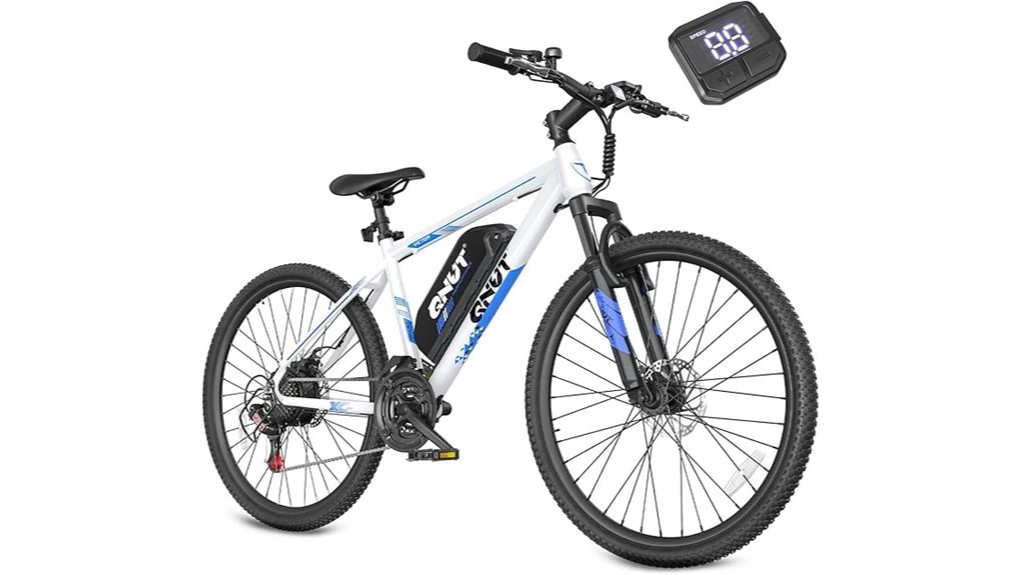
You’ll get a burly 1000W-peak hub motor that reliably sustains 28 MPH in PAS and climbs 15° grades without strain, favoring usable torque over headline wattage for predictable acceleration. The removable 36V 10.4Ah (375Wh) battery yields about 25 miles throttle-only or up to 45 miles in conservative pedal-assist, recharges in 4–6 hours, and is UL certified. The heavy 26″ steel frame, suspension fork, Shimano-style 21-speed gears and mechanical discs prioritize durability and control — keep going for full specs and trade-offs.
Some Key Takeaways
- 1000W peak brushless motor gives strong, predictable acceleration and supports assisted speeds up to 28 MPH in PAS mode.
- 36V 10.4Ah (375Wh) removable UL-certified battery yields about 45 miles PAS range and 25 miles throttle-only.
- Sturdy 26″ steel frame and front suspension offer stable, comfortable rides but add significant weight (~25 kg).
- 21-speed drivetrain and mechanical disc brakes deliver reliable climbing control and consistent stopping power.
- Good value with 12-month warranty, lifetime 1-on-1 support, and practical recommended accessories for long-term use.
Real-World Power & Speed: 1000W Peak, 28 MPH, and Hill Climbs
Tap into the QNUT’s 1000W peak brushless motor and you’ll notice it delivers strong, immediate acceleration—enough to sustain assisted speeds up to 28 MPH in PAS mode and handle 15° climbs without laboring. You’ll assess motor efficiency by observing sustained power delivery and thermal stability under load; the system balances output and battery draw better than comparable hub motors. Climb performance remains consistent across mid-range gears, aided by the 21-speed drivetrain for cadence control. Compared to similar e-bikes, the QNUT prioritizes usable torque over peak watt claims, offering predictable, repeatable acceleration on pavement and moderate gradients. For riders who enjoy outdoor adventures, selecting the right motor means considering torque and durability alongside peak power.
Range and Battery: 36V 10.4Ah Performance, Charging, and Expectations
Although the QNUT’s 36V 10.4Ah (375Wh) removable lithium pack isn’t the largest in its class, it delivers predictable range and charging behavior you can plan around. You’ll typically see up to 45 miles in conservative PAS and about 25 miles using throttle-only; real-world range prediction depends on load, terrain, and assist level. The pack uses standard lithium battery chemistry with UL 2849 certification, offers 4–6 hour recharge time, and is removable for indoor charging. Expect reasonable charge cycles lifespan with basic thermal management from the frame and charging protocol; replace after gradual capacity decline over years. For riders seeking replacements or upgrades, consider compatibility with replacement ebike batteries and outdoor use when selecting a new pack.
Ride Comfort and Control: Frame, Suspension, Gears, and Brakes
Having covered battery behavior and range expectations, let’s look at how the QNUT feels on the road and trail. You’ll notice the 26″ steel frame gives stability but feels heavier than aluminum alternatives; it soaks pedal feedback for predictable handling. Front suspension fork smooths moderate bumps; it’s not plush like higher-end forks but effective for mixed surfaces. The professional 21-speed Shimano-style gearset shifts crisply, letting you maintain cadence up inclines the 1000W motor assists. Mechanical disc brakes offer consistent stopping power and modulation. Small touches—ergonomic grips and an adjustable saddle—improve long-ride comfort and control. For riders who frequent varied terrain, pairing the bike with an ebike-compatible suspension seatpost can noticeably enhance comfort and reduce rider fatigue.
Build, Weight, Payload, and Everyday Usability
Because the QNUT uses a 26″ heavy-duty steel frame, you’ll notice a solid, durable build that trades lightness for robustness—at roughly 25 kg the bike feels heftier than comparable aluminum models but delivers a stable ride and higher load tolerance. You’ll appreciate clear assembly ease: it arrives 90% assembled with tools and straightforward steps, so setup is quick. Payload capacity supports riders up to 140 kg and integrates well with racks and panniers, offering practical cargo compatibility. Everyday usability benefits from the upright geometry, removable battery for indoor charging, and balanced weight distribution, though lifting requires effort. The bike’s sturdy construction pairs well with heavy-duty ebike racks designed for high payloads, improving long-distance touring and cargo hauling.
Value Verdict: Warranty, Support, Price Considerations, and Who Should Buy
Moving from everyday usability to overall ownership costs and support, the QNUT’s warranty and service offering play a big role in its value proposition. You get a 12-month warranty, lifetime 1-on-1 support and documented customer responsiveness—responses within 24 hours—giving stronger warranty clarity than many budget ebikes. Price sits competitively for a 1000W bike with UL-certified battery and solid components. If you prioritize power, range and quick service, it’s a sensible buy. If you need premium components, lighter weight, or extended factory warranties, compare higher-tier models. Overall, value favors riders seeking robust performance with dependable aftercare. Many riders also protect their investment by using ebike trackers and insurance tailored to outdoor riding.
Some Questions Answered
Does It Come With Integrated Lights or a Horn?
No, it doesn’t include an integrated horn or dedicated daytime runninglights. You get front and rear mechanical disc brakes, a backlit LCD, and basic lighting often mounted rather than integrated. Compared to bikes with built-in horns and DRLs, this model relies on standard lights and accessories; you’ll likely add an aftermarket integrated horn or true daytime runninglights for improved visibility and audible signaling, matching other e-bikes’ safety features.
Is the Bike Compatible With Rear Racks or Panniers?
Yes — you can fit a rear rack and expect pannier compatibility. The heavy-duty 26″ steel frame and 140 kg load capacity give strong support compared with lightweight commuter frames. You’ll likely mount most standard rear racks to the frame eyelets; use a robust rack rated for e-bike loads. For panniers, choose ones with secure clips and water-resistant materials. If you plan heavy cargo, compare rack weight ratings before buying.
Can I Legally Ride It on Bike Paths in My State/City?
That depends — you’ll need to check local regulations and path classifications. Many areas restrict e-bikes over 750W or >20 MPH to roads or class 3 bike routes; others allow higher-power bikes on multi-use paths if speed’s limited. Compare your city and state rules, note posted signage, and confirm whether paths are designated for pedal-assist only, throttle allowed, or banned. If unsure, contact local transportation or parks departments for clarification.
Are Replacement Batteries or Spare Parts Readily Available?
Yes — you can generally find replacement batteries and parts, but availability varies. You’ll source OEM units via the manufacturer for battery sourcing and warranty coverage; aftermarket options exist from retailers and third-party cells sellers, offering cost or capacity trade-offs. Compare specs, connector type, and UL certification before buying. For other spare parts, check dealer networks and online marketplaces; independent shops often stock compatible components and offer installation.
What Tools Are Needed for Final Assembly and Maintenance?
You’ll need basic tools for final assembly and routine maintenance: Allen wrenches (metric set), adjustable wrench, torque wrench for correct bolt tightening, screwdrivers, tire levers, patch kit, pump, chain tool and lubricant, and a pedal wrench. Compared to pricier e-bikes, this list’s lighter—professional shops add bike stand and cable cutters—but these tools let you assemble safely, adjust shifting, and maintain brakes, tires, and drivetrain.