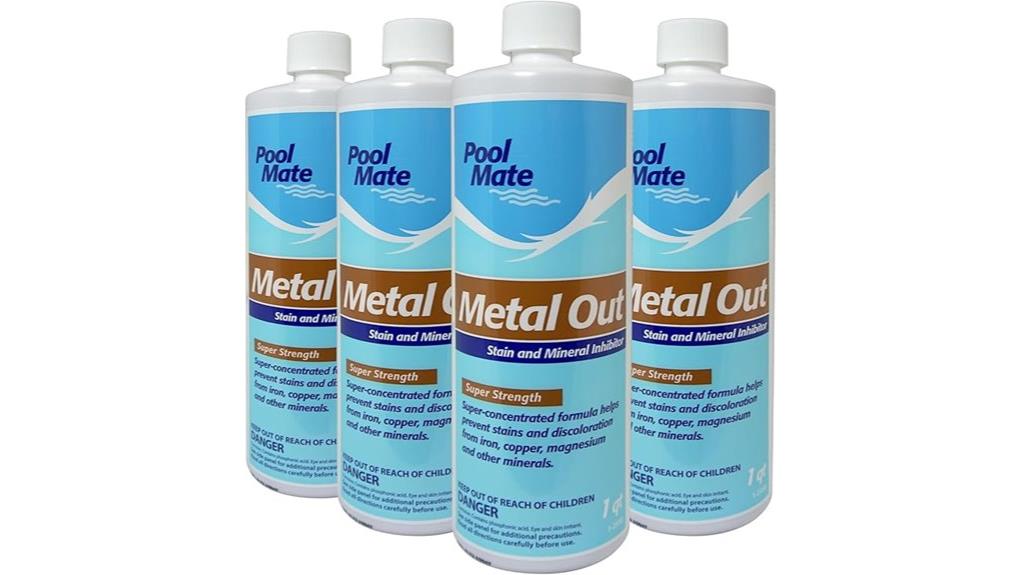
You’ll get a concentrated, multi‑metal sequestering treatment that prevents staining and clears metal‑clouded water when used exactly as directed. It chelates iron, copper, manganese, calcium and trace metals to keep them soluble and stop plating on surfaces. Dose before chlorination on fills, use shock protocol for colored water, then maintain monthly. Works fast with proper pH control and filtration but won’t remove embedded stains. Keep going to see detailed dosing, troubleshooting and comparisons.
Some Key Takeaways
- Chelates and sequesters iron, copper, manganese, calcium, and trace metals to prevent staining and discoloration.
- Best used preventively monthly or for corrective shocks; 1 qt treats 10,000–20,000 gallons depending on use.
- Works fastest when chlorine is off, pH lowered to ~6.8, product added, and water circulated overnight.
- Clears mild discoloration typically overnight; heavy or multiple-metal issues may need repeat treatments.
- Pros: concentrated and easy to dose; cons: won’t remove embedded stains and needs pH manipulation and monthly maintenance.
Quick Verdict: Who Pool Mate Metal Free Is Best For
Who should use Pool Mate Metal Free? You’re a homeowner with saltwater systems battling metal staining or a competitive pool owner needing consistent water clarity. Use this concentrated sequestrant if you fill with well or municipal sources prone to trace metals, run regular seasonal openings/closings, or perform intensive backwashing that lowers chelant levels. It’s practical for preventive monthly dosing and corrective shock treatments when metals cause discoloration. You’ll follow precise dosing: initial, corrective, and maintenance rates, and adjust pH as directed. Avoid casual or off-label mixing; apply per label to protect surfaces, plumbing, and performance.
What Pool Mate Metal Free Does and Which Metals It Targets
Pool Mate Metal Free chelates and sequesters dissolved metals and minerals in pool water to prevent discoloration, staining, and scale. You get a concentrated liquid sequestrant that ties up iron, copper, manganese, calcium and trace metals like cobalt, nickel, lead and silver, keeping them soluble and nonreactive. Its metal binding mechanisms form stable complexes that resist oxidation and precipitation, so metals won’t plate onto surfaces or catalyze stains. You’ll protect plumbing and liners during normal operation, shutdowns, and long term storage when residual sequestrant prevents redeposition. Use as directed to maintain clear water chemistry and minimized staining risk.
How to Use It: Dosages, Timing, and Step‑by‑Step Stain Removal
When you suspect metal contamination or see staining, follow the precise dosing and timing steps to chelate metals, clear the water, and prevent redeposition. For initial fill, add 1 quart per 10,000 gallons before chlorination; for colored water, close the pool, run the pump, stop chlorination until chlorine = 0 ppm, lower pH to 6.8, then add 1 quart per 10,000 gallons. Circulate overnight or until clear, then reset pH to 7.2–7.8 and resume chlorination when residual is 1.0–3.0 ppm. For maintenance add 1 quart per 20,000 gallons monthly. Follow application timing and cleanup procedures exactly.
Performance in Real Use: Effectiveness, Speed, and Troubleshooting Tips
Although results depend on metal type and concentration, Pool Mate Metal Free consistently chelates common contaminants (iron, copper, manganese) and clears mild discoloration within one overnight circulation when dosed per label; heavier or multiple-metal infestations can take repeated treatments and longer run times. You’ll see fastest results when you follow recommended application timing: stop chlorination, lower pH, add product, then circulate overnight. Monitor water and repeat if haze persists. Maintain efficient filtration and backwash as needed—poor filter performance prolongs clearing. If stains persist on surfaces, treat directly after metals are sequestered and confirm filter maintenance to prevent redeposition.
Pros, Cons, Cost Per Gallon, and How It Compares to Alternatives
Having covered real-world performance and troubleshooting, let’s evaluate strengths, weaknesses, pricing, and how Metal Free stacks up against other sequestrants. You get concentrated, multi-metal protection, easy dosing, and compatibility with routine chemistry — clear pros backed by user testimonials praising stain prevention. Cons: requires pH manipulation for fixes, won’t remove embedded stains, and monthly maintenance dosing adds ongoing cost. Cost per gallon: a 1-quart bottle treats 10,000–20,000 gallons; per-gallon product cost is moderate versus chelator-heavy brands. In price comparison, Metal Free is competitive for routine use; alternatives may be cheaper per-treatment but less versatile or concentrated.
Some Questions Answered
Is Metal Free Safe for Vinyl, Plaster, Fiberglass, and Concrete Pools?
Yes — you can use it on vinyl, plaster, fiberglass, and concrete pools. You’ll follow label directions: dose per gallons, lower pH for metal removal, circulate, then restore pH and chlorine. Vinyl compatibility is good when used as directed; avoid prolonged high concentrations. Fiberglass durability isn’t harmed by normal application. It’s a sequestrant that prevents stains and scale, so monitor levels and use pH adjusters to protect surfaces.
Does It Affect Pool Heater or Salt Cell Operation?
No — when used per label you won’t harm heater efficiency or salt cell longevity. You’ll add the sequestrant at recommended doses, keep chlorine at zero during treatment, and return pH to 7.2–7.8 before resuming sanitization. That prevents metal buildup that could reduce heat transfer or foul a salt cell. Follow circulation and dosing instructions; occasional maintenance dosing actually protects heater heat exchangers and extends salt cell life.
Is the Product Biodegradable or Environmentally Friendly?
No — the label doesn’t claim the formula or packaging is biodegradable, so you shouldn’t assume it’s fully eco-friendly. You can expect a concentrated liquid sequestrant that treats metals but may persist in water; check local discharge rules to limit ecosystem impact. To reduce harm, you should follow dosage, avoid overuse, capture backwash, and dispose of rinse water per regulations. Contact manufacturer for biodegradability data and safety datasheet.
Can Metal Free Be Mixed With Other Pool Chemicals in One Dose?
No — you shouldn’t mix Metal Free with other pool chemicals in one dose. For dosing compatibility, add Metal Free separately per label directions to make certain proper stain prevention and sequestration. Follow the sequence: adjust pH, stop chlorination if correcting colored water, dose Metal Free, circulate, then recheck pH and resume sanitizers. Mixing chemicals can reduce effectiveness or cause reactions; always follow label instructions and wait between additions.
What Is the Shelf Life After Opening the Bottle?
You’ll find no official best before on the label; treat an opened bottle as stable for about 1–2 years if stored properly. Keep it sealed, out of direct sunlight, and maintain a cool storage temperature (ideally 50–77°F / 10–25°C). If product shows discoloration, precipitation, or unusual odor, don’t use it. Always follow label safety and disposal instructions, and replace if performance seems diminished.