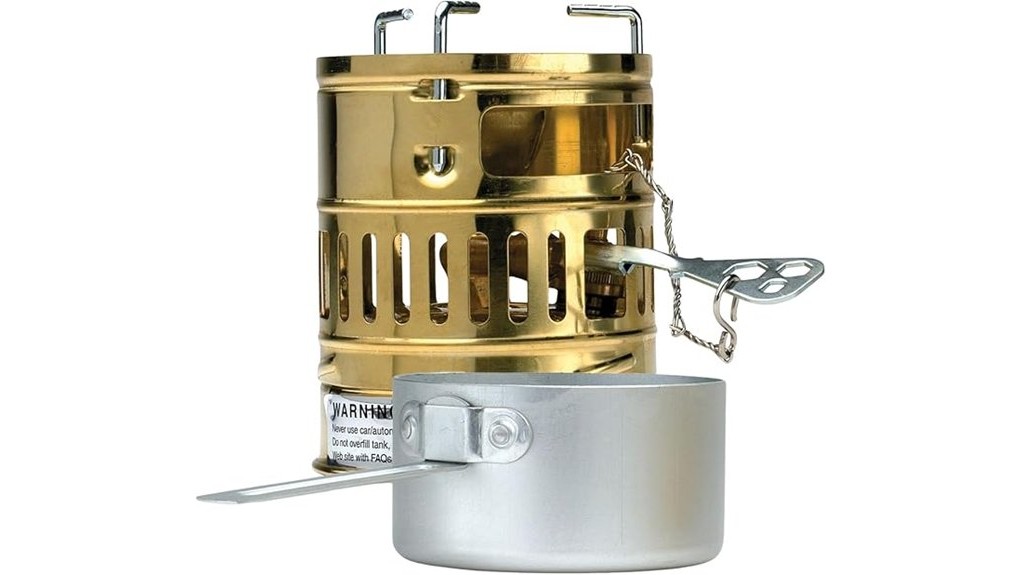
You’ll get a compact, sturdy brass white‑gas stove that’s built for reliable, high‑output cooking in cold and high‑altitude conditions where canisters fail. It’s self‑contained, lightweight for its class (≈550 g), simple to service, and has a built‑in cleaning needle for low maintenance. White gas vaporizes cleanly, boils 1 L in about seven minutes, and the control valve gives good simmering. It’s a proven mountaineering choice—keep going to see fuel, service, and pairing details.
Some Key Takeaways
- Compact, durable brass stove offering reliable high-heat performance for mountaineering and cold-weather use.
- Runs on white gas with predictable boil time of about 1 L in ~7 minutes under typical backcountry conditions.
- Liquid-feed, pressurized design vaporizes cleanly and performs better than canisters in cold and at altitude.
- Built-in cleaning needle and straightforward disassembly make routine maintenance and field repairs simple.
- Weighs ~550 g and is self-contained, trading extra weight for proven reliability and long service life.
Quick Verdict: Is the Optimus Svea Worth Buying for Camping and Mountaineering?
Though it’s compact and simple, the Optimus Svea delivers reliable, high-performance cooking for camping and mountaineering, and it’s worth buying if you value durability and fuel reliability. You get a sturdy brass stove that favors consistent boils, precise control, and a built-in cleaning needle for low-maintenance use. Its lightweight portability (550 g) and self-contained design suit backpacking and alpine moves where weight and reliability matter. You’ll appreciate the classic aesthetic and long service life; it won’t compete with ultralight canister systems on convenience, but it outperforms them in cold, high-altitude conditions and rugged longevity. Ideal for users who rely on camp stoves and durable gear when venturing into remote or cold environments.
Purpose and Performance: How the Svea’s White Gas System Handles Altitude and Cold
Because white gas vaporizes cleanly and burns hot, the Svea keeps working reliably where canister stoves falter: in freezing temperatures, low-oxygen high-altitude environments, and cold alpine bivies. You’ll notice consistent altitude performance because the liquid-feed, pressurized brass system doesn’t depend on gas canister vapor pressure. Cold starts are straightforward: pre-warm the generator briefly, prime once, and the built-in cleaning needle maintains flow. You can fine-tune flame for simmer or boil without hunting for pressure. For mountaineering use, the Svea’s predictable output and simple maintenance minimize failure points when you need reliable heat at elevation. Essential accessories like fire starter kits and durable matches help ensure you can get a fire going when conditions make stoves difficult to operate.
Fuel, Boil Time, and Temperature Control: Real Numbers and Simmering Detail
When you need predictable heat, the Svea delivers: running on white gas it brings 1 L of water to a rolling boil in roughly 7 minutes under typical backcountry conditions, and you can throttle that output down to a gentle simmer without hunting for pressure. You’ll appreciate consistent fuel efficiency — white gas burns cleanly, performs in cold and at altitude, and meters energy predictably. The control valve gives fine, immediate response so you get simmer precision for delicate sauces or rehydration. Expect repeatable boil times with standard fuel loads; plan consumption by trip duration rather than minute-by-minute adjustments. For reliable backcountry cooking, pair the Svea with essential two-burner camp stove gear like wind screens and fuel bottles for best performance and safety, especially when managing camp stove accessories.
Build, Maintenance, and Durability: Brass Construction and Service Features
Having reliable simmer control is only part of the story—how the stove is built determines how long it will keep performing that way. You get solid brass components that resist corrosion and handle repeated disassembly without deforming. The compact, self-contained design keeps parts protected in your pack. Routine service is straightforward: use the handle tool for minor adjustments and the built-in cleaning needle to clear jet blockages in the field. Threads and seals are robust but inspect O-rings regularly and replace them as scheduled. With basic maintenance and proper storage you’ll preserve consistent operation and extend stove lifespan. Keep a lightweight patch kit in your pack to handle unexpected fabric or gear damage while camping.
Who Should Buy the Svea and What to Consider Before You Buy
If you prioritize reliability, simplicity, and proven performance in extreme conditions, the Svea is worth serious consideration. You should buy it if you need a compact, durable stove for mountaineering, cold-weather trips, or minimalist backcountry travel; it’s 550 g, boils 1 L in ~7 minutes, and handles high altitude and low-oxygen environments. Consider fuel availability—white gas performs best but isn’t sold everywhere—so plan resupply or carry extra. Compare Lightweight alternatives if weight-critical: some can be lighter but less durable or cold-tolerant. Factor maintenance skills, spare parts access, and long-term value before you buy. The Svea pairs well with other essential cold-weather gear like insulated tents and camping heaters for staying warm during night temperatures.
Some Questions Answered
Can the Svea Use Alternative Fuels Like Coleman or White Propane Canisters?
No, the Svea won’t directly accept Coleman or white propane canisters; its fuel compatibility is native to liquid white gas (naphtha). You can, however, use canister adapters that convert pressurized gas canisters to a liquid-feed system, but they’re bulky and may void safe operation or warranty. You’ll get best reliability and freezing/high-altitude performance sticking with white gas, unless you’re prepared to rig and test adapters carefully before backcountry use.
Is Replacement Fuel Bottle or Parts Readily Available Globally?
Yes — replacement fuel bottles and parts have good global availability, so you can source spares fairly easily. You’ll find original and compatible bottles, seals, and jets through specialty outdoor retailers, manufacturer networks, and online marketplaces. Spare sourcing is practical in Europe and North America; availability in remote regions varies, so carry key spares on long trips. Prioritize genuine brass parts and proper seals to maintain reliable performance and safety.
How Loud Is the Stove During Operation at Full Burn?
At full burn you’ll hear a steady, moderate noise level—more of a firm whoosh than a high-pitched scream. The sound profile is low-to-mid frequency turbulence from the brass jet, audible at close range but not deafening. You’ll still hold conversations a few feet away, though quiet campsites will notice it. Its compact design keeps resonance down, so expect predictable, continuous noise rather than sharp spikes.
Can the Cookpot Lid Be Used Directly on Other Stoves?
Yes — you can use the cookpot lid on other stoves, but check lid fitment and heat transfer first. The lid’s integrated design fits most small backpacking burners, yet wobble can occur on oversized grates. Expect good heat transfer for simmering and boiling when centered; uneven contact reduces efficiency. If the other stove’s flame or pot supports don’t align, use a stabilizer or different pot to avoid poor performance or tipping hazards.
Is There a Warranty or Manufacturer Support for International Buyers?
Yes — you’ll usually get a limited manufacturer warranty, but Warranty transferability varies by seller and region. Check your receipt and register the stove to secure coverage; international buyers may need proof of purchase. Regional service depends on local distributors; some countries offer full repair support while others require shipping to authorized centers. You’ll want to contact the manufacturer or retailer before purchase to confirm exact terms, transfer rules, and service options.