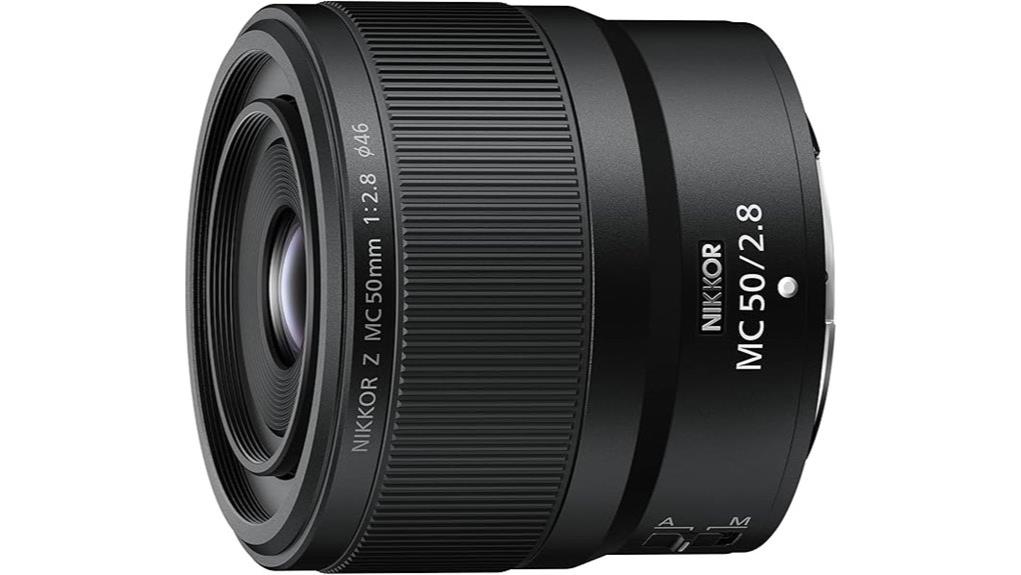
You’ll get a compact, weather‑resistant 50mm 1:1 macro that’s sharp at the center from wide open and resolves fine texture down to f/11, with corners tightening by f/4–f/5.6 and mild field curvature at extreme close distances. Autofocus is quiet, snappy, and precise for handheld work and stacks, while stabilization relies on your camera’s IBIS. It’s ideal if you want a portable, durable macro that doubles as a natural 50mm — more specifics follow.
Some Key Takeaways
- True 1:1 macro with 50mm field of view and 0.16 m close-focus offers versatile, life-size macro capability in a compact package.
- Excellent central sharpness and micro-contrast from f/2.8, with corners improving by f/4–f/5.6 and diffraction limiting after f/11.
- Responsive, quiet linear-stepping AF and smooth manual focus make it suitable for handheld macro, stacks, and general shooting.
- Lightweight, weather‑resistant build, 46 mm filters, and included hood/case favor field use and portability over longer macros.
- Trades working distance for compactness compared with 60–105mm alternatives, but outperforms many third-party options on sealing and Z-system integration.
What This 50mm Macro Actually Offers (Key Specs & Real-World Use)
The Nikon NIKKOR Z MC 50mm f/2.8 gives you a true 1:1 macro in a compact, front-focusing 50mm prime that doubles as an everyday lens. You get a 50mm field of view, f/2.8 maximum aperture, 0.16 m close-focus and life-size 1:1 magnification in a weather‑resistant, lightweight package. Its compact versatility suits product, food and nature field applications where a short working distance and predictable framing matter. Optical stabilization, 9‑blade diaphragm and fluorine coating support practical shooting. You’ll switch between macro and walkaround uses without changing lenses, making it a pragmatic everyday macro for Z‑system users. This makes it a convenient choice for photographers who also need reliable accessories like camera body caps to protect their gear when swapping lenses.
How Sharp Is It at 1:1 and Across Apertures? Real-World Image Quality
Look closely and you’ll see the Z MC 50mm f/2.8 delivers impressively high central sharpness at 1:1 right from wide open. You’ll resolve fine texture and micro-contrast in the center with minimal diffraction until about f/11. Edge performance is good for a compact macro: corners tighten by f/4–f/5.6, though slight falloff and very mild field curvature remain at extreme close distances. Stopping down improves uniformity across the frame, but diffraction limits ultimate gain beyond f/11. In real-world shooting you’ll get reliable, repeatable detail for product and nature work, maintaining usable edge rendition at practical apertures. This makes it a strong choice for wide-angle enthusiasts who also appreciate macro capabilities.
Autofocus, Stabilization, Handling, and Build for Z-Series Shooters
Expect responsive, accurate autofocus and sensible handling from the Z MC 50mm f/2.8 when paired with Nikon Z bodies. You’ll get quiet, snappy AF driven by a linear stepping motor; autofocus performance is reliable for macro stacks and general shooting, with minimal hunting at close distances. Optical stabilization in-body (IBIS) complements the lens’ design—there’s no internal VR, so camera stabilization is essential for handheld macro work. Handling ergonomics favor compactness: light weight, short barrel, and a smooth, damped focus ring for precise manual adjustments. Build is weather-resistant with quality finishes and solid mount alignment for durable field use. This lens is a great fit for mirrorless photographers seeking essential gear that balances performance and portability.
How It Compares to Other 50mm Macros and Close Alternatives
Having covered autofocus, stabilization, handling, and build, it’s useful to compare the NIKKOR Z MC 50mm f/2.8 against other 50mm macro options and nearby focal-length alternatives to see where it stands in optical performance, handling, and value. You’ll find its sharp center resolution, 1:1 magnification, and compact weight outperform many compact alternatives from camera makers. Against longer focal 60–105mm macros it trades working distance for a smaller profile and easier handheld use. Third party competitors may undercut price but often lag in coatings, weather sealing, and AF integration on Z bodies. Overall balance favors Nikon for Z users. This makes it a solid choice for those using handheld gimbals who need smooth shots while shooting macros.
Who Should Buy the Nikon Z MC 50MM F/2.8 and Practical Buying Advice
Who benefits most from the NIKKOR Z MC 50mm f/2.8? You will if you need a compact, weather‑resistant 1:1 macro that doubles as a natural-field 50mm for everyday use. Macro photographers and portrait enthusiasts gain sharp center detail, reliable close-focusing (0.16 m) and optical stabilization. Budget shooters will appreciate the modest weight, small filter size (46 mm) and included hood/case versus pricier alternatives. Practical buying advice: prioritize if you use Nikon Z bodies and value portability over extreme bokeh; compare to longer macros for working distance; consider used units to save money while retaining Nikon’s one‑year warranty. Also consider pairing it with other essential lens accessories for better results, like protective filters and cleaning kits, to round out your essential lens gear.
Some Questions Answered
Does This Lens Support In-Camera Focus Stacking on Z Cameras?
Yes — you can use in-camera focus bracketing (focus stacking) with Z cameras and this lens, provided your camera model supports the feature. You’ll control bracket step size and frame count in the camera menu, then let the camera capture the sequence. Use focus peaking to fine‑tune manual focus and confirm sharp areas during setup. Note: final stacking still requires post‑processing or in‑camera stacking depending on your Z model’s capabilities.
Can It Be Used for Video Macro With Continuous Autofocus?
Yes — you can use it for video macro with continuous autofocus, and it performs adequately on Z bodies that support AF-C. You’ll get smooth AF tracking at close distances, though performance depends on camera AF system and subject contrast. Expect some focus breathing when racking focus, typical for compact macro designs. Stabilization and 1:1 capability help handheld work, but monitor AF-C behavior and consider manual focus for critical focus pulls.
Is the Front Element Threaded for Close-Up Accessories?
Yes — the front element accepts a 46 mm front filter and is threaded so you can attach close-up accessories; the lens cap fit remains secure with the LC-46B cap. You’ll screw filters or diopters onto the front threads for macro work, preserving autofocus and weather resistance. Maintain proper torque to avoid cross-threading, and use the included hood (HN-41) when necessary to reduce flare while keeping the front filter in place.
How Does the Fluorine Coating Hold up to Cleaning Over Time?
You’ll find the fluorine coating remains durable with routine cleaning, showing minimal degradation. Durability testing indicates strong chemical resistance to common cleaning solutions and fingerprints; solvents and abrasive scrubbing accelerate wear. You should use lens-safe fluids and microfiber cloths, avoid alcohol-heavy cleaners, and limit pressure. With proper care you’ll retain repellency and easy-clean performance for years, though heavy industrial chemicals or repeated abrasive contact will eventually reduce effectiveness.
Are Extension Tubes Compatible Without Losing Autofocus?
You can use an extension tube, but you’ll likely lose reliable autofocus. Extension tubes increase flange distance, reducing lens contrast and AF speed; focus accuracy often degrades, especially at 1:1. If you need AF, choose an electronic tube with contacts and confirm adapter compatibility with your Z body. For consistent results, use a manual tube or switch to manual focus—it’s technically more predictable for macro work and guarantees precise results.