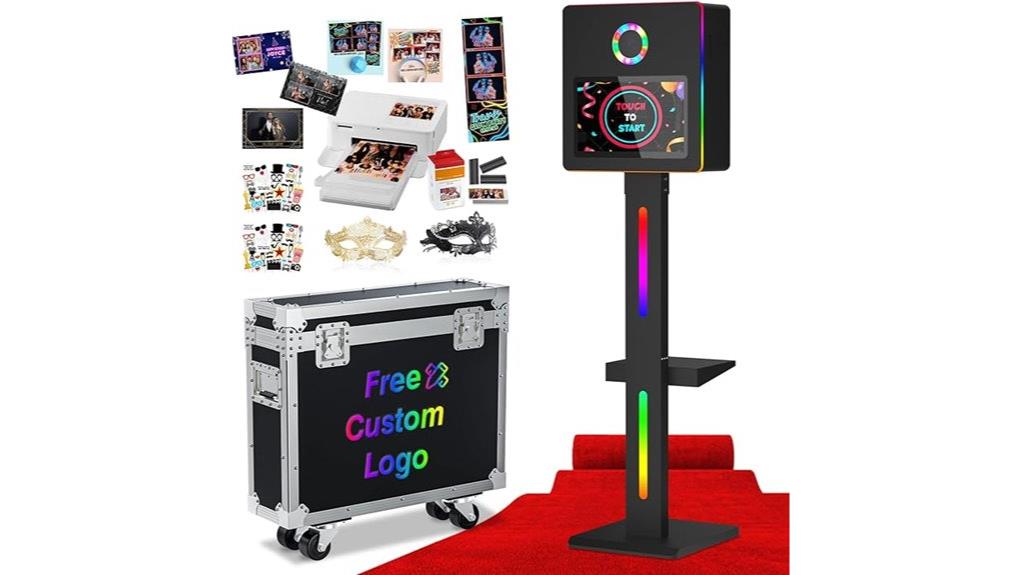
You’ll get a rugged, rental‑ready mirror photo booth that’s built for travel and fast setup, with a lockable flight case, lockable wheels, and organized accessories. The 15.6‑inch touchscreen is simple and accessible, and the DSLR mount delivers sharp images though the fixed 35mm lens limits tight portraits. Prints are instant and reliable from the included printer, with basic onboard color tweaks; heavy edits need external software. Keep going to see full specs, pros, and tradeoffs.
Some Key Takeaways
- Durable flight case, wooden shell, and lockable wheels make this mirror photo booth highly transportable and rental‑ready.
- 15.6″ capacitive touchscreen with large touch targets, adjustable contrast, and voice prompts ensures intuitive, accessible operation.
- DSLR‑mount plus fixed 35mm wide‑angle lens and mini‑PC yield sharp, consistent group shots; tight portraits are limited.
- Included instant printer (108 starter sheets) reliably produces acceptable color prints quickly; heavy edits need external software.
- Mid‑premium pricing, five‑year warranty, and rental focus suit pros seeking recurring revenue and dependable uptime.
Hardware and Build: Enclosure, Touchscreen, Camera, Printer, and Accessories
Inspect the Mirror Photo Booth and you’ll find a solid, event-ready build: a flight case plus wooden outer shell protects a lockable, heavy‑duty mirror surface on lockable wheels, and the unit houses a 15.6‑inch capacitive touchscreen, a DSLR‑compatible mount (wide‑angle 35mm, max focal length ~30mm), RGB lighting with music sync, and an integrated mini PC (Intel i5, 8GB RAM, 256GB storage, Windows 10). You’ll appreciate the material resilience across shell, hinges, and wheels. Touchscreen calibration is straightforward, responsive, and repeatable. Accessories—props, lockable camera case, printer and cables—are organized for rapid setup and durable transport. Many photographers pair the booth with rugged protective solutions like Pelican cases to simplify travel and protect equipment.
Photo Quality and Printing: DSLR Integration, Lens/Focal Limits, Image Processing, and Print Speed/Quality
Evaluate the Mirror Photo Booth’s imaging chain by looking at how the DSLR integration, lens constraints, and onboard processing work together to produce printable results. You’ll find the fixed 35mm wide-angle (max 30mm noted) delivers consistent framing for groups but limits tight portraits; you must position subjects deliberately to avoid distortion. DSLR mounting is solid and compatible, yielding DSLR-grade sensors for sharp captures. The mini PC handles basic color calibration and noise reduction well for event lighting, though heavy edits need external software. Prints are instant and reliable with included printer; print speed is adequate and output color fidelity is acceptable for guests. Many mirrorless and DSLR users will appreciate the system’s compatibility with mirrorless accessories and related gear.
User Experience at Events: Touchscreen Workflow, Launch/Print/Share Flow, Props, Audio/Lighting, and Remote Support
Usually you’ll start interactions on the 15.6-inch capacitive touchscreen, which responds quickly to double-tap commands to launch the DSLR, guide captures, and trigger instant printing or sharing. You’ll find a clear workflow: preview, pose prompts, countdown, then instant print/share. Touch targets are large and accessibility features like adjustable contrast and voice prompts help diverse guests. Props and red carpet enhance engagement; RGB lighting and music sync amplify mood but expect manual tweaks for balance. Remote engineer-assisted video support resolves issues fast. Built-in user analytics report session counts and share rates, letting you optimize flow and staffing for events. Consider offering gift card options to let guests purchase prints or photo-related products after the event.
Setup, Durability, and Mobility for Rentals: Packaging, Flight Case, Lockable Wheels/Case, Power System, and Long-Session Reliability
Because events demand quick turnarounds and rough handling, the Mirror Photo Booth’s flight case plus wooden outer crate and lockable camera case give you a rugged, transport-ready system that cuts setup time and damage risk. You wheel the unit on lockable wheels, unpack in minutes, and lock components for transit. Flight durability is evident in foam-fit mounts and reinforced corners; the wooden crate adds crush protection for shipping. The power system supports long-session reliability with stable AC operation and clear cable routing. Battery redundancy option guarantees sessions continue during venue outages, reducing downtime and client complaints. For photographers who travel frequently, a dedicated tripod carrying case helps keep your supporting gear organized and protected.
Value, Warranty, and Who Should Buy or Rent This Unit: Price-Related Value, Five-Year Warranty, Return Policy, Target Use Cases, and Final Recommendation
Having proven durable and easy to deploy for rentals, you’ll next want to compare what this Mirror Photo Booth delivers against its cost and protections. You’ll judge value by hardware (i5 mini PC, touchscreen, DSLR-ready mount, instant printer with 108 sheets) versus pricing strategy: mid-premium for rental pros or studios. The advertised five-year warranty on unit/components reduces lifecycle risk; Amazon’s 30-day return policy adds short-term protection. Review customer testimonials for consistent uptime, print reliability, and service response. Buy if you run rentals or events frequently; rent if needs are occasional. Recommendation: buy for recurring revenue, rent for one-offs. This aligns with how photographers often prioritize carry comfort when choosing gear for on-the-go events.
Some Questions Answered
Does the Mirror Support Offline Printing Without Internet Access?
Yes — you can print offline. You’ll use offline printing via the built-in mini PC and local storage (256GB) so the unit handles captures, layouts, and instant print jobs without internet. You’ll still control capture and printing through the 15.6-inch touchscreen; the included printer uses its onboard drivers and paper supply. This setup suits events where network access isn’t available and keeps sharing/backup optional until you reconnect.
Can I Use Third-Party Photo Paper or Different Paper Sizes?
Yes — you can use third-party photo paper, but you should match the printer’s specs and test quality first. You’ll want compatible photo paper with the correct thickness, coating, and ink chemistry to avoid jams or poor color. Paper sizes must fit the built-in printer’s supported dimensions; using different paper sizes may require margin adjustments or custom templates. Always test a few sheets and keep original supplies as a fallback.
Is the Touchscreen Usable While the Printer Is Warming Up?
Yes — you can use the touchscreen while the printer warms up. The touch responsiveness stays active during print boot latency, so you won’t be locked out of menus or previews. You can browse, apply layouts, customize stickers and queue prints while the mini PC handles printer initialization. Expect slight delays invoking print jobs until the printer finishes booting, but overall the UI remains responsive and practical for continuous event workflows.
Are Software Updates User-Installable or Require Technician Support?
You can install routine firmware updates yourself via the touchscreen or included mini PC, but critical patches and major upgrades usually require technician support. The system supports remote diagnostics so Enwozp (or your service partner) can push fixes or guide installs over a remote session. You’ll get clear prompts for user-installable updates; for anything flagged by remote diagnostics as risky, schedule technician assistance to avoid downtime and preserve warranty coverage.
Can I Rent Additional Backup Units for Large Events?
Yes — you can rent extra units for large events. You’ll coordinate logistics coordination with the supplier, confirm delivery timing for staggered drop-offs or returns, and review staffing options for setup, monitoring, and pack-down. Evaluate unit availability, backup printer supplies, and power requirements ahead of time. Get written schedules and contact points, budget for technician-assisted support if needed, and confirm return/insurance terms before finalizing.