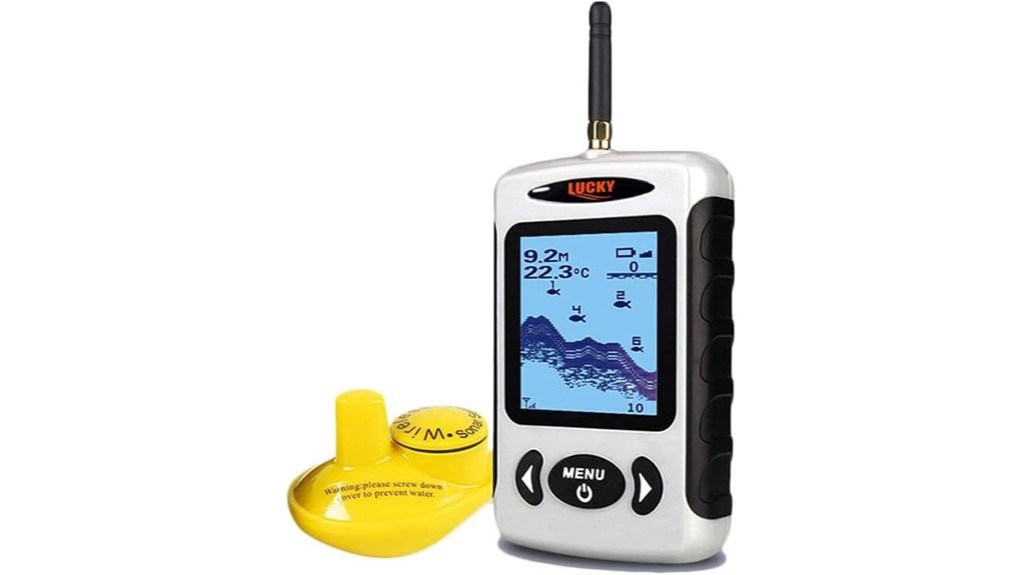
You’ll get a compact, battery-powered sonar that pairs with a wireless transducer to show depth, temperature, and fish echoes on a 2.2″ LCD. It casts or tethers, offers about 100–120 m wireless range in open water and usable depths from ~0.7–45 m, and runs on four AAA cells. Accuracy drops with thermoclines, turbidity, or interference, and screen detail is limited. It’s ideal as a portable primary or backup; keep reading to get setup tips and tradeoffs. When considering a lucky portable fish finder review, it’s important to evaluate the battery life and the ease of use in different environments. User feedback often highlights how these devices can enhance fishing experiences, particularly for those new to sonar technology. Additionally, many anglers appreciate the versatility in various fishing conditions and the compact design that makes it easy to transport.
Some Key Takeaways
- Portable 2.2″ LCD handheld shows depth, temperature, and fish icons, powered by four AAA batteries for simple on-the-water use.
- Wireless transducer pairs to the display and offers tethered or free-cast deployment, with typical range around 100–120 m in open water.
- Effective depth readings from about 0.7 m to 45 m, with best performance in calm, clear-water conditions.
- Limitations include small screen resolution, reduced accuracy in thermoclines/turbidity, and shorter wireless range near electronics.
- Good budget option for kayaks, shore, and small boats as a primary or backup sonar, though higher-end CHIRP/GPS units provide more detail.
How the Lucky Sonar Handheld Fish Finder Works and What’s in the Box
Although it’s compact, the Lucky Sonar Handheld Fish Finder uses a wireless sonar transducer to send and receive acoustic pulses, letting you locate fish and map depth profiles beneath the surface. You’ll power the 2.2-inch LCD unit with four AAA batteries, pair it to the transducer, and choose tethering or free-cast deployment. The box contains the display, wireless transducer with tethering holes, lanyard, and basic manual. Follow installation precautions: secure tether, avoid metal interference, and confirm seal integrity. Retain purchase documentation for warranty details (one year). Operation displays depth, temperature, battery, sensitivity, zoom, and fish icons. This device is a convenient option for kayak anglers seeking portable electronics tailored to on-the-water adventures.
Real-World Performance: Range, Depth, Accuracy, and Battery Life
When you test the Lucky Sonar in the field, you’ll find its wireless range, depth limits, accuracy, and battery life generally match the specs but vary with conditions: the transducer reliably communicates up to about 100–120 m in open water with clear line-of-sight, and depth readings are usable from roughly 0.7 m down to 45 m, with best performance in calm water and over a clear bottom. You’ll observe consistent fish returns and contour detail in ideal conditions; accuracy degrades with thermoclines, turbidity, or complex bottoms. Signal interference from nearby electronics reduces range. Four AAA cells deliver multiple outings, though battery life depends on temperature and transmission duty cycle. This makes it a solid choice for kayak anglers looking for reliable, compact electronics and kayak fish finder mounts that suit water adventures.
Setup and Daily Use: Pairing, Mounting/Tethering, Display Settings, and Tips
Get the Lucky Sonar talking to your handheld before you drop the transducer in the water: power on both units, enable the transducer’s transmitter, and press the display’s pairing button until the unit locks onto the wireless signal (indicator and display icons confirm a successful link). Install 4 × AAA correctly; check battery placement polarity and secure the compartment to prevent moisture ingress. Mount or tether the transducer using supplied holes and a short tether; avoid tangles when casting. Use display menus for sensitivity tuning, zoom, and backlight. Calibrate zero-depth if needed. Store dry, remove batteries for long-term storage. Consider using a durable dry box to keep batteries and the handheld protected during water-based adventures.
Pros, Cons, and Who This Fish Finder Is Best For
Because it balances portability with useful sonar features, the Lucky Sonar is well suited to anglers who need a compact, straightforward depth finder for shore, kayak, or small-boat use. You get lightweight portability and simple wireless deployment, clear numeric depth, temperature readout, fish icons, and 90° sonar coverage to 45 m. Downsides: small 2.2″ display limits resolution, AAA battery operation requires spares, and limited sonar detail compared with chartplotters. At its Budget pricing and one-year warranty, it’s ideal if you want an inexpensive, easy-to-carry backup or primary unit for casual fishing, ice fishing, or small-water outings. The unit fits neatly into a kayak gear setup for paddlers who prioritize portable watercraft gear without sacrificing essential sonar functions.
Should You Buy It? Alternatives and Final Buying Recommendation
You’ve seen where the Lucky Sonar fits—lightweight, wireless, and budget-friendly with basic sonar readouts—so now weigh whether its trade-offs match your needs. If you want simple depth and fish icons for casual kayak or shore fishing, it’s a pragmatic buy: compact, 120 m wireless range, 45 m depth, one-year warranty. Consider budget alternatives if you need lower cost or secondary backup units. For anglers requiring greater resolution, mapping, GPS, or CHIRP-style returns, pursue advanced upgrades from respected brands. Buy the Lucky Sonar for portability and price; opt for upgrades when precision and features matter. Our shop also carries kayaks and fish finder batteries and accessories for water adventures.
Some Questions Answered
Does It Come With a Protective Carrying Case?
No, it doesn’t include a protective carrying case. You’ll use 4 × AAA batteries, so plan for spare battery life management; actual runtime depends on battery quality and usage. For storage options, you can keep the 4.53 × 2.76 × 1.18-inch unit in generic small electronics cases, padded pouches, or tackle-box compartments. Consider a waterproof pouch or foam insert to protect the wireless transducer and display during transport and storage.
Is the Transducer Waterproof for Submersion?
Yes, the transducer is waterproof for submersion; you can cast or float it. You’ll monitor battery life on the 2.2-inch LCD while it operates. Mounting options are limited—tethering holes for casting or temporary attachment only—no permanent bracket included. Operate within the stated depth range (0.7–45 m) and wireless range (up to 120 m). Rinse after saltwater use and replace batteries as needed for reliable performance.
Can I Cast the Transducer While Trolling?
Yes — you can cast the transducer while trolling, but you’ll need proper casting tips and trolling techniques to protect it and maintain signal. Use a tethered setup, secure the transducer to a heavy line or rig, avoid high-speed trolling, and keep speeds moderate to prevent cavitation or loss of contact. Monitor signal strength, watch for snags, and retrieve carefully to avoid damaging the wireless unit or antenna.
Is There a Smartphone App or Bluetooth Connectivity?
No — there’s no mobile app or bluetooth pairing available. The unit uses a proprietary wireless transducer link with up to 120 m range, not standard Bluetooth, so you can’t pair it to smartphones. You’ll view depth, temperature and fish icons on the built-in 2.2-inch LCD only. For smartphone integration you’d need a different model that explicitly lists Bluetooth connectivity and a compatible mobile app in its specifications.
Are Replacement Parts or Accessories Available?
Yes—replacement parts and accessories are available, though limited. You can get battery replacements (4 × AAA) from any retailer; the unit uses standard cells. Third-party mounting brackets and tethering accessories are sold online for handheld transducers, and some vendors offer OEM brackets or replacement transducer housings. For guaranteed compatibility and warranty coverage, contact the manufacturer or authorized dealer to source official parts and verify fitment before purchase.