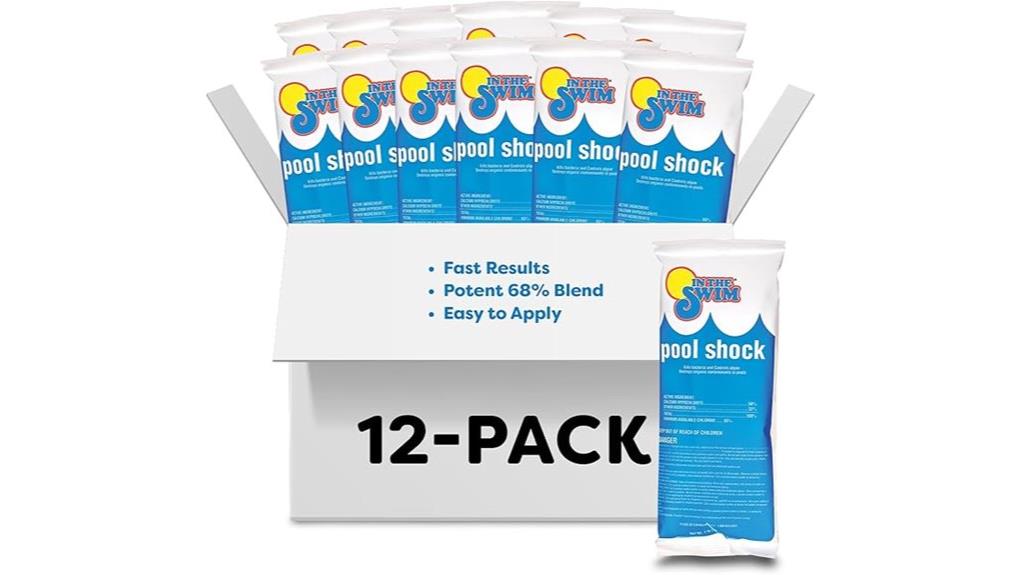
In The Swim 68% cal‑hypo is a fast, non‑stabilized granular shock that you’ll use to rapidly raise free chlorine for routine weekly shocks or as tests dictate; you’ll need to pre‑dissolve and dose carefully to get predictable pathogen log reductions and avoid local bleaching. It’s effective against algae and bacteria, but dust, fumes and undissolved granules can irritate and damage liners, so store and handle it safely. Continue for specifics on dosing, packing and tradeoffs.
Some Key Takeaways
- Fast‑acting 68% calcium hypochlorite delivers rapid free chlorine boost for routine weekly shock and quick microorganism control.
- Non‑stabilized granular formula requires pre‑dissolving and calibrated dosing for predictable, safe results.
- Typical weekly guideline: 1 lb per 10,000 gallons, adjusted upward for heavy contamination.
- Handle and store cautiously: dust/fumes irritate, granules bleach liners, keep dry and away from acids.
- Good value for small‑to‑mid pools in 12×1 lb kits; larger bags offer better per‑pound economics with higher storage risks.
What In The Swim 68% Cal‑Hypo Is and Who It’s Best For
Choose In The Swim 68% Cal‑Hypo when you need a high‑strength, fast‑acting granular sanitizer that delivers 65–68% available chlorine for routine pool and spa disinfection. You’ll get a non‑stabilized calcium hypochlorite formulation in granular form intended for above‑ and in‑ground pools, spas and hot tubs. You’ll use it to rapidly raise free chlorine and control bacteria, algae and other microorganisms while preserving water clarity. It’s best for pool owners who can manage safe handling, pre‑dissolving and calibrated dosing. Plan maintenance frequency around weekly shock or as testing indicates; monitor chlorine and adjust dosing to maintain target levels. Pool maintenance with calcium hypochlorite is crucial for ensuring that your water remains sanitized and free of contaminants. Regularly testing the water will help determine the right amount of calcium hypochlorite needed to keep your pool safe for swimmers. Additionally, understanding how to properly dissolve and distribute it can significantly enhance your pool care routine.
How Effective Is the 65–68% Calcium Hypochlorite for Routine Pool Shock?
Evaluating 65–68% calcium hypochlorite for routine shock shows it’s a highly effective, fast‑acting oxidizer that reliably raises free chlorine to shock levels and destroys bacteria, algae, and organic contaminants when dosed correctly. You’ll get an immediate oxidation boost and rapid sanitization thanks to the high available chlorine; this translates to shorter contact times and predictable log reductions of common pathogens. Monitor free chlorine and cyanuric acid (none present) to avoid overdosing. Use measured increments based on pool volume and contaminant load. The formulation’s potency makes it efficient for routine weekly shock cycles when you maintain correct testing and control.
Safe Usage and Compatibility: Dosing, Pre‑Dissolving, and Avoiding Liner Bleaching
When handling 65–68% calcium hypochlorite, you should follow strict dosing and pre‑dissolving procedures to protect pool surfaces and guarantee safe, predictable chlorination. Measure per volume: 1 lb per 10,000 gallons as a weekly shock guideline, adjust for contaminants. Always pre dissolve in a plastic bucket with cool water, stirring until fully dissolved; never add water to granules. Circulate while dosing to avoid high local concentrations. For liner safe application, avoid dumping undissolved crystals on vinyl; use dilution and slow introduction at deepest point. Store dry, cool, and separated from acids and organics to prevent hazards.
Real‑World Pros and Cons From Customers and Performance Notes
Although powerful and fast-acting, real-world users report mixed trade-offs you should weigh: most praise its rapid bacteria and algae control and high available chlorine (65–68%), but several note handling challenges—undissolved granules can bleach vinyl liners if not pre-dissolved, dust and fumes can irritate eyes and lungs, and the strong oxidizer requires strict storage away from acids and organics. You’ll find Customer testimonials highlighting quick clarity and reduced algae recurrence, yet Application mishaps appear repeatedly: improper dosing, direct granule contact, and inadequate dissolution. Treat reports as operational data; follow protocols, use PPE, and inspect after initial use to validate performance.
Value and Buying Guide: Pack Size, Price Points, and When to Choose This Shock
The customer reports on handling risks and performance help frame how you should assess value: pack size, price per pound, and use-case determine whether this 12 x 1 lb kit makes sense for your routine. You’ll evaluate unit economics: compare price per pound versus larger bulk options to confirm bulk savings justify storage and safety constraints. The 12-pack suits weekly maintenance on small to mid-size pools or as a backup for seasonal stocking, but it’s less efficient for large estates where 25–50 lb bags cut cost. Prioritize safe storage, pre-dissolving to protect liners, and regulatory disposal of residues.
Some Questions Answered
Is This Product Safe to Store With Other Pool Chemicals?
No — you shouldn’t store it mixed with other pool chemicals. You must practice proper segregation: keep calcium hypochlorite granules apart from acids, cyanurates, and combustible materials. You’ll need ventilation needs addressed: store in a cool, dry, well-ventilated area away from direct sunlight and moisture. Use original, tightly sealed containers, secondary containment, and clear labeling. Follow local regulations and manufacturer safety data sheet instructions to avoid hazardous reactions.
Can I Use Cal‑Hypo in a Saltwater Pool Generator?
Yes — you can use cal‑hypo with a salt system, but you’ve got to be cautious. Cal‑hypo raises free chlorine quickly and won’t harm the generator directly, yet elevated chlorine and chlorides can accelerate electrode corrosion over time. You should monitor salt levels, avoid adding granules near the cell, pre‑dissolve or dose away from the generator, and test regularly to maintain balanced chemistry and minimize long‑term wear on electrodes.
What Is the Shelf Life Unopened and After Opening?
Unopened, you can expect a storage duration of about 2–3 years if kept sealed, cool, dry, and away from moisture. After opening, you should use it within 6–12 months for reliable potency; tightly reseal and store in an airtight, moisture-proof container. Watch for degradation signs: clumping, strong chlorine odor changes, discolored granules, or reduced effervescence when dissolved. Dispose if you observe any of those signs.
Does It Affect Pool Plaster or Natural Stone Finishes?
Yes — if misused, it can damage plaster and natural stone. You’ll avoid surface etching by diluting or pre-dissolving granules and not dumping concentrated product onto finishes. High chlorine and prolonged contact can accelerate etching and cause grout discoloration, especially on porous stone or weakened grout. Test in a small area, follow recommended dosages, brush to disperse, and rinse any splash to minimize chemical attack and aesthetic damage.
Are Shipping or Hazmat Fees Applied at Checkout?
Yes — you’ll often see shipping fees and hazmat surcharges applied at checkout. Because calcium hypochlorite is regulated, carriers assess hazmat surcharges and handling fees; sellers may add shipping fees to cover packaging, insurance, and special labeling. You should review the seller’s shipping policy before purchase, expect higher costs for residential delivery, and contact customer service for exact line-item breakdowns to confirm total charges and any possible exemptions or promotions.