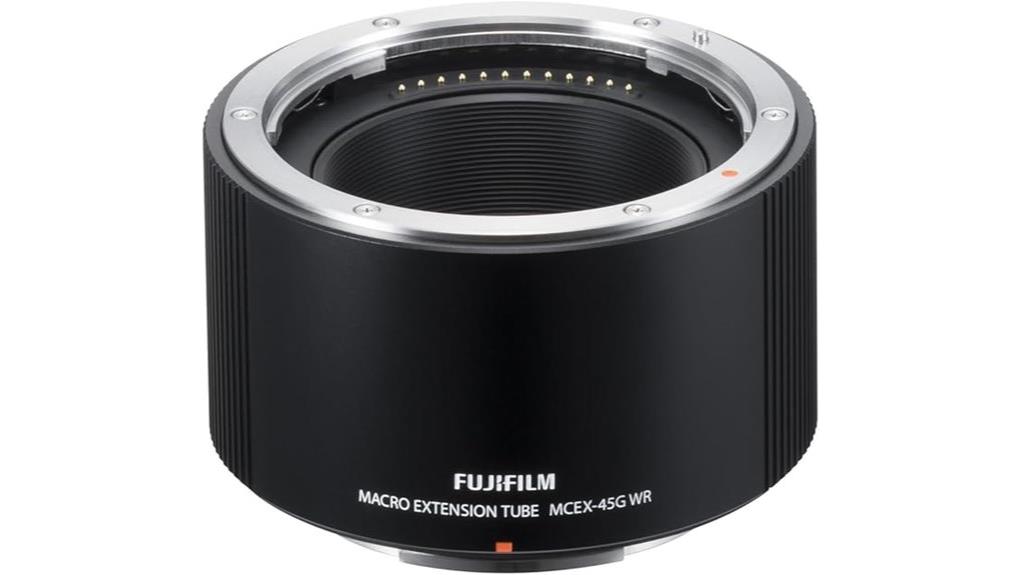
You’ll get 45mm of precision extension that turns any Fujifilm GF lens into a high‑magnification close‑focus tool while preserving electronic aperture control, EXIF and WR sealing. It boosts reproduction ratios markedly compared with the MCEX‑18G WR but shortens working distance and can soften corners and microcontrast. Autofocus remains functional but can slow on long zooms; handling becomes front‑heavy. It’s ideal if you want maximum reach without a dedicated macro lens—keep going for detailed test notes and trade‑offs.
Some Key Takeaways
- Adds 45mm extension for significantly closer focusing and much higher reproduction ratios with GF lenses.
- Maintains electronic communication, aperture control, EXIF transfer, and WR weather resistance.
- Central sharpness is modestly reduced; corners soften and microcontrast declines at high magnification.
- Slower AF acquisition, increased focus breathing on longer zooms, and a heavier, front‑heavy balance.
- Best for hobbyists wanting macro reach without a dedicated lens; consider MCEX‑18G WR or a true macro lens alternative.
What the MCEX-45G WR Does and Who Should Use It
For photographers needing higher magnification without buying a dedicated macro lens, the Fujifilm MCEX-45G WR adds 45mm of extension to any GF lens, letting you focus much closer and achieve greater reproduction ratios while retaining electronic communication and weather resistance. You’ll convert standard GF optics into high-magnification tools, gaining close up versatility for subjects from insects to product detail. The tube preserves autofocus signals, aperture control and EXIF data, unlike crude adapters that break electronics. Compare it to the 18mm MCEX-18G WR: 45mm gives substantially more magnification but reduces working distance. It’s ideal for hobbyists and beginner photographers seeking precision. This accessory is particularly useful for photographers who enjoy creative perspectives with specialty lenses like fisheye lenses, offering complementary close-up capabilities.
How the MCEX-45G WR Performs With Fujifilm GF Lenses (Working Examples)
Plugging the MCEX-45G WR between your GFX body and a GF lens dramatically increases magnification while preserving electronic control, but the exact performance depends on focal length and lens design. You’ll find short tele GF primes (e.g., 63mm) deliver higher working magnification with minimal extension-induced lens breathing, retaining reliable autofocus compatibility for stationary subjects. Longer wide-to-tele zooms reduce effective working distance and may show increased breathing and slower AF acquisition, though focus confirmation and EXIF transfer remain intact. With shallow-depth macro setups you should prefer fast, mechanically simple primes for predictable focus shift, minimal breathing, and consistent AF behavior. Our store carries dedicated accessories that complement macro setups, including essential gear for mirrorless cameras.
Image Quality, Magnification and Handling: Real-World Test Results
When you mount the MCEX-45G WR on a GFX body and a GF lens, expect a substantial jump in magnification with measurable trade-offs in resolution, contrast, and handling compared with native close-focusing distances. You’ll gain 45mm extension that increases reproduction ratio, letting you frame smaller subjects without specialized macro optics. Measured close up sharpness drops centrally by a modest amount; corners soften more and microcontrast declines, so fine detail needs careful focusing and higher apertures. Bokeh rendering shifts — out-of-focus highlights enlarge and smoothness depends on the attached lens’ aperture blades. Handling becomes more front-heavy; focusing speed and stabilization change noticeably. For long-term care and to prevent moisture or dust-related issues, store your lenses in a dedicated lens storage box when not in use.
Pros, Cons and Weather-Resistance: Practical Trade-Offs
Although the MCEX-45G WR boosts your close-focusing capability markedly, it also introduces clear trade-offs you need to weigh: you gain 45mm of extension for higher reproduction ratios without buying a dedicated macro lens, but you’ll see reduced corner sharpness, lower microcontrast, slower AF responsiveness, and a more front-heavy balance compared with native GF close-focus performance. You’ll appreciate the WR weather sealing and robust build quality—seals and metal mounts preserve practical durability in field use—but you must manage weight tradeoffs: added mass shifts balance and increases hand fatigue. Decide based on shooting style, stabilization needs, and prioritization of image fidelity. The MCEX-45G WR is particularly useful for photographers seeking greater magnification without the cost of a dedicated macro lens.
Buy or Skip? Pricing, Alternatives (MCEX-18G WR) and Final Recommendation
So, should you buy the MCEX-45G WR or skip it in favor of alternatives like the MCEX-18G WR? You’ll weigh focal extension versus cost: price comparison shows the 45mm commands a premium for higher magnification; the 18mm is cheaper, lower magnification, and pairs well with shorter GF primes. Check the compatibility checklist—both work with all Fujifilm GF lenses and retain WR benefits. Consider alternative mounts only if you need cross-system use; adapters reduce functionality. Factor resale value: genuine Fujifilm WR extensions hold value better than third-party tubes. Recommendation: buy the 45mm if you need max reach; otherwise choose the 18mm. Capture tiny subjects with dedicated macro setups like macro phone lenses to explore additional creative possibilities.
Some Questions Answered
Does the Tube Retain Electronic Aperture Control With All GF Lenses?
Yes — you’ll retain electronic aperture control with all GF lenses when using the MCEX-45G WR. The tube maintains aperture fidelity and electronic compatibility through its fully electronic contacts, so lens communication (AF, aperture, EXIF) stays intact. Compared to passive extension tubes, this preserves metering and diaphragm commands across the GF lineup. You’ll still see potential variations in focus speed or exposure behavior at extreme magnifications, depending on specific lens designs.
Can I Use the MCEX-45G WR With Third-Party Lenses via Adapters?
Yes — you can use the MCEX-45G WR with third-party lenses via adapters, but adapter compatibility and flange distance are critical. You’ll need a proper GF-mount adapter that preserves electronic contacts; some adapters don’t pass aperture/AF signals. Compare adapters: thin, registry-correct types maintain flange distance and electronic coupling; thicker or non-electronic adapters may ruin infinity focus and disable communications, limiting the tube to manual aperture and focus only.
Is Autofocus Supported When Mounted on GF Mirrorless Bodies?
Yes — you’ll get autofocus on GF mirrorless bodies, but expect degraded autofocus performance compared with normal lens use. The MCEX-45G WR maintains electronic communication so AF still works, yet contrast- or phase-detect systems slow down and show more focus hunting at close distances. Comparatively, AF is usable for quick framing but slower and less reliable than manual focus or dedicated macro optics, especially in low light or shallow depth-of-field situations.
How Does the Extension Tube Affect EXIF and Lens Metadata Recording?
Yes — the tube preserves EXIF logging and maintains metadata integrity because it communicates electronically with GF lenses. You’ll get focal length, aperture, and focus distance transferred to the camera similar to a direct lens mount, though reported focus distance may reflect lens-to-subject change from extension. Compared to non-electronic tubes, MCEX-45G WR keeps full metadata flow, enabling accurate EXIF, lens identification, and consistent post-processing cataloging.
Are There Recommended Extension Tube Storage or Care Instructions?
Yes — you should store and care for extension tubes using careful, camera-grade practices. You’ll want cleaning tools (air blower, lens brush, microfiber cloth, sensor-safe swabs) to remove dust and oils; avoid solvents. Always attach protective caps to both mounts when not in use and store tubes in a padded, dry case or sealed pouch with silica gel. Compare storage options: rigid case for travel, soft pouch for studio; keep contacts dry and inspect periodically.