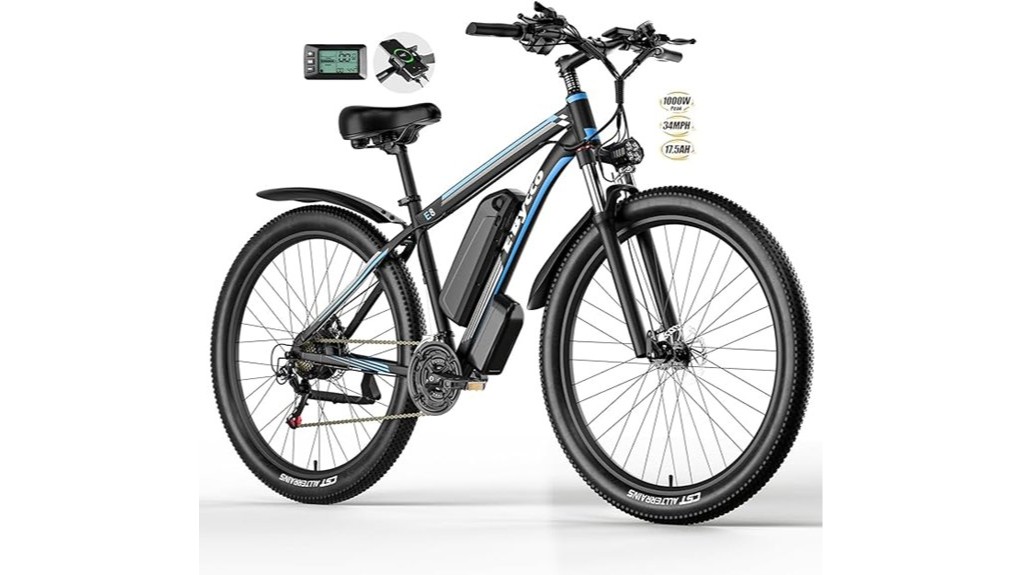
You’ll find the E·Bycco E8 (29”) is built for big riders and heavy loads, with a 1,000W peak motor, 34 mph top speed, and a 330‑lb payload that handles cargo or a passenger. The 48V/840Wh removable battery gives solid real‑world range, while 29″ wheels, a stiff aluminum frame, lockable fork, and 2.1″ tires deliver stable, efficient rolling. It’s heavy and bulky for tight storage, but performance compromises are clear—keep going to see detailed test numbers, limits, and setup tips.
Some Key Takeaways
- Powerful 1000W peak motor reaches a claimed 34 MPH with strong acceleration, though sustained high-speed runs can heat the motor.
- 48V 17.5Ah (840Wh) removable battery charges in ~7–8 hours and yields about 30–35 miles electric-only.
- Stiff aluminum frame, 29″ wheels, and lockable front suspension deliver stable, confident handling over rough urban terrain.
- 21-speed drivetrain, disc brakes, and IP67 waterproofing offer reliable performance, though heavy loads demand disciplined braking.
- 330 lb capacity suits heavy riders or cargo, but the heavy, bulky frame and short warranty complicate storage and ownership.
Quick Verdict: Who the E·Bycco E8 (29) Is Best For
If you ride big, carry heavy loads, or want a high‑speed commuter that can handle trails and beach paths, the E·Bycco E8 (29) fits those needs. You’ll appreciate its 330 lb capacity and 29″ wheel stability when hauling cargo or a passenger. For commuter comfort it delivers plush tires, front suspension, and an upright geometry that reduces fatigue on long urban runs. Be mindful: frame bulk and 48V removable battery complicate tight apartment storage and urban storage solutions. You’ll like the power and control, but factor in size for daily parking, lifts, and elevator fits. Consider pairing it with a heavy-duty ebike rack designed for high capacities and outdoor use.
Power, Speed, and Range Tested: Motor, Battery, and Real-World Numbers
Now that we’ve covered who the E·Bycco E8 (29) suits best, let’s look at what that extra size and power actually deliver on the road. You’ll feel the 1000W peak brushless motor push hard, reaching the claimed 34 MPH on flat ground with minimal lag. Throttle responsiveness is crisp, though sustained high-speed runs heat the motor and cut peak output. The 48V, 17.5Ah (840Wh) pack charges in ~7–8 hours; real-world electric-only range averaged ~30–35 miles under mixed terrain, extending to ~65 miles with conservative pedaling. Battery longevity looks reasonable if you avoid frequent deep discharges. For riders who want better performance, upgrading to smarter ebike motor controllers can improve throttle response and thermal management.
Ride Feel and Components: Frame, Suspension, Drivetrain, Brakes, and Tires
You’ll notice the E·Bycco E8’s aluminum frame feels stiff and confidence‑inspiring: its larger 29” wheels roll over roots and cracks with less chatter, while the lockable front fork soaks up bigger hits without wallowing. You’ll feel precise tracking from deliberate frame stiffness, which aids climbing and high‑speed stability but transmits more trail feedback to your hands. Suspension tuning favors firm support over plush compliance—good for efficiency, less forgiving on repeated chatter. The 21‑speed drivetrain shifts reliably under motor load, disc brakes bite predictably, and upgraded 2.1″ tires balance rolling efficiency with puncture resistance for varied terrain. Riders who spend long days outdoors should consider saddle comfort and ergonomic options like comfort saddles to reduce fatigue and improve ride enjoyment.
Everyday Usability: Controls, Display, Cargo Capacity, and Assembly
Moving from how the frame and suspension handle real‑world bumps, the bike’s cockpit determines how comfortably you actually ride day to day. You’ll notice handle ergonomics prioritize reach and grip for larger riders; controls are logically placed but feel stiff until broken in. The intelligent waterproof LCD gives useful data, and display readability is strong in daylight though menu navigation could be faster. Cargo versatility is decent: rack and fender mounts suit commuting and light hauling within the 330 lb limit, but heavy loads affect handling. Assembly is mostly straightforward; assembly clarity in the manual is adequate, supplemented well by the online video. The bike pairs well with popular ebike display screens designed for outdoor riders, improving on-ride information and durability.
Value Check: Warranty, Safety Features, Pros/Cons, and Final Buying Recommendation
Because warranty and safety details can make or break long-term ownership, you should weigh them heavily when judging the E·Bycco E8’s value. The one-year limited warranty covers defects but has clear warranty limitations on wear items and misuse—expect to pay for certain repairs. Safety certifications are solid: UL-listed battery and IP67 waterproofing reduce electrical and water-failure risks. Practically, powerful 1000W motor and 34 MPH top speed demand disciplined use and quality braking. Pros: robust power, removable 840Wh battery, adaptable display. Cons: short warranty, heavy frame, throttle legality concerns. Buy if you prioritize performance and accept added maintenance risk. This site focuses on keeping your ebike battery healthy for outdoor adventures.
Some Questions Answered
Does the Battery Ship Charged or Partially Charged?
You’ll usually receive the battery partially charged (around 30–60%) to comply with transport regulations and safe battery storage. You should top it up before first use to optimize charge lifespan, but don’t fully charge for long-term storage. This practice preserves battery health and avoids voiding warranty implications tied to misuse. When unpacking, inspect for damage, follow the manual’s storage guidance, and keep shipment records if you need to claim warranty.
Can I Add a Rear Rack or Child Seat?
Yes — you can add a rear rack and mount a child seat, but you’ll need to verify fit and load limits. The aluminum frame and 330 lb max capacity handle extra cargo, yet the 29” wheel clearance, rear mounting points, and brake/derailleur layout may restrict some racks. Pick a rack rated for e-bike use and a child seat compatible with frame/fender geometry. Test stability and torque impact on the motor.
Are Replacement Batteries Available From the Manufacturer?
Yes — you can get replacement batteries, but availability is limited through the manufacturer; you’ll often rely on third party suppliers for faster service and alternatives. Inspect connector compatibility and UL listings, and expect to pay premium for OEM packs. When swapping, follow safe handling and disposal: use authorized battery recycling channels to avoid hazards. You’ll want to verify warranty implications and serial-match capacity and BMS specs before purchase.
What Tools Are Needed for the Final Assembly Steps?
You’ll need basic hand tools plus a torque wrench and cable cutters for final assembly. Expect Allen keys, adjustable wrench, Phillips screwdriver, pedal wrench, and pliers for cable routing. Use the torque wrench to tighten stem, handlebar, and crank bolts to spec; don’t overtighten. Trim and seal brake/shift housing neatly with cable cutters, then adjust derailleurs and brakes. Test ride and re-torque after the first 20–30 miles.
Is There a Smartphone App or Bluetooth Connectivity?
Yes — you can use Bluetooth pairing with a mobile app to access the bike’s display functions. You’ll connect the bike via Bluetooth pairing, then open the vendor mobile app to view speed, battery status, and adjust pedal-assist levels. Expect basic telemetry and configuration rather than full-featured ride analytics; the app’s UI can feel sparse and occasionally laggy. You’ll need to update firmware through the app when prompted.