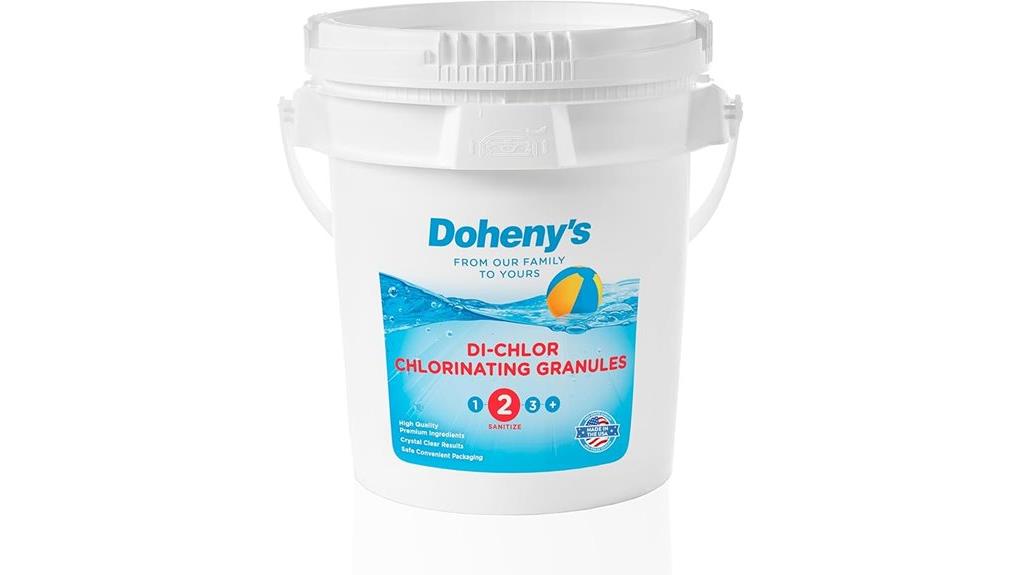
You’ll find Doheny’s Di‑Chlor is a fast‑dissolving, calcium‑free sodium dichloro granular chlorine that’s meant for routine sanitizing, weekly shocks, and modest algae control in vinyl, concrete, and fiberglass pools. It provides 56% available chlorine with cyanuric acid for UV protection, dissolves quickly to avoid scale, and raises free chlorine predictably for breakpoint chlorination. Use with filtration running, wear PPE, and avoid mixing chemicals; keep storage dry and ventilated for best stability. More specifics follow.
Some Key Takeaways
- Doheny’s Di‑Chlor is a fast‑dissolving, calcium‑free sodium dichloro granular chlorine (56% available chlorine) suited for pool sanitizing and shocking.
- Works as a 3‑in‑1 sanitizer, shock, and algaecide with added cyanuric acid to reduce UV degradation.
- Recommended routine dose is 1 lb per 10,000 gallons; broadcast with filtration running and avoid adding dry to shallow water.
- Best for regular maintenance and modest algae control; heavy blooms or poor filtration may need supplemental treatments.
- Store cool and dry, use PPE when handling, and compare package sizes (10/25/50 lb) for per‑pound cost efficiency.
What Doheny’s Di‑Chlor Is and Who It’s For
Although it’s a granular stabilized chlorine, Doheny’s Di‑Chlor is fundamentally a fast‑dissolving, calcium‑free sodium dichloro product (99.5% active; 56% available chlorine) designed to sanitize, shock, and help control algae in pools. You’ll find it suited to multiple pool types—vinyl, concrete, fiberglass—and commercial or residential systems needing quick chlorine elevation without calcium buildup. You’ll use measured doses for routine sanitization; maintenance users typically dose 1 lb per 10,000 gallons to sustain free chlorine. Packaging options (10, 25, 50 lb buckets) support single‑site stocking or bulk procurement. It’s technical, stable, and minimizes residue and clouding.
How the 3‑in‑1 Formula (Sanitizer, Shock, Algaecide) Actually Performs
Having established what Di‑Chlor is and where it’s used, let’s examine how its 3‑in‑1 claims perform in practice. You’ll see rapid oxidation of organic load—sodium dichlor releases available chlorine quickly while stabilizer (cyanuric acid) moderates UV loss. As a shock, it raises free chlorine predictably without adding calcium, so you can restore breakpoint levels efficiently. For algae suppression, the formulation disrupts cell membranes and limits regrowth when residual free chlorine is maintained. Performance depends on correct dosing and circulation; results are reliable for routine maintenance but may require supplemental treatment in heavy blooms or poor filtration.
Safe Dosing, Application Tips, and Troubleshooting for Pools
When you dose Doheny’s Di‑Chlor, measure by pool volume and add granules to the skimmer, feeder, or dissolver—never toss dry into shallow water—to achieve precise, even distribution. For routine maintenance, add 1 lb per 10,000 gallons to raise free chlorine predictably; adjust for temperature, bather load, and sunlight. Broadcast only after filtration runs to circulate. Wear PPE; avoid mixing with acids or cyanuric sources. For pool troubleshooting, test pH, TA, and cyanuric acid before increasing chlorine; high CYA or low pH impairs efficacy. If combined chlorine persists, perform breakpoint chlorination per calculated dose and retest.
Pros, Cons, and Real‑World Issues (Residue, Stability, Packaging)
Because Doheny’s Di‑Chlor is calcium‑free and fast‑dissolving, you’ll typically avoid visible scale or clouding that some trichlor products cause. You get effective sanitation with minimal solid residue; occasional fine particulates can settle if overdosed or dissolved poorly. Stability is good when stored cool and dry—avoid humidity and sunlight to preserve available chlorine. Packaging durability is acceptable for normal handling, though drop impacts can deform plastic buckets; reseal lids promptly. Expect a mild chlorine odor when handling or dosing; ventilate storage and use gloves and goggles. Monitor free chlorine and cyanuric levels to control long‑term effects.
Should You Buy It? Price, Alternatives, and Best Use Cases
If you want a fast‑dissolving, calcium‑free pooled chlorine that doubles as shock and algaecide, Doheny’s Di‑Chlor is a cost‑effective choice for regular maintenance and occasional shock treatments. You’ll pay per 10 lb unit; perform a budget comparison against 25–50 lb options and unstabilized shock. Its 56% available chlorine and 99.5% sodium dichlor active suit routine dosing (1 lb/10,000 gallons) and targeted shocks without calcium scaling. Choose it for weekly dosing, seasonal buying at start/close, or treating modest algae blooms. Skip it if you need unstabilized, high‑strength non‑staining shock for heavy remediation.
Some Questions Answered
Is This Product Safe for Use With Vinyl Pool Liners?
Yes — you can use this product with vinyl pool liners when you follow directions and control dosage. Its calcium-free, fast-dissolving sodium dichlor is generally vinyl compatible and won’t leave scale that causes liner discoloration. You’ll want to dissolve properly, maintain recommended 1 lb per 10,000 gallons maintenance dosing, monitor chlorine and pH, and avoid high concentrations or undissolved granules contacting the liner to prevent local bleaching or damage.
Can Doheny’s Di‑Chlor Be Mixed With Other Pool Chemicals?
No — you shouldn’t mix Doheny’s Di‑Chlor directly with other pool chemicals. You’ll avoid hazardous reactions by adding chemicals separately, allowing full dissolution and thorough circulation between additions. Perform compatibility testing on small quantities when unsure, and follow storage precautions: keep dichlor dry, sealed, away from acids, metals, and organics, stored cool and ventilated. Always consult product labels and use proper PPE during handling.
What Is the Shelf Life Once the Bucket Is Opened?
Once opened, you should expect opened stability of about 6–12 months if stored correctly. Keep the bucket tightly sealed, dry, and away from moisture or organic material; maintain a cool, stable storage temperature between 50–77°F (10–25°C). Avoid heat, sunlight, and temperature swings that degrade active sodium dichlor. Label the open date and inspect for caking or odor; discard if degraded or contaminated to guarantee safe, effective dosing.
Is This Chlorine Safe to Handle Without Gloves?
No — you shouldn’t handle it without gloves. Sodium dichloro is a concentrated oxidizer that can cause skin irritation and burns on prolonged contact. Use appropriate protective equipment: chemical-resistant gloves, eye protection, and a dust mask if dusty. Avoid inhalation and wash skin immediately if contact occurs. Store sealed, dry, and away from incompatible materials. Follow label and MSDS instructions for safe handling and emergency measures.
Does It Alter Pool Water pH Significantly?
Yes — it can lower pH modestly on application because sodium dichlor is slightly acidic, but you won’t see massive swings if dosed per instructions. You should monitor for pH drift after treatment; repeated dichlor use can lead to alkaline rebound as total alkalinity and cyanuric interactions shift equilibrium. You’ll prevent issues by testing pH/TA after dosing and adjusting with alkali or acid as needed to maintain target levels.