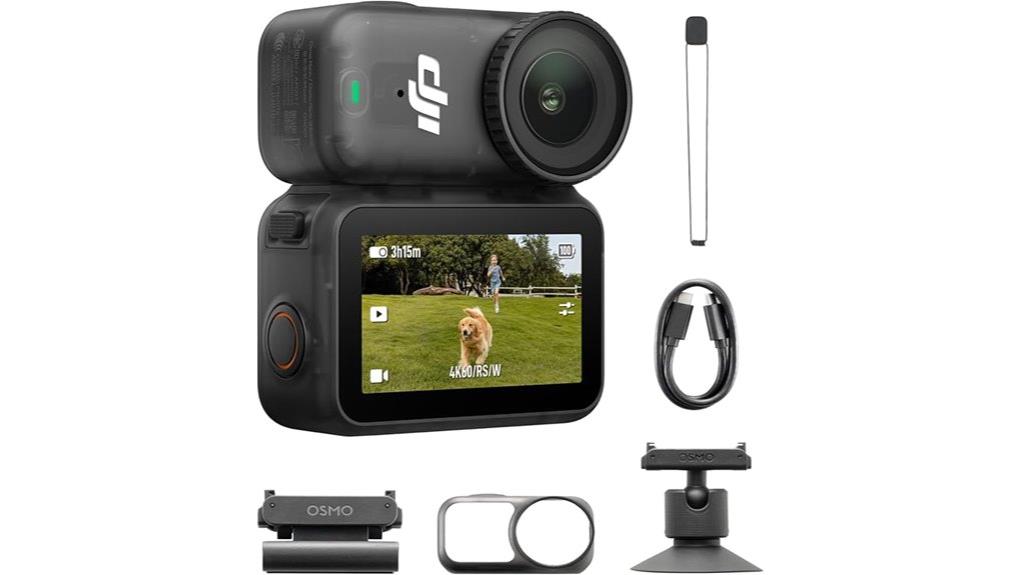
You’ll get a pocketable action cam with a 1/1.3" sensor that captures clean 4K/60 video and 35MP stills, plus 10‑bit D‑Log M for better grading and reduced banding. It’s built for fast deployment with magnetic mounts, USB‑C transfers, and waterproofing to 10 m. Stabilization is solid for handheld and POV but not a gimbal substitute; battery life and thermal limits matter for long 4K/60 runs. Keep reading to see detailed use cases and tradeoffs.
Some Key Takeaways
- Lightweight 124 g pocket vlogging camera with 1/1.3" sensor delivers 35MP stills and clean 4K/60 footage.
- 10-bit D‑Log M and f/2.8 aperture provide strong dynamic range and improved low-light performance.
- Digital stabilization handles handheld and moderate action but lags behind gimbals for aggressive motion.
- 64GB internal storage plus microSD (UHS‑I V60) support, USB‑C PD and fast wireless transfers streamline workflow.
- Waterproof to 10 m, magnetic mounts and accessories make it ideal for POV, travel, and quick-deploy shooting.
What the DJI Osmo Nano (64GB) Actually Is and Who It’s For
What is the DJI Osmo Nano (64GB) in practice? You get a pocket vlogging and action POV device: a 124 g, 1/1.3" CMOS camera with 4K/60 capture and 143° ultra-wide optics. You’ll appreciate 64 GB built-in storage, microSD expansion, USB-C PD, and dual-mic inputs for versatile audio. Compared to larger rigs, it trades advanced stabilization and lens interchangeability for compactness, magnetic mounts, and waterproofing to 10 m—ideal for hands-free sports, pet POV, and travel creators. You’ll choose it if you prioritize portability, quick deployment, and solid tech specs over pro cinema controls. It also pairs well with GoPro mounts for users who want flexible mounting options in photography and action scenarios.
Real-World Image, Video, and Low-Light Performance (4K/60, 35MP, 10-Bit D‑Log)
Having established who the Osmo Nano suits, let’s look at how its imaging hardware performs in real use. You’ll get sharp 35MP stills and clean 4K/60 footage from the 1/1.3″ sensor; fine detail holds up against similar compact action cams. The 10‑bit D‑Log M enables wider dynamic color grading latitude, pushing highlights and midtones without banding. In low light the larger sensor and f/2.8 aperture deliver less noise but watch exposure limits. Monitor sensor thermal behavior during prolonged 4K/60 recording—heat can introduce noise and throttling, narrowing usable continuous-record windows compared with larger, actively cooled models. For best results when shooting portraits or product work, pair the Osmo Nano with LED light panels to ensure consistent, controllable illumination.
Stabilization, Shooting Modes, Battery Life, and Handling in Use
Although it lacks a physical gimbal, the Osmo Nano's digital stabilization performs reliably for most handheld, POV, and action shots, smoothing out walk-and-talk vlogs and moderate bike or ski runs while you keep motion within its correction envelope. You’ll compare stabilization to gimbal rigs: it’s less authoritative on aggressive pans but superior to basic electronic-only solutions. Sport mode raises responsiveness, trading some stabilization for quicker framing and less rolling shutter. Expect battery longevity up to 200 minutes under mixed use; fast charging shortens downtime. Magnetic handling and lightweight ergonomics make shifts and mounts fast, improving real-world usability for active creators. Perfect for photographers who need versatile mounting options on the go, it pairs well with action camera mounts designed for fast transitions and secure shooting.
Connectivity, Storage, Accessories, and Waterproofing That Matter Day-to-Day
Plug the Osmo Nano into your workflow and you'll notice the connectivity and storage choices are built for speed and flexibility. You get USB‑C PD (USB 3.1), Bluetooth and Wi‑Fi for rapid wireless transfer across multi device setups—phone, tablet, PC—so syncing clips is efficient. Built‑in 64GB plus microSD (UHS‑I V60 support) lets you balance onboard recording and extended capacity. The magnetic mounting and rich accessory ecosystem—Vision Dock, hat clip, lanyard, ball‑joint adapter—streamline hands‑free shots. Waterproof durability to 10 m and IPX4 for the dock mean rugged daily carry without sacrificing compactness. Consider pairing it with a durable drone carrying case to protect your kit while on the move.
Final Verdict: Strengths, Weaknesses, and Who Should Buy the Osmo Nano
The Osmo Nano’s connectivity, storage options, and rugged accessories set the stage for a practical final assessment: you get a compact 4K/60 action cam that balances image quality, portability, and workflow speed. Strengths: larger 1/1.3″ sensor, 10-bit D-Log M, 4K/60, fast transfers via USB-C, robust accessory compatibility and waterproofing to 10 m. Weaknesses: digital stabilization limits extreme sports use, app distribution issues, and reliance on replaceable C batteries—plan battery recycling and spares. Who should buy: vloggers, POV shooters, and compact-travel creators who prioritize image quality and modular mounts over pro gimbal stabilization. The product fits well within a lineup aimed at drone-camera enthusiasts who value compact, modular gear for aerial and action shooting, especially when paired with lightweight drone mounts.
Some Questions Answered
Does the Osmo Nano Support RAW Stills or Log RAW Video Recording?
No — you won’t get RAW photos or Log video files from this camera. It captures high-quality JPEG stills (up to 35 MP) and 10-bit D-Log M color for extended dynamic range in MP4 output, but not sensor-original RAW stills or Log raw video containers. Compared to cameras that record RAW/Log raw, you’re limited to compressed 10-bit footage and JPEGs, though color grading flexibility is better than standard profiles.
Can I Livestream Directly From the Camera to Platforms Like Youtube?
Yes — you can live stream directly, but Platform compatibility varies. You’ll use the DJI app and Wi‑Fi/USB‑C connection to stream to services like YouTube; supported protocols depend on firmware and app versions. Compared to action cams with built‑in RTMP presets, the Osmo Nano relies on DJI’s streaming bridge, so latency, resolution and bitrate control are more limited. Check DJI’s site for current RTMP endpoints and app updates before broadcasting.
Are Replacement Batteries and Vision Dock Sold Separately?
Yes — replacement batteries and the Vision Dock are sold separately beyond what's bundled. You’ll get two C batteries and a Vision Dock in the Standard Combo, but additional replacement batteries must be purchased independently if you want spares. Compare official DJI replacements versus third‑party cells for capacity and fast‑charge compatibility. For extra Vision Dock units, buy OEM to guarantee IPX4 behavior and magnetic alignment; third‑party docks may compromise fit or charging.
Is There a Warranty Extension or International Support Available?
Yes — you can extend Warranty options and access International support. You’ll get the standard manufacturer warranty; optional extended plans are offered through DJI or authorized retailers for longer coverage and accidental-damage add-ons. International support’s available in many regions via DJI service centers and online support, but coverage and service terms vary by country. Compare local dealer extensions and DJI global service policies before purchase to guarantee desired protection and cross-border repairs.
Can I Use Third-Party Gimbals or Mounts With Its Magnetic Design?
Yes — you can use many third-party gimbals and mounts due to magnetic compatibility, but you’ll need proper mount adapters for secure attachment. You’ll get reliable quick swaps with magnetic accessories, yet some gimbals lacking magnetic plates or specific balance points may need custom adapters or counterweights. Compare adapter materials, magnetic strength, and mounting geometry to guarantee stability, reduce rolling, and maintain autofocus and image-stabilization performance.