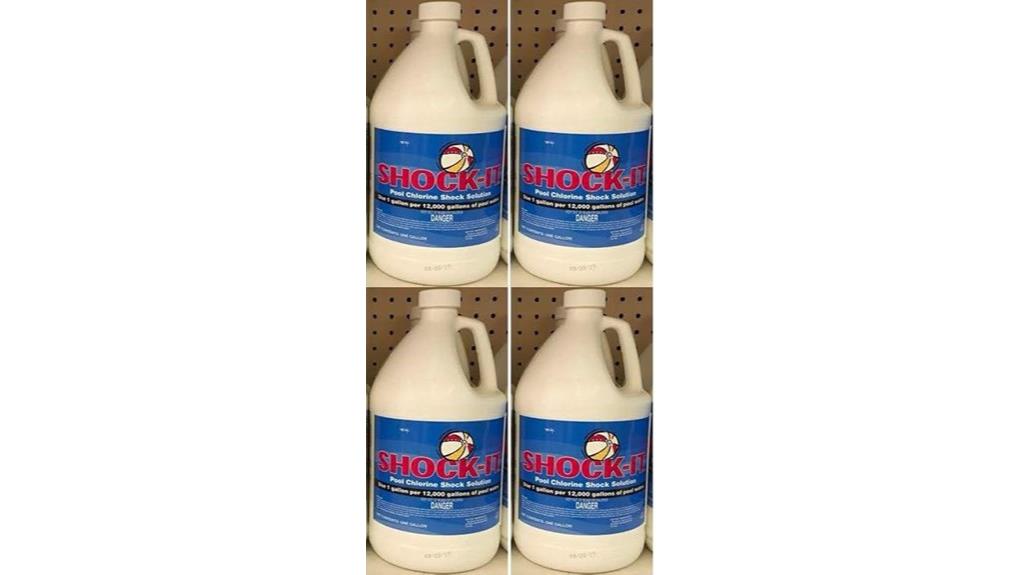
You’ll get ready-to-use 12.5% liquid chlorine in four-gallon containers that simplify dosing and eliminate on-site mixing. You’ll dose to breakpoint chlorination for fast organic oxidation and algae control while avoiding cyanuric-acid interactions. Inspect NSF/ANSI 60 and EPA 42177-82 labeling, check lot markings and SDS, and store upright in cool, ventilated areas away from acids. Use gloves, goggles, and spill kits; secure transport. Keep reading for detailed handling, dosing, and value guidance.
Some Key Takeaways
- One case contains 4-gallon containers of 12.5% sodium hypochlorite, providing ready-to-use liquid shock without on-site dilution.
- NSF/ANSI 60 indication and EPA registration 42177-82 support its suitability and labeled hazard communication for pool water treatment.
- Predictable dosing reduces handling steps, speeds treatment, and minimizes free-chlorine overdosing compared with variable-strength products.
- Best value for commercial or high-usage buyers; weigh shelf life, storage capacity, and transport restrictions before purchasing.
- Treat as a concentrated oxidizer: store cool and upright, keep away from acids, use PPE, and inspect containers for leaks.
Quick Verdict and Who Should Buy This 1-Case Pack
Cut through the noise: this 1-case pack of commercial-grade liquid chlorine delivers 12.5% concentrated, ready-to-use shock in four gallons, so you don’t have to mix or dilute on-site. You’ll appreciate the predictable dosing and reduced handling steps; quick setup minimizes exposure incidents and speeds treatment. It’s aimed at budget buyers who need reliable performance without bulk complexity. You’ll follow label storage and PPE guidance, maintain ventilation, and avoid incompatible chemicals. Use it for routine shock, pool closings, and compatible sanitation tasks. Inspect containers before use and dispose per local regulations to reduce risk. Poolife rapid shock benefits for pool maintenance are significant, as they provide a fast and effective solution for keeping water clean and clear. Many pool owners find that using rapid shock simplifies their maintenance routine and saves time. By incorporating this product into your regimen, you can ensure that your pool remains inviting and ready for use at all times.
Key Specs and Certifications That Matter (12.5% Strength, NSF/ANSI 60, EPA Reg.)
Because you need predictable disinfection and regulatory compliance, the product’s 12.5% sodium hypochlorite strength, NSF/ANSI 60 certification, and EPA registration (No. 42177-82) are the specs to verify before purchase and use. You’ll rely on concentration consistency to dose accurately; a verified 12.5% solution reduces drift in free chlorine targets and minimizes shock overdosing. NSF/ANSI 60 confirms suitability for water-treatment use, while the EPA reg. number documents approved labeling and hazard communication. Check lot markings and SDS for stability, storage limits, and handling precautions. Prioritize suppliers who maintain traceability to guarantee ongoing regulatory compliance and safe operations.
Real-World Performance: Pool Shocking, Clarity, and Pool-Closing Use
When you shock the pool with this 12.5% liquid chlorine, you’ll get rapid oxidation of organic load with minimal short-term turbidity, letting filters clear the water without prolonged cloudiness. You’ll dose to breakpoint chlorination based on measured combined chlorine; the 12.5% strength reaches target residuals quickly. Monitor free chlorine and pH; stabilizer interaction is minimal because this product is unstabilized, so cyanuric acid management remains critical for outdoor pools. For algae prevention and pool-closing use, apply higher initial doses, run filtration continuously, and retest before winterizing. Follow label directions and certified dosing guidance for consistent results. Champion pool shock liquid review has highlighted its effectiveness in maintaining water clarity and sanitation. Many users report improved water quality with fewer treatments required over time. Its ability to quickly eliminate contaminants makes it a popular choice among pool owners.
Handling, Storage, and Safety Tips for a 4-Gallon Liquid Chlorine Case
If you store or handle a 4‑gallon case of 12.5% liquid chlorine, treat it as a concentrated oxidizer and follow label precautions: keep containers upright in a cool, well‑ventilated area away from heat, direct sunlight, acids, and organic materials; use corrosion‑resistant shelving and secondary containment; wear chemical‑resistant gloves, splash goggles, and an NIOSH‑approved respirator if ventilation is inadequate; and make certain eyewash and spill kits are accessible. For safe transport, secure the case upright, limit vehicle cabin exposure, and separate from incompatible cargo. Maintain inventory control, inspect containers for leaks, and follow a documented spill response plan with neutralizer, PPE, and emergency contacts.
Price, Alternatives, and When This Case Is the Best Value
While comparing costs and use-cases, note that a 4‑gallon case of 12.5% liquid chlorine usually offers lower per‑gallon and per‑pound-of‑available-chlorine pricing than smaller retail bottles, making it cost‑effective for commercial pools, service companies, or extensive seasonal treatments. You’ll realize bulk savings when demand is predictable: frequent shocks, large-volume turnovers, or winterizing tasks. Alternatives include granular cal hypo or stabilized dichlor, which suit smaller pools or spot treatments. Consider resale options for unused sealed cases, and check regional availability and transport restrictions. Always weigh purchase quantity against shelf life, storage capacity, and site safety protocols before buying.
Some Questions Answered
Does This Product Require Dilution Before Use in Pools?
No, you don’t dilute this product before use in pools; it’s ready-to-use. For pre dilution safety, follow label storage and handling instructions, wear appropriate PPE, and avoid mixing with other chemicals. For application techniques, pour evenly around the deep end with pump circulation running, or apply via automatic feed per manufacturer guidance. Monitor chlorine levels and pH after treatment, and allow proper circulation time before re-entry to guarantee safe sanitizer distribution.
Can It Be Used in Saltwater or Mineral Pools?
Yes — you can use it in saltwater and mineral pools; it’s saltwater compatibility and mineral compatibility are suitable. You’ll add ready-to-use liquid chlorine to maintain free chlorine levels, following label dosing. Don’t mix with other chemicals, avoid over-chlorination, and make certain proper circulation. Wear PPE, handle per storage instructions, and monitor cyanuric acid and salinity because high levels can reduce effectiveness and require adjusted dosing.
What Is the Shelf Life Once the Case Is Opened?
Once opened, you should use the liquid chlorine within about 3–6 months if you maintain proper storage temp and container integrity. Store between 50–80°F, upright, sealed, away from heat and sunlight; don’t expose to freezing or high heat. Inspect caps and drums for leaks; replace compromised containers. Keep ventilation, follow label instructions and NSF/ANSI 60 guidance. If odor, cloudiness, or color change appears, dispose per local regulations.
Are There Environmental Disposal Restrictions for Leftover Liquid?
Yes — you must treat leftover liquid as hazardous waste if concentrations or quantities exceed thresholds; check local regulations for specifics. You’ll follow label instructions, neutralize per guidance, and never pour high-strength chlorine into storm drains or natural waters. Store leftovers securely, use a licensed hazardous waste hauler for disposal when required, and document disposal actions. Consult your municipal hazardous waste program to verify compliance with local regulations and EPA guidance.
Does This Product Void Any Pool Equipment Warranties?
You shouldn’t assume warranty coverage will remain intact; check your equipment manual and manufacturer’s terms. Using this commercial 12.5% liquid chlorine can trigger manufacturer exclusions if concentrations, application methods, or NSF/ANSI 60 claims aren’t referenced. You should follow label directions, store and handle per instructions, and document use. If in doubt, contact your equipment maker to confirm compatibility and obtain written guidance to avoid voiding warranties.