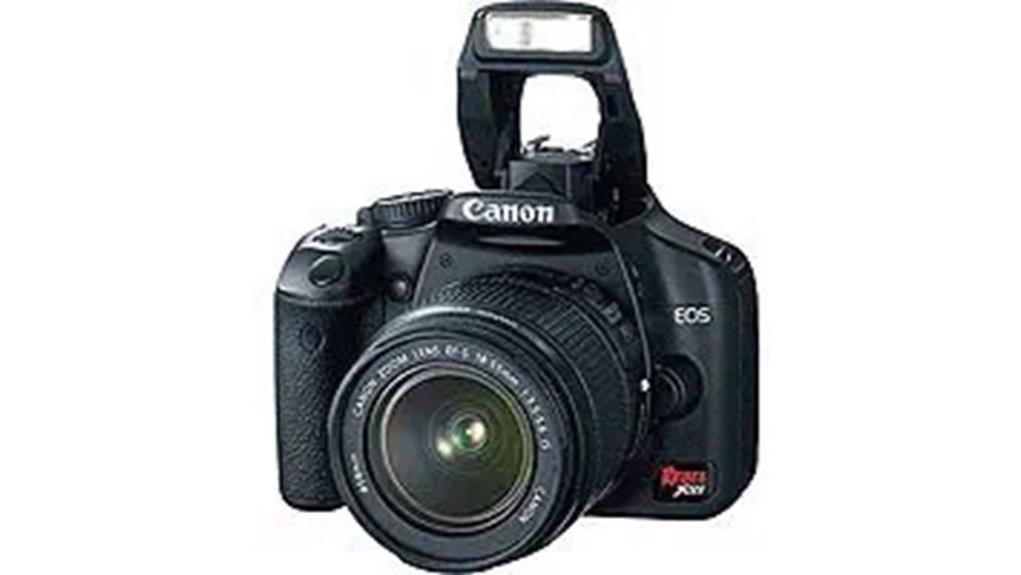
You’ll find the Canon EOS 450D (Rebel XSi) a straightforward, budget DSLR that gives 12.2MP RAW output, DIGIC III processing, and reliable phase‑detect AF with 45 points. The bundled EF‑S 18–55mm IS is versatile for general use, with decent center sharpness, modest corner falloff, and 2–3 stops of lens IS. Shooting is limited to ~3.5 fps with slower Live View AF, and connectivity is USB 2.0; keep a spare battery and fast SD. Continue for a full breakdown of strengths, weaknesses, and practical tips.
Some Key Takeaways
- Solid 12.2 MP sensor with 12‑bit RAW and DIGIC III delivers good color and mid‑ISO performance for moderate prints and editing.
- Bundled EF‑S 18–55mm IS lens provides useful focal range and ~2–3 stops optical stabilization, but corners soften at long end.
- 45-point phase-detect AF and 3.5 fps continuous shooting suit static subjects and short bursts, while Live View AF is slower.
- Ergonomic, compact DSLR body with metal mount, textured grip, and manual controls ideal for beginners and hobbyists learning exposure.
- Limited connectivity (USB 2.0), modest battery life, and SD/SDHC storage mean spares and faster cards recommended for extended use.
Who Should Consider the Canon EOS 450D (Rebel XSi) Today?
If you’re buying a DSLR on a tight budget or want a simple, proven camera to learn basic exposure and composition, the Canon EOS 450D (Rebel XSi) is worth considering; its 12.2 MP CMOS sensor, DIGIC III processor, and full manual controls give you a solid platform for still photography, especially with the included EF‑S 18–55mm IS kit lens for general-purpose shooting. You’ll benefit if you’re budget beginners seeking reliable metering, interchangeable-lens flexibility, and manual exposure learning. It suits hobbyists attracted to a vintage aesthetic who prioritize ergonomics, optical IS, and RAW capture over high-speed video or modern connectivity. For mirrorless camera enthusiasts exploring accessories and support gear, consider essential items like extra batteries, memory cards, and protective cases to complement your setup, especially when transitioning from DSLRs to mirrorless systems.
12MP DIGIC III Image Quality and Sensor Details
Having covered who might choose the 450D, let’s look at what its 12.2‑megapixel CMOS sensor and DIGIC III processor deliver in practice. You get 12 bit processing into RAW workflow files, preserving color depth for moderate prints and editing. DIGIC III handles conversion and noise reduction, yielding competent noise performance up to mid ISOs; low light capabilities are limited compared with modern sensors but remain usable with careful exposure. The EOS integrated cleaning system and Dust Delete Data (dust mapping) reduce sensor contamination. Note that image stabilization is provided by lenses, so IS limitations depend on the attached optical stabilizer. Use of color checker cards can help ensure accurate color reproduction during capture and post-processing.
How the Bundled EF‑S 18–55mm IS Lens Performs in Real Use
Usually dependable for everyday shooting, the bundled Canon EF‑S 18–55mm f/3.5‑5.6 IS delivers a practical balance of focal range and image stabilization for general-purpose work. You’ll find center resolution good at lower ISOs; corner‑to‑corner sharpness falls off toward the long end and wide open. Vibrance and contrast are neutral; peripheral illumination correction in-camera helps vignetting. The focus‑ring feel is plasticky and short‑throw, adequate for casual manual adjustments but not precise manual focus work. IS provides 2–3 stops of stabilization for handholding. Chromatic aberration appears under high-contrast edges and softens microdetail at maximum aperture. Essential lens gear can help enthusiasts get more from this kit lens by complementing its strengths with supporting accessories.
Autofocus, Shooting Speed, and Handling for Everyday Photography
The 450D’s autofocus system and shooting speed are designed for straightforward everyday use: you get 45 AF points with AF‑S and AF‑C modes, basic contrast‑detection help in Live View, and a continuous rate of about 3.5 fps for short bursts. You’ll find phase‑detect AF reliable for static subjects, with AF‑C offering basic focus tracking for moving targets but limited compared with modern systems. Live View relies on slower contrast detection. Buffer and write speeds constrain long sequences. Handling is ergonomic; grip comfort and control layout let you operate quickly with one hand. Manual focus and AF overrides remain precise. The site also offers specialized light meters and guides to help photographers improve exposure accuracy with light meters.
Exposure, Metering, Flash, and Creative Shooting Modes Explained
Dial in exposure and you’ll get predictable results from the 450D: its evaluative metering, center‑weighted, and spot options let you choose how the camera reads a scene, while Program, Shutter‑priority, Aperture‑priority, Manual, and Depth‑of‑field AE modes give you direct control over how shutter, aperture, and ISO interact. You’ll use ambient metering for balanced scenes, switch to spot for critical highlights, and apply exposure lock to hold readings while recomposing. Built‑in E‑TTL II flash supports flash rebalance to prioritize ambient light. Advanced users can employ creative bracketing (AEB) for HDR workflows or precise exposure selection. For accurate color and exposure references, consider using a gray card to set custom white balance and verify exposure.
Connectivity, Storage, Battery Life, and Physical Features You’ll Notice
While you won’t get the latest wireless conveniences, the 450D gives straightforward wired and removable‑media options: it uses a single USB 2.0 port for tethering or image transfer and accepts SD/SDHC cards for storage. You’ll note sd compatibility across common card sizes and reliable usb transfer speeds for JPEG/RAW workflows. Battery life is modest; battery capacity supports typical DSLR shooting sessions but expect to carry a spare battery for extended use. The compact DSLR body emphasizes ergonomics and body durability with textured grip, metal mount, and robust control layout that resists everyday wear. For photographers choosing storage, it’s helpful to consider SD card speed and class when selecting SD/SDHC cards for reliable performance.
Pros, Cons, and Who This Renewed Kit Is Best Suited For
Having covered connectivity, storage, battery and handling, let’s look at what this renewed 450D kit does well and where it falls short. You get reliable image quality from a 12MP CMOS sensor, solid accessory compatibility with EF/EF‑S lenses, and a serviceable kit lens. Battery performance is modest; expect limited shots per charge compared with modern cameras. Firmware limitations constrain advanced features and video capability. Cons: older processor, slower continuous shooting, and potential cosmetic wear. Pros: low cost, familiar ergonomics, and decent resale value for collectors. Best suited for beginners learning DSLR fundamentals or budget-conscious hobbyists. It’s a practical choice for those building an essential gear collection for DSLR photography.
Some Questions Answered
Does the Camera Include a Memory Card in the Package?
No, the package doesn’t include a memory card. You won’t get an SD or SDHC card in the sales packaging; the kit lists camera body, EF‑S 18–55mm lens, battery, and manual. You’ll need to purchase a compatible SD/SDHC card separately to store JPEG or RAW files. This keeps storage options flexible, but plan to buy a card before shooting to avoid delays—choose speed class appropriate for stills and potential video.
Can the 450D Shoot Full HD or 4K Video?
No — it can’t shoot Full HD or 4K video. You won’t get 1080p/4K footage because the camera’s video capabilities are limited by its sensor limitations and legacy DIGIC III design; it’s primarily a stills DSLR with basic motion capture reported as MP4 at non‑HD resolutions. You’ll be confined to lower‑resolution video suitable for simple clips, not modern high‑definition recording or cine workflows requiring Full HD/4K.
Is the Battery Compatible With Newer Canon Chargers?
Yes — the battery uses Canon’s older LP‑E5 chemistry, so battery compatibility with newer canon chargers depends on charger model and adapters. You’ll need a charger that explicitly supports LP‑E5 or a compatible charger adapter; many modern chargers for LP‑E6/LP‑E8 won’t accept LP‑E5 without an adapter. Verify voltage/current specs and polarities before use. Using noncompatible chargers risks damage; prefer official Canon chargers or certified third‑party units.
Does the Renewed Unit Come With Original Accessories Packaging?
No — the renewed unit typically ships in refurbished packaging and may not include original accessories. You’ll get the camera, the EF‑S 18–55mm IS lens, battery, and manual as listed, but accessory authenticity of extra items (original boxes, branded cables, proprietary remotes) isn’t guaranteed. Inspection and testing are performed; a 90‑day limited warranty and Amazon Renewed Guarantee cover replacements or refunds if included accessories differ from the listing.
Can Third‑Party Ef‑S Lenses Affect Autofocus Performance?
Yes — third‑party EF‑S lenses can affect autofocus performance. You’ll face variations in lens compatibility, mechanical tolerances, and AF motor design that may require focus calibration to restore accuracy. Some lenses work fine; others show front/back focus, slower AF, or hunt in low light. Test each lens across apertures and distances, update camera firmware if available, and perform microadjustments or send to a tech for professional calibration.